Investing for Beginners: A Simple Guide to Start Building Wealth
Investing for Beginners: Simple Guide to Start Investing


A lot of individuals desire to increase their wealth. Nevertheless, they are usually confused with investment. The financial world seems to be complicated. However, investing does not have to be a daunting experience.
Actually, any person can become an investor as long as he has the appropriate knowledge. All you have to do is to be patient, have a simple strategy, and have financial objectives.
Here in this guide you will get to know the fundamentals of investing. You will also know how beginners can begin on an easy path and accumulate wealth with time.
What Is Investing?
Investing refers to engaging in putting money on assets with the aim of increasing the money in the future. Investors use the financial markets to make wealth as opposed to having cash in a savings account.
However, individuals invest in real estate, bonds, funds, and stocks. Such investments could gain value as time goes by.
There is, however, risk also in investing. Prices rise and fall. Thus, investors need to hear that they cannot be assured of profits.
Despite this, investing can assist individuals to accumulate more wealth over time than it would do in the form of cash.
Why Should Beginners Start Investing?
This saving is useful in securing your future. Nevertheless, it is better to invest because your money will increase more quickly.
Investing has a number of advantages:
- Wealth growth in the long term- investments can grow throughout the years.
- Hedge against inflation- inflation erosion gradually decreases the buying power. Inflation can normally increase at a pace that is less than investments.
- Financial freedom- through investing you can attain your target like retiring, purchasing a house, or covering school expenses.
Thus, early start is a great benefit to the investors.
Understand Risk Before Investing
Each investment has a certain amount of risk involved. Generally, increased potential returns typically have increased risk.
For example:
- Low-risk investments – bonds, certificates of deposit, treasury bills.
- More risky investments – Stocks, real-estate, and crypto.
Novices need to know their level of risk taking. Risk tolerance is the level of comfort one has when the investments become worthless. Younger investors can take increased risk since they have time to overcome the negative market changes. In the meantime, investors who are nearing their retirement are typically discussing risk-averse instruments.

Investment Strategy: Investors of all levels.
Novices have a wide variety of investments to make. Both alternatives have varying risks and rewards.
Stocks
Shares are an ownership in an organization. Stock prices can increase with the expansion of the company. Investors may gain money in terms of price gains or dividend received by the company. Nonetheless, the price of stocks varies regularly. Thus, newcomers ought to study companies prior to investing.
Bonds
Bonds work like loans. The investors borrow from either governments or companies. In their turn, they get a constant interest payment. The returns on bonds are usually low in comparison with stocks. Nonetheless, they are more stable too.
Mutual Funds
Mutual funds pull funds together from numerous investors. Professional managers subsequently spend that money in other assets. This is a structure that allows the beginners to easily access diversified investments.
Exchange‑Traded Funds (ETFs)
ETFs resemble mutual funds. They are however traded by investors on stock exchanges just like normal stocks. A large number of ETFs track market indexes. Thus, they offer easy diversification and cheapness.
The Significance of Diversification.
Diversification refers to spreading money across several investments instead of putting all money into one asset. Investors do not rely on a single stock. Instead, they buy different types of investments to reduce risk.
For example, a diversified portfolio may include:
- Stocks
- Bonds
- Real estate investments
- International assets
This strategy lowers risk. If one investment performs poorly, another investment may perform better and balance the loss.
Therefore, diversification remains one of the most important principles of investing
Long term Investment vs Short term Trading.
Novices also have the notion that they need to trade often. But long-run investing tends to be more successful. Long-term investors are concerned with economic growth and fundamentals of a company. Investments made by them take years or decades. In the case of short-term trading, the latter one is always to be monitored. It also involves higher risk. Thus, analysts usually suggest long-term investment to the novice investors.
Simple Strategies Beginners Can Use
New investors do not require complex strategies. Instead, they are able to use risk reduction strategies that are simple to follow.
Dollar‑Cost Averaging
Dollar-cost averaging refers to the act of investing a specific amount of money on a time basis. As an illustration, an investor can invest one hundred dollars per month. Under this approach, investors are able to purchase a large number of shares when prices are low and a small number of shares when prices are high. In the long-run, it can lower the average investment cost.
Portfolio Rebalancing
Markets change constantly. Thus there can be changes in asset allocations. Rebalancing refers to the process of adjusting investments in order to retain the initial strategy. To regain equilibrium, investors sell and purchase different assets. This is to aid in risk control and diversification.
Investing Today: 5 Steps to Get Started.
There is no need to have huge sums of money to initiate your investment. On the contrary, beginners need to do several things.
Set clear financial goals.
Decide why you want to invest. Retirement, owning a home or even education are common objectives.
Build an emergency fund.
Always save a sizable sum of money before spending it. This action insures against financial crisis.
Select an investment account.
The investors typically open the accounts via: brokerage firms, investment applications, retirement accounts. Select a platform that has low charges and quality tools.
Start small.
Numerous beginners start off with small investments. In this way they will be able to learn without risking huge amounts of money.
Stay consistent.
Timing the market is less important than operating with uniformity. Better results could be achieved as a result of regular investing in the long run.
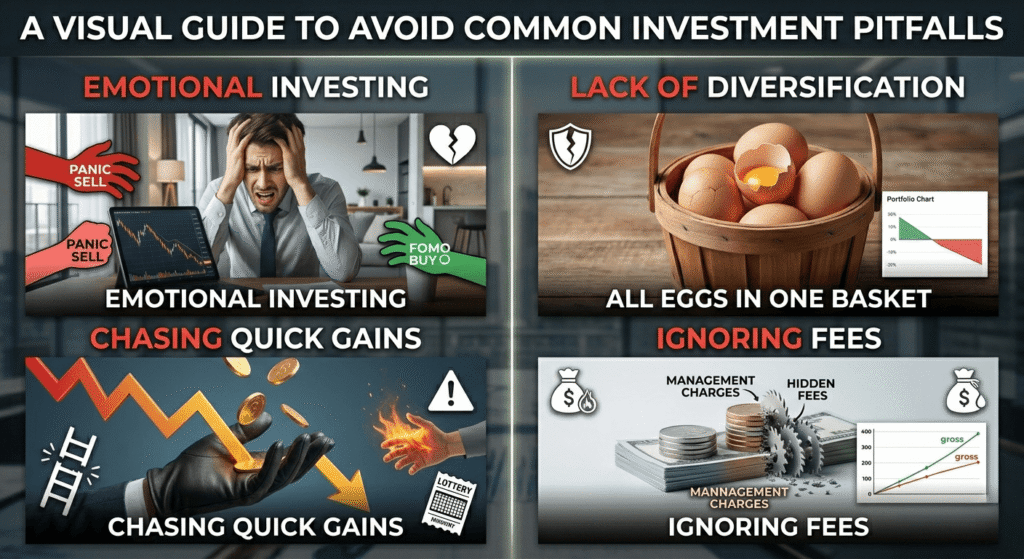
The Pitfalls that amateurs must not fall into.
Numerous new investors commit such mistakes. You can however avoid them with the right knowledge.
- Emotional investing – The fear and excitement tend to make poor decision-making.
- Absence of diversification – investing the entire money in a single investment is a risk.
- Attempting to make a quick buck – investing is not a quick task.
- Neglecting charges – excessive investment charges may decrease profits in the long run. As such, long-term discipline is a must to the investor.
Final Thoughts
The process of investing might appear hectic. Nevertheless, the novices can attain success when they have the right mind.
Start with clear goals. Learn the basics. Diversify investments. Most of all, be patient.
With time you can begin with the little and constant investments and build up to a lot of wealth.
That is why the most appropriate time to start investing is the present.