SEO Search Intent and Its Types (Easy Guide for Bloggers & Marketers)
SEO Search Intent Explained: Types & How It Helps Your Content



It is not only about keywords to write what is ranked on Google. It’s also about search intent. Simply, search intent gives the reason why an individual entered a query into Google. When you have the same content as that rationale, you will be ranked and users would not be disappointed.
You will get to know what search intent is in this guide. You will also learn the major ones and how to apply them to enhance your search engine optimization.
What Is Search Intent?
The search intent refers to the intent of a search query. It demonstrates what one desires to do. This objective could be to learn, to locate a web site, to compare alternatives or to purchase.
Knowing intent can assist you to write content relevant to that of the user and not overcrowded with keywords. When the content fits the intent, Google regards it as a more relevant content in that query.
The importance of Search Intent in SEO.
The awareness of the search intent will alter the way you plan the content. You do not guess what users want, you are constructing pages that suit their objective. Google tends to give preference to content that has a matching intent, and more likely to be on the results page.
What you want to do is also what determines your content type and structure. Should one wish to know something, give unambiguous answers. In case they have a desire to shop, it should be easy to locate the products. This enhances ranking and conversions.
Types of Search Intent
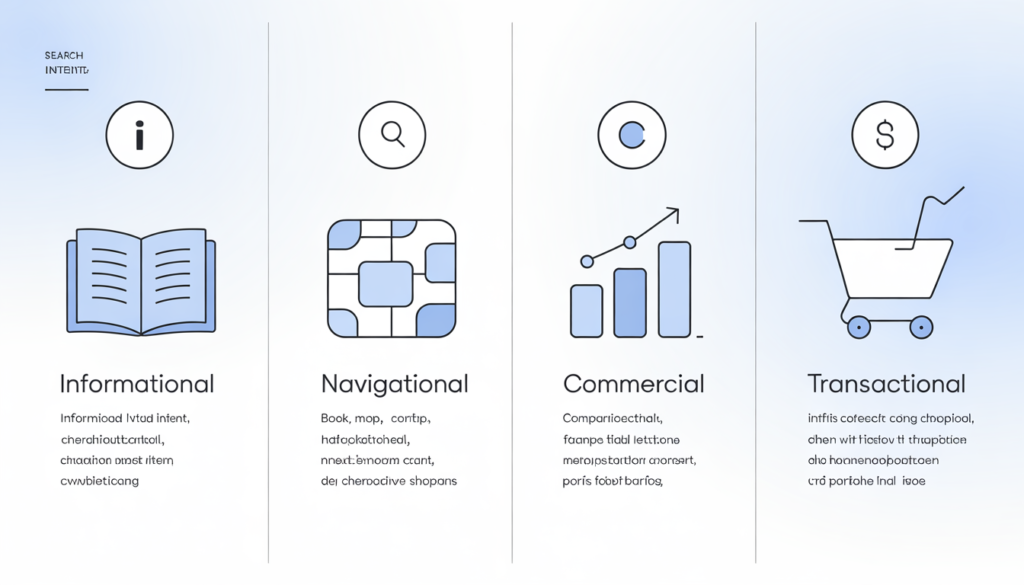
The majority of search engine optimization specialists classify search intent into four broad categories. Each of them corresponds to a particular user requirement.
Informational Intent
The informational queries demonstrate that the searcher desires answers or information. They are still in the user journey. They can begin with what, how, why or tips.
Examples include:
- What is search intent
- How to plan content calendar
- SEO best practices
The information that can serve this purpose is guides, tutorials, and explanations. It must be able to teach or provide answers in a clear manner.
Navigational Intent
Navigational intent occurs when an individual attempts to access a particular site or a page. They are already aware of where they are going.
Examples include:
- Facebook login
- Amazon
- Yoast SEO homepage
In most cases, such searches do not attract new traffic to your site unless one is familiar with your brand. Thus, concentrate on the optimization of your own brand pages to your audience.
Commercial (or Commercial Investigation) Intent.
The commercial intent demonstrates the user to be researching prior to purchase. They will be about to make a purchase but need additional information first.
Such searches are likely to contain such words as best, compare, review, or top.
Examples include:
- Best SEO tools
- IPhone vs Samsung review
- Top WordPress themes
Information on such queries must be product comparison, advantages and disadvantage of products and assist the user in making a choice. You are allowed to write reviews, comparisons or best of lists.
Transactional Intent
Transactional intent implies that the user would like to act immediately. This may involve purchasing, registering or downloading.
Such words as buy, order, subscribe, or names of certain products are common in searches.
Examples:
- buy running shoes
- Netflix subscription
- Mangools pricing
The pages that have this purpose should be the ones that take the user to the action. Calls of action and dispensable steps to get the task done.
Mixed Intent (Optional Category)
There are searches that do not exactly belong to one of them. When users go along with goals, it is referred to as mixed intent. As an illustration, one may desire information and at the same time may desire to compare products within the same query.
In general searches, such as best laptops with students, Google tends to be full of guides, comparison posts, and links to products on the first page of the search results. This implies that the search purpose encompasses information + commercial aspects.
As this occurs, you should address both sides of the coin- give answers and assist users to compare oneself.
The Impact of Search Intent on Your Content Strategy.
The search intent has a number of impacts on SEO:
- It guides you on what you should write about.
- It influences content structure and headings.
- It controls the use of key words and the way you respond to questions.
- It assists you to match your content with the expectations of the users.
As a case in point, informational pages are expected to be informative and comprehensive. Transactional pages must ensure that it is not complicated to make a purchase. When your content is what the user wants to see they spend even more time on your site and search engines will reciprocate this by giving you top rankings.
Search intent identification
One can easily look at the intent of a keyword:
- Research the search results (SERP): Check whether there are tutorials, product pages, or reviews on Google.
- Look at the query words: Such words as how to point towards informational intent.
- Use SEO tools: Such tools as Mangools can label keywords based on purpose.
Analysis of intent before writing ensures that you make content that matches the needs of users. This enhances standings and retains readers.

Final Thoughts
Search intent provides the hints regarding the reasons why users search. Intent can also be used to influence content to suit the user requirements instead of guessing. This will make your pages more useful and you are more likely to rank in Google. With the advancement of search engines, intent interpretation and fulfillment is also another section to winning SEO.