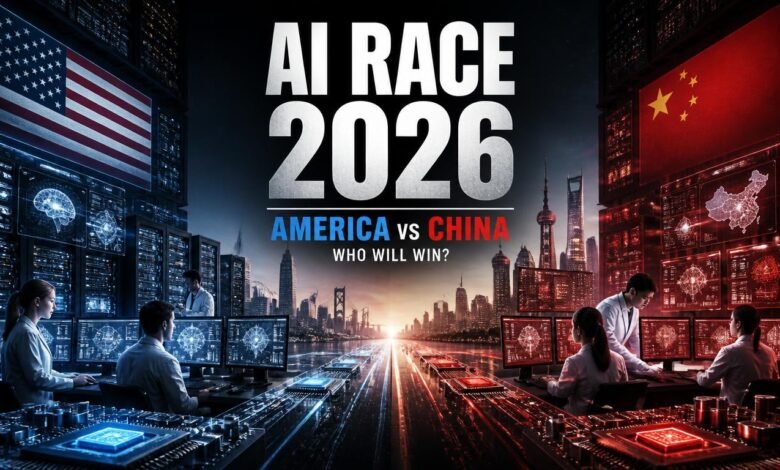
Artificial intelligence has evolved far beyond a simple technology competition, becoming a major struggle for economic influence, military strength, semiconductor dominance, global leadership, and the future of innovation. As discussed by ItsTechClub, the United States and China are now at the heart of this rapidly intensifying AI rivalry, with both nations investing heavily in advanced models, powerful computing infrastructure, cutting-edge chips, and emerging technologies to establish themselves as the world’s leading AI superpower.
The question sounds simple: who is winning the AI race in 2026? The reality is much more complicated. America still has major advantages in frontier AI models, computing infrastructure, private investment, and access to leading AI chips. China, however, has rapidly narrowed the gap through cheaper models, open-weight strategies, manufacturing strength, and aggressive domestic adoption.
This makes the US-China AI competition different from a traditional race where one country simply crosses the finish line first. Both nations are winning in different areas, and the final outcome may depend on which country can turn technological progress into widespread economic and strategic power. The AI superpower rivalry 2026 could therefore shape the global technology landscape for decades.
1. US vs China AI Capability: Where Do They Stand?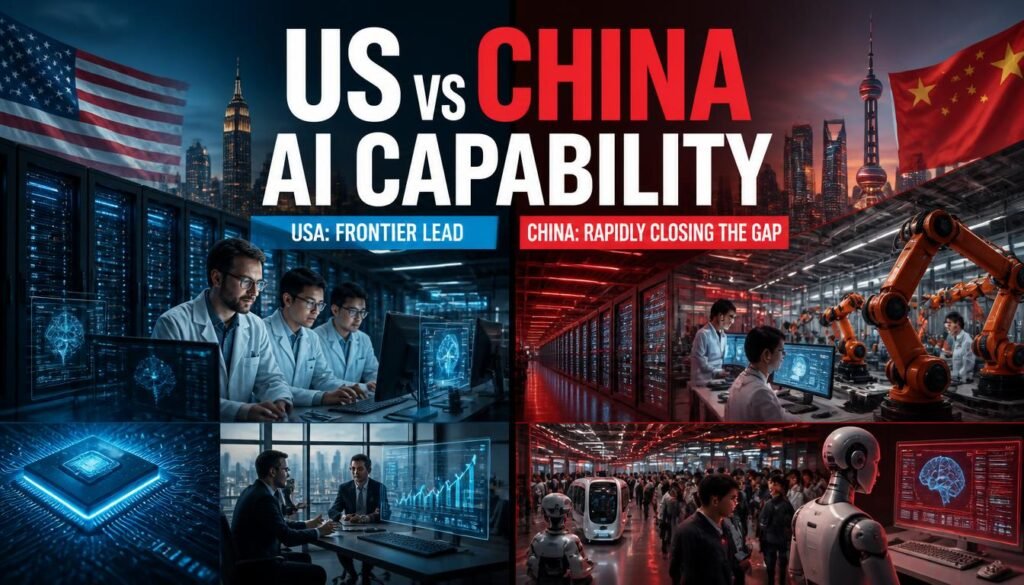
When comparing US vs China AI capability, America currently retains an overall advantage at the frontier. Leading American companies have enormous access to capital, advanced computing infrastructure, highly skilled researchers, and a powerful ecosystem of AI startups. A 2026 analysis by Boston Consulting Group concluded that the US remains ahead in frontier AI models, talent, and capital deployment, although China continues to close the gap in computing and practical adoption.
China’s strength lies in a different combination of advantages. Chinese companies have become extremely effective at taking existing technological breakthroughs, improving their efficiency, lowering costs, and deploying them across a huge domestic market. Chinese policymakers are also pushing for greater technological self-reliance, particularly in semiconductors and computing infrastructure.
That is why declaring one country the clear winner would be misleading. America currently has the stronger overall frontier ecosystem, while China has demonstrated an impressive ability to catch up quickly and turn AI into an industrial tool. The real battle is therefore not simply about which country has the smartest model, but which country can build the strongest complete AI ecosystem.
2. Chinese AI Models vs American AI Models
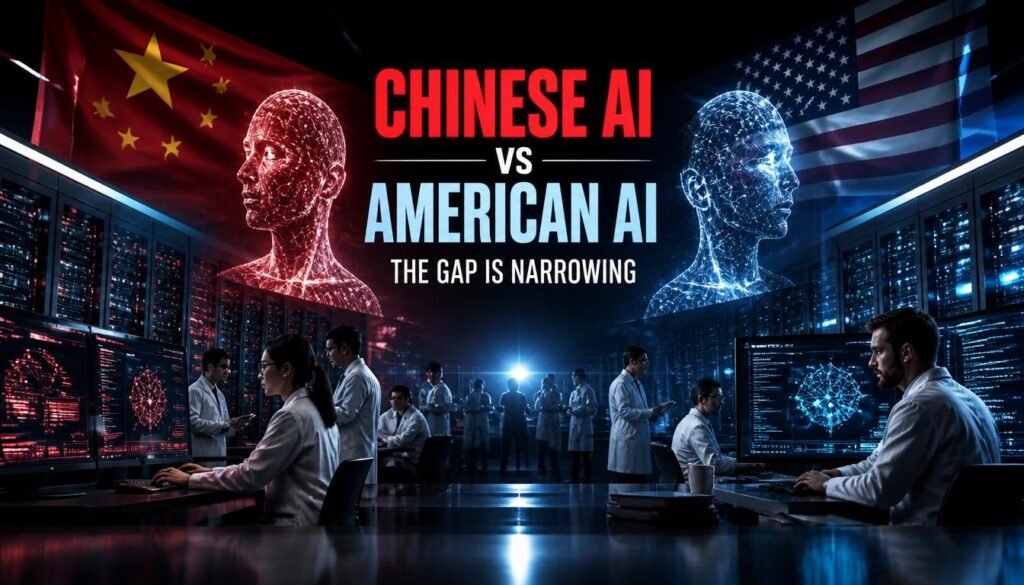
The gap between Chinese AI models and American AI models has become much narrower than many expected. Companies such as DeepSeek, Alibaba, Z.ai, and other Chinese developers have produced models capable of competing with leading Western systems on important coding, reasoning, and agent-related tasks. CSIS notes that recent Chinese models have moved close enough to the frontier to compete with US models across many real-world applications.
The biggest difference is often not raw capability but strategy. American companies have generally focused heavily on proprietary frontier models and commercial platforms, while many Chinese developers have embraced open-weight models that can be downloaded, modified, and deployed more freely. This approach can make powerful AI significantly cheaper and easier for businesses and developers around the world to adopt.
China’s open strategy is becoming a serious competitive weapon. A 2026 report from the U.S.-China Economic and Security Review Commission found that Chinese laboratories have increasingly published model weights and source code, helping create large ecosystems around models such as Alibaba’s Qwen. The report argues that widespread adoption creates a feedback loop in which more users generate more improvements and further adoption.
3. Who Is Winning the AI Race in 2026?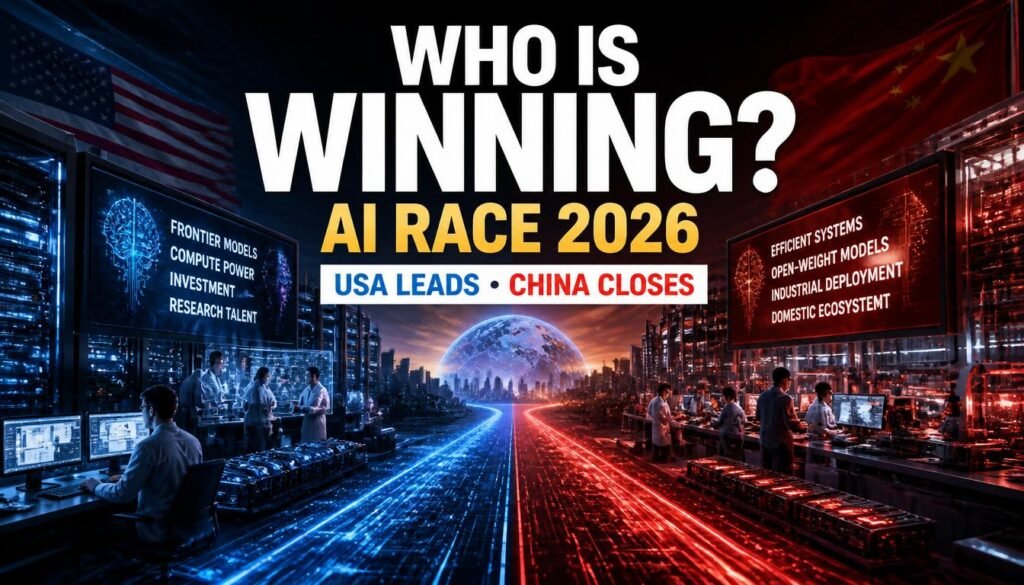
So, who is winning the AI race 2026? If the measurement is frontier model leadership, investment, talent, and advanced computing, the United States still has the stronger position. American AI companies have built an enormous commercial ecosystem around generative AI, while US access to leading AI infrastructure remains a critical advantage.
But if the measurement is cost efficiency, open-source or open-weight adoption, industrial deployment, and the ability to operate under hardware restrictions, China’s performance becomes much more impressive. Chinese developers have shown that limitations on access to the world’s most advanced chips do not automatically prevent rapid AI progress. Instead, those restrictions have encouraged greater emphasis on efficiency and domestic alternatives.
The most accurate answer, therefore, is that America is still ahead overall, but China is no longer simply chasing from a distance. The competitive gap has become strategically important. The US may have the lead today, but China’s ability to innovate under pressure means the race is becoming harder to predict.
4. US China AI Export Controls Impact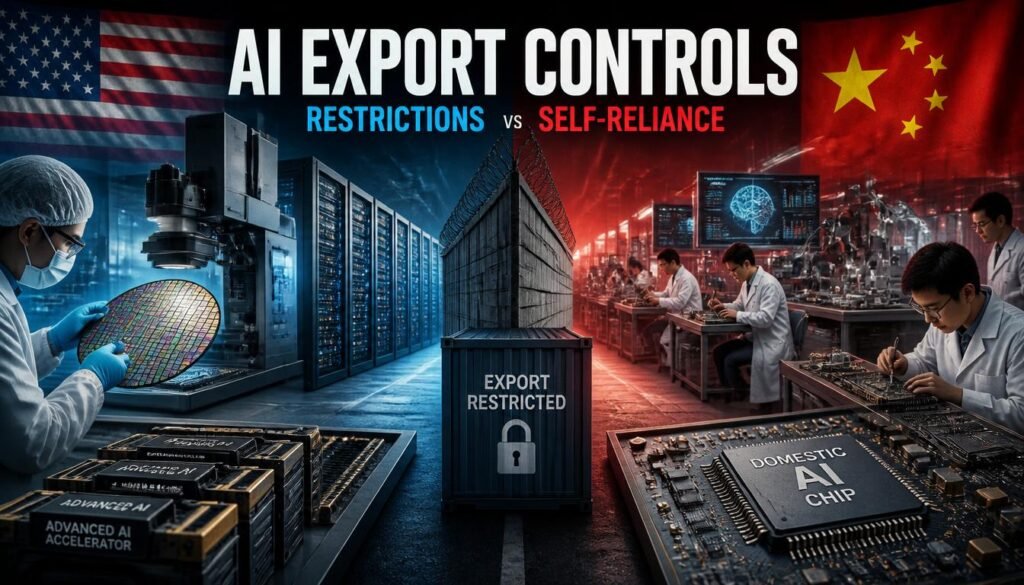
Technology restrictions have become one of America’s most important tools in the AI competition. US export controls have attempted to limit China’s access to advanced AI chips and semiconductor technologies that could help Chinese companies train increasingly powerful models. The goal is to slow China’s access to frontier computing while protecting America’s technological advantage.
However, the US China AI export controls impact has not been entirely one-sided. Restrictions have made advanced computing more difficult and expensive for Chinese companies, but they have also strengthened Beijing’s motivation to develop domestic alternatives. Chinese companies and policymakers are increasingly focused on reducing dependence on foreign semiconductor technology and building a self-sufficient AI supply chain.
The policy itself is also evolving. In 2026, debate continues in Washington over how aggressively to control AI hardware, while reports indicate that US officials are examining ways to prevent Chinese entities from accessing advanced computing remotely through overseas servers. These developments show how difficult it has become to separate AI software from the global infrastructure that powers it.
5. Open Source AI:US vs China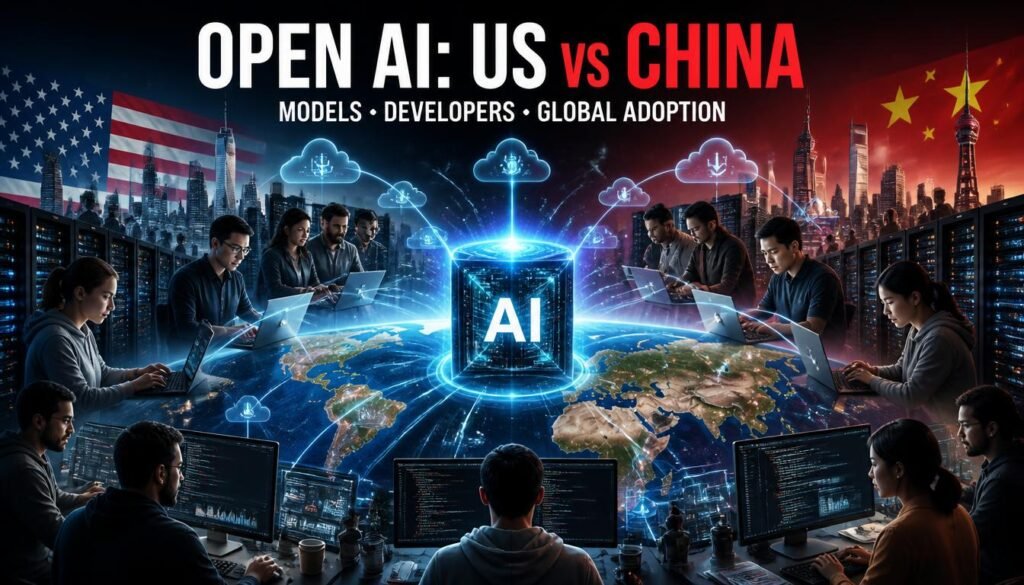
The open source AI US vs China competition may ultimately prove just as important as the race between proprietary models. American companies helped establish the modern frontier AI industry, but China has increasingly used open-weight AI as a way to spread its technology rapidly and reduce dependence on Western platforms.
This strategy gives Chinese AI a potentially powerful global advantage. Developers, startups, universities, and businesses in countries that cannot afford expensive proprietary systems can experiment with lower-cost open models. China’s approach is particularly attractive in emerging markets where affordability, customization, and local deployment matter more than access to the absolute most powerful commercial model.
That does not mean America has abandoned open AI. US researchers and companies also contribute heavily to open-source ecosystems. The difference is strategic emphasis. China increasingly views open AI as a way to expand its technological influence, while American companies often have stronger commercial incentives to keep their most advanced systems proprietary. This growing divide could eventually produce two competing global AI ecosystems.
6. US vs China AI Hardware Gap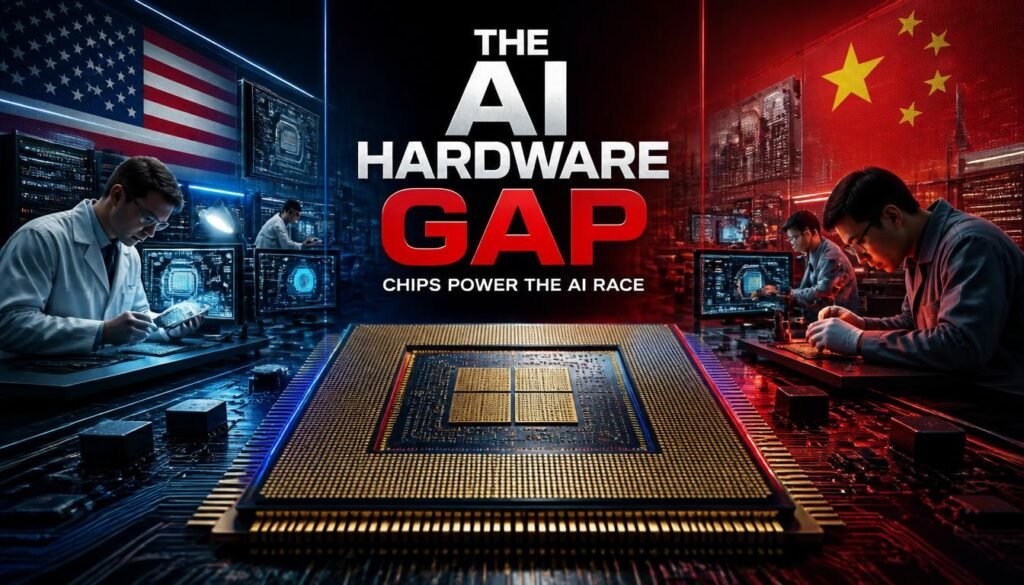
If AI models are the brains of the new technology economy, advanced chips are the electricity that keeps those brains running. Here, the US and its allies still possess a major advantage. Companies such as Nvidia dominate the supply of advanced AI accelerators used by leading AI developers, giving America enormous influence over the computing infrastructure behind frontier models.
The US vs China AI hardware gap is therefore one of China’s biggest challenges. Chinese companies have faced restrictions on accessing some of the most advanced foreign chips, while domestic semiconductor development still has to overcome difficult manufacturing and performance challenges. The result is a major incentive for China to improve its own chip ecosystem.
Yet China is not standing still. Chinese companies are developing alternative processors, optimizing software to extract more performance from available hardware, and exploring new approaches to AI inference. DeepSeek has even been reported to be working toward its own inference-chip efforts, highlighting how export restrictions can push AI companies deeper into hardware development.
7. Silicon Valley vs Beijing AI Chips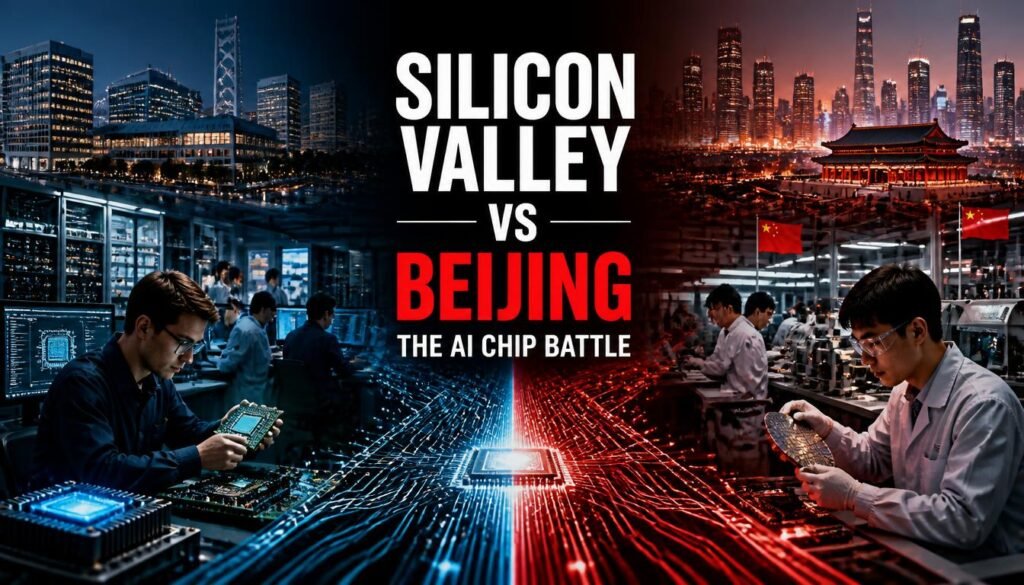
The Silicon Valley vs Beijing AI chips competition represents a broader struggle over technological independence. Silicon Valley benefits from America’s world-leading semiconductor design ecosystem, huge venture-capital markets, and close relationships between AI developers and hardware companies. This creates a powerful cycle in which better chips enable better models, which attract more investment and further chip development.
Beijing, meanwhile, is trying to build an AI ecosystem that can function with less dependence on American technology. China has enormous manufacturing capacity, a large engineering workforce, and strong government support for strategic industries. Its challenge is turning these advantages into a semiconductor ecosystem capable of matching the most advanced American and allied technologies.
This hardware contest could determine the speed of the AI race. A country may have brilliant researchers and huge amounts of data, but without sufficient computing power, turning ideas into frontier systems becomes much harder. That is why semiconductors have become one of the central battlegrounds of the US China artificial intelligence war.
8. DeepSeek vs OpenAI: The Global Market Impact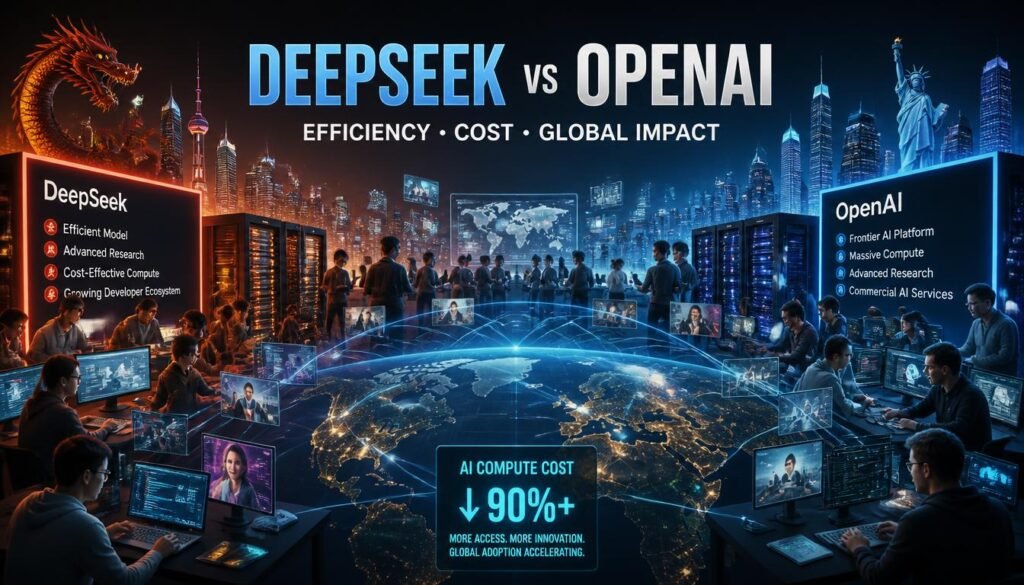
Few developments have symbolized China’s rise in AI more clearly than DeepSeek. Its emergence challenged the assumption that frontier-level AI development would always require enormous spending and unrestricted access to the most advanced hardware. DeepSeek demonstrated how algorithmic and architectural efficiency could reduce the computing resources needed to achieve strong performance.
The DeepSeek vs OpenAI market impact therefore extends beyond a simple comparison between two companies. It has influenced how investors, developers, and governments think about the economics of AI. If capable models can be developed and deployed at dramatically lower costs, the competitive advantage may shift from simply owning the largest model to operating the most efficient ecosystem.
And DeepSeek was not an isolated event. Chinese AI laboratories have continued releasing increasingly capable systems, reinforcing the idea that China’s progress is part of a broader trend. The challenge for American companies is no longer simply staying ahead in benchmark performance; they must also compete on price, efficiency, distribution, and global adoption.
9. Conclusion: The AI Superpower Rivalry Is Just Beginning
The US China AI competition is entering a new phase. America still holds significant advantages in frontier models, AI talent, investment, advanced computing, and the semiconductor ecosystem. China, however, has demonstrated remarkable speed in closing capability gaps while building strength in open-weight models, cost efficiency, manufacturing, and large-scale domestic deployment.
That means the US China AI rivalry should not be viewed as a simple race with one winner and one loser. America may remain the leader in cutting-edge model development, while China could become increasingly influential through affordable models and global adoption. The country that ultimately gains the greatest advantage may be the one that successfully connects AI models, chips, energy, data, talent, industry, and international markets.
For now, the United States has the stronger overall position, but the lead is no longer comfortable. China’s rapid progress has transformed the competition from an American technological advantage into a genuine AI superpower rivalry. As both nations continue investing billions into models, chips, robotics, data centers, and AI infrastructure, the most important chapter of the US-China AI race may still be ahead.