
Introduction
Most software projects don’t fail because of bad coding. They fail much earlier—before the first usable version even exists.
Teams start building without a clear plan. Requirements are half-understood, timelines are guessed, and responsibilities are loosely defined. As development continues, deadlines get missed, budgets blow up, and the final product often looks nothing like what the client originally wanted.
This is where things silently start going wrong: not in execution, but in structure.
What Is the Software Development Life Cycle (SDLC)

The software development life cycle (SDLC) is a structured process used to design, develop, test, and deploy software in a controlled and predictable way.
However, many teams misunderstand it.
- Some think SDLC is just paperwork or documentation.
- Others assume it’s only needed for large enterprise-level projects.
- Many ignore what each phase actually delivers and why it matters.
In reality, SDLC is not bureaucracy—it’s a roadmap. It ensures every stage of development has a clear purpose, output, and validation step before moving forward.
The Real Cost of Skipping the Planning Phase

Skipping proper planning is one of the fastest ways to derail a project.
When teams rush into coding without structured requirements:
- Requirements keep changing after development has started
- Entire features need to be rebuilt from scratch
- The final product often does not match client expectations
What seems like “saving time” in the beginning usually turns into massive rework later. In software development, unclear planning always becomes expensive debugging.
Why Teams Get Stuck in the Testing Phase

Testing is meant to validate the product—not rescue it.
But when earlier SDLC phases are ignored, testing becomes a bottleneck:
- Bugs are discovered too late in the cycle
- Developers and testers start blaming each other
- Release dates keep getting pushed forward
Instead of polishing a nearly finished product, teams end up fixing foundational issues that should have been caught much earlier in the process.
How Poor Communication Between Stakeholders Breaks the Cycle

Even a strong technical team cannot save a poorly communicated project.
Common communication failures include:
- The client provides a vague or incomplete brief
- Project managers pass down missing or misunderstood requirements
- There is no single, agreed-upon document everyone follows
Without alignment, each team member builds their own interpretation of the product. This creates confusion, rework, and constant misalignment between expectation and reality.
Choosing the Right SDLC Model for Your Project
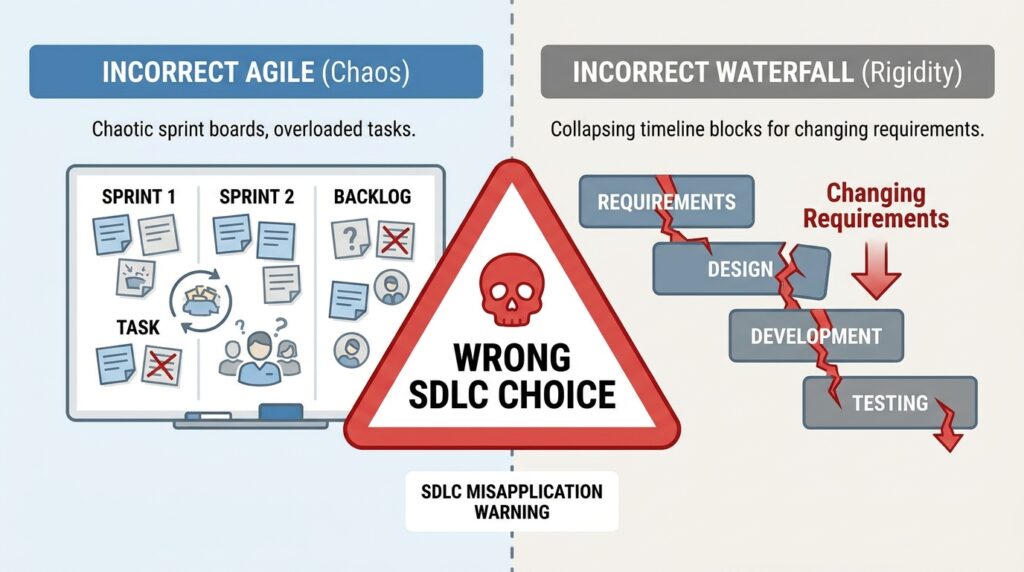
Not all projects should follow the same SDLC approach.
Yet many teams blindly choose a model without evaluating project needs:
- Agile is used even when requirements are fixed and well-defined
- Waterfall is used for projects where requirements keep changing
- The wrong model leads to delays, frustration, and budget overruns
Choosing the right SDLC model is not about trends—it’s about project behavior. Stability, flexibility, and clarity of requirements should guide the decision.
How to Actually Implement SDLC Without Overcomplicating It

Many teams make SDLC harder than it needs to be.
Common mistakes include:
- Investing in expensive tools that are never fully used
- Creating too many approval layers that slow down progress
- Prioritizing process over actual product development
SDLC should simplify delivery, not slow it down. A lightweight, well-understood process with clear ownership is far more effective than a complex system nobody follows properly.
Conclusion