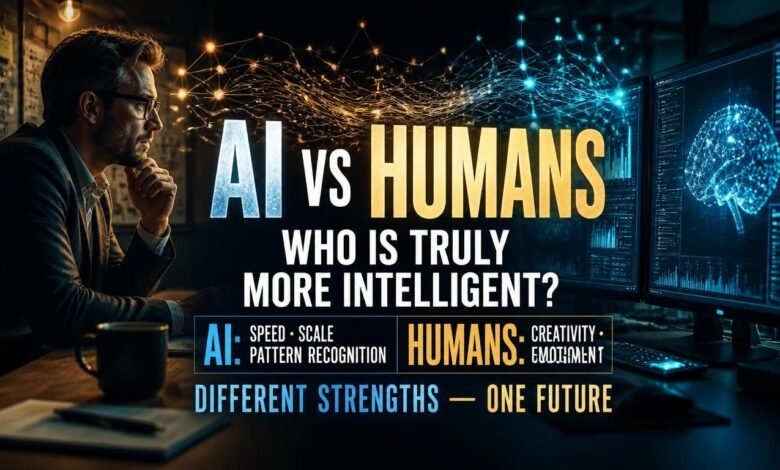
For centuries, human beings have imagined machines that could think, learn, and act like us. Today, that idea is no longer science fiction. Artificial intelligence can write articles, generate images, analyze enormous datasets, translate languages, recognize patterns, and even help make complex decisions. This rapid “AI progress” has created an exciting but uncomfortable question: “AI vs humans — who is actually more intelligent?”
The answer is far more complicated than simply declaring a winner. AI can outperform people in certain tasks, but **human intelligence** remains remarkably flexible, emotional, creative, and adaptable. Modern AI is better understood as a powerful technology designed to perform particular tasks rather than a complete digital copy of the human mind.
So, is humanity heading toward an **AI takeover**, or are we entering an era where humans and machines work together? Let’s explore the real differences between **human vs AI** intelligence.
What Makes Artificial Intelligence Intelligent?
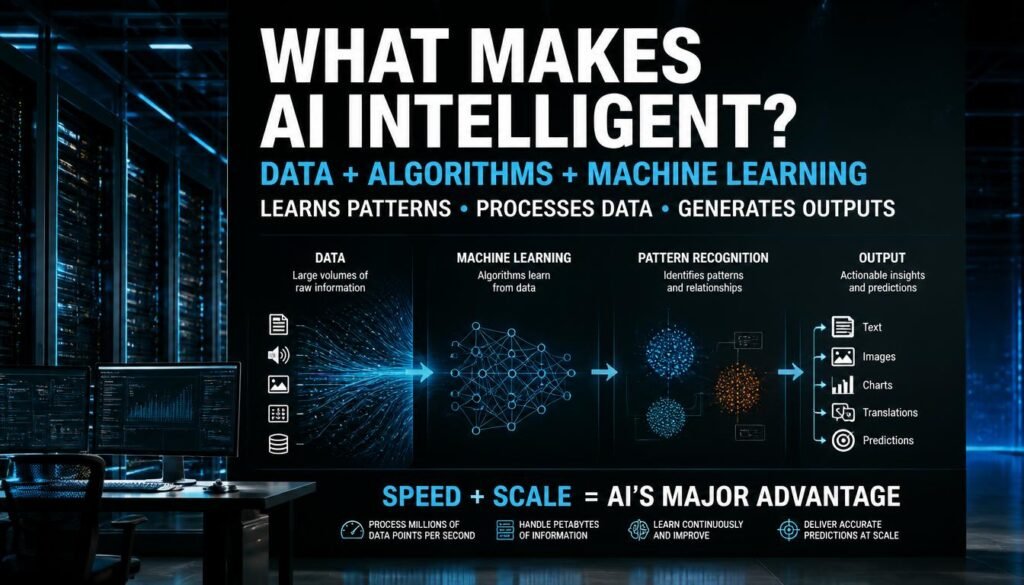
**Artificial intelligence** refers broadly to computer systems capable of performing tasks normally associated with human intelligence. These include learning from data, recognizing patterns, reasoning, generating content, and supporting decisions.
Modern AI depends heavily on **machine learning**, algorithms, and **neural networks**. Instead of gaining knowledge through childhood experiences, emotions, and physical interaction with the world, AI systems are trained using huge amounts of data.
This gives AI a remarkable advantage: speed and scale.
A machine can examine millions of records, images, or pieces of text far faster than a person. It can identify patterns that might take humans years to discover. AI automation can also perform repetitive work continuously without getting tired.
But there is an important distinction. Processing information efficiently is not necessarily the same as understanding it.
Human Intelligence vs Machine Intelligence:
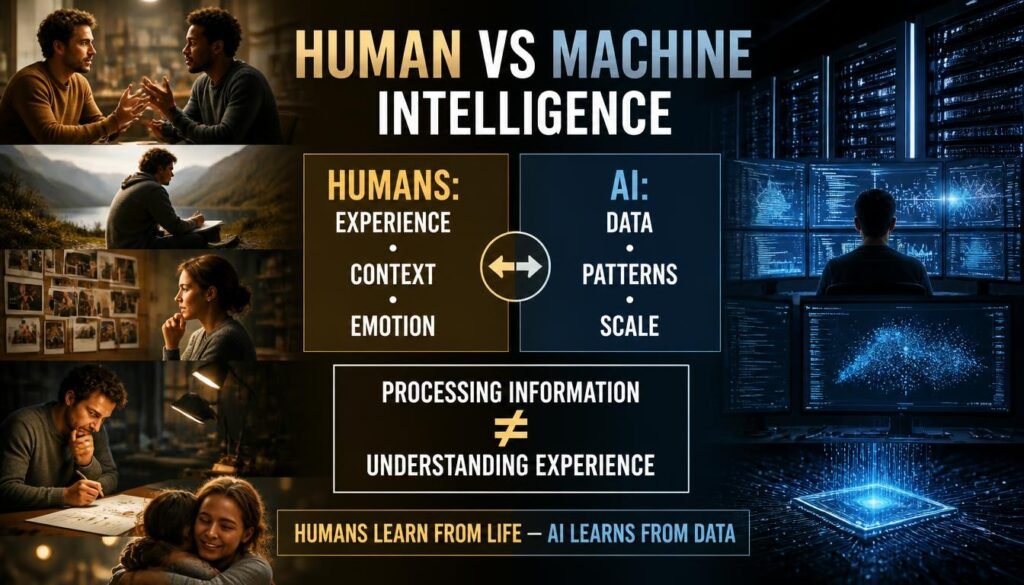
The biggest difference in the **AI vs humans** debate is how intelligence develops.
Humans learn through experience. A person can learn something from a single event, connect it with previous knowledge, understand its emotional meaning, and apply that lesson somewhere completely different.
AI learning generally works differently. A system identifies patterns within training data and uses those patterns to produce predictions or outputs. This can make AI incredibly capable, but its capabilities remain strongly connected to its training, objectives, and available information.
Consider a simple example.
A child may touch a hot object once and quickly learn that fire can cause pain. That lesson becomes part of a broader understanding of danger. A machine does not experience pain or danger. It processes information that humans have provided.
This difference separates **machine vs mind** in a fundamental way.
Where AI Has the Advantage:
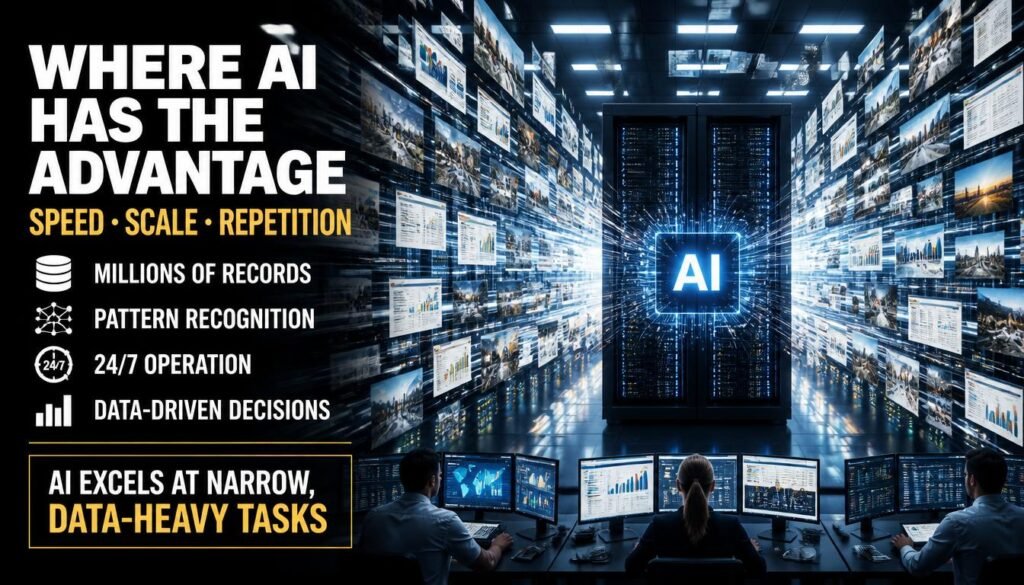
If the question is about speed, repetition, and enormous amounts of information, AI has a clear advantage.
AI systems can:
* Process huge datasets within seconds
* Recognize patterns consistently
* Automate repetitive processes
* Generate text, images, audio, and video
* Analyze information at enormous scale
* Work continuously without fatigue
* Support complex data-driven decisions
For example, an AI system can examine thousands of documents much faster than a human team. In areas such as fraud detection, language translation, customer service, and medical image analysis, AI can provide significant practical value.
This is where **AI capability** becomes genuinely impressive.
However, high performance in a specific task should not automatically be interpreted as general intelligence. An AI system might be extraordinary at recognizing patterns while struggling with an unfamiliar situation that requires common sense.
That is one of the most important **AI limits** to understand.
Where Humans Still Have the Upper Hand:
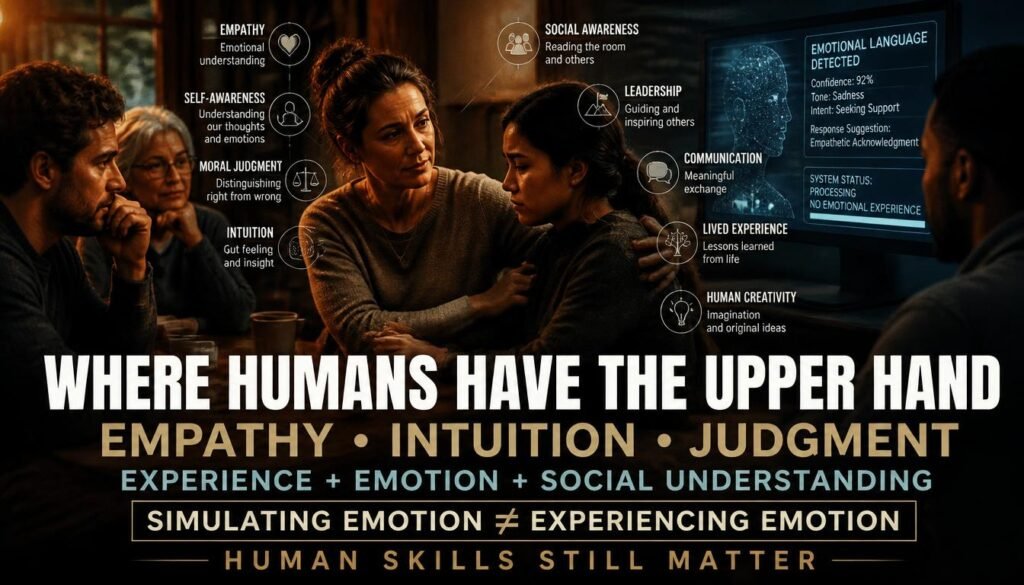
Humans possess qualities that current AI systems do not genuinely experience.
These include empathy, emotional understanding, self-awareness, moral judgment, intuition, social awareness, and the ability to understand situations through lived experience.
Imagine asking an AI to comfort a grieving friend. It can generate an appropriate response and may even recognize emotional signals in language. But it does not actually experience sadness, compassion, or friendship.
That distinction matters.
**AI emotions** can be simulated or recognized, but simulation is not the same as feeling. Similarly, AI can produce impressive creative-looking outputs, but human creativity is influenced by memories, culture, personal experiences, emotions, intentions, and imagination.
This is why **human skills** such as empathy, leadership, communication, ethical reasoning, and creative thinking remain valuable even as technology advances.
AI Creativity vs Human Creativity:
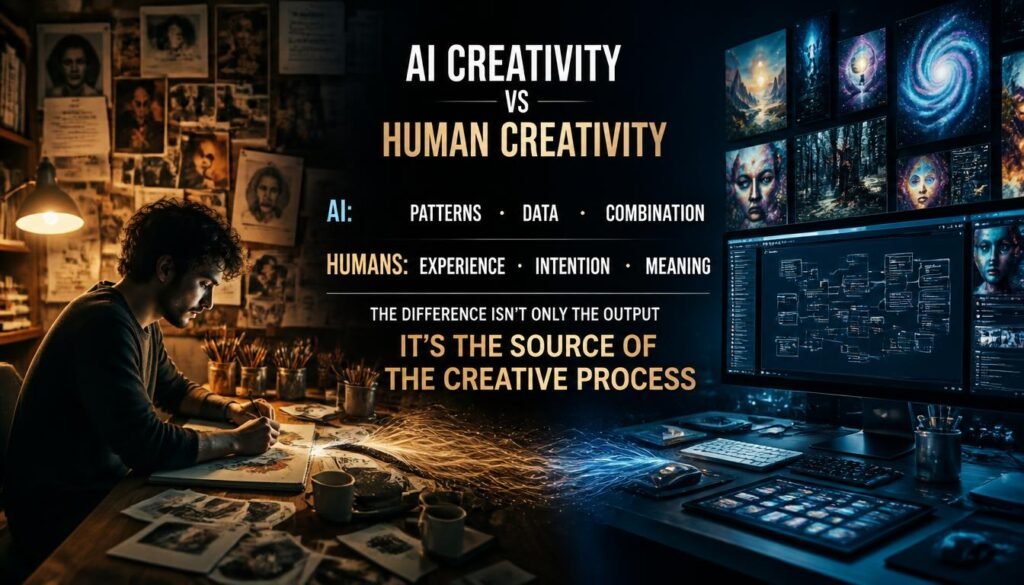
One of the most fascinating parts of the **AI vs humans** discussion is creativity.
Today’s AI can create paintings, advertisements, stories, music, logos, videos, and designs within seconds. An **AI art generator** can produce visually impressive work from a short prompt, while generative AI can transform a simple idea into an entire piece of content.
Does that mean machines are genuinely creative?
Not necessarily.
AI creativity is largely based on patterns learned from existing data. Human creativity has another dimension: intention.
A human artist may create a painting because of childhood memories, political beliefs, love, loss, frustration, or a desire to communicate something deeply personal. The resulting work carries meaning because it comes from a lived experience.
AI can imitate styles and combine concepts in surprising ways, but today’s systems do not possess the personal experiences or inner motivations that shape human creativity.
So in the **human vs machine** creativity debate, the real difference is not simply the quality of the final product. It is the source of the creative process.
Can AI Replace Human Workers?
This is where the conversation becomes more serious.
“AI automation”, “job displacement”, and “AI replacement” are already major concerns. As machines become more capable, certain repetitive or predictable jobs may require fewer human workers.
But the future of work is unlikely to be as simple as “robots take every job.”
Instead, AI may change how jobs are performed.
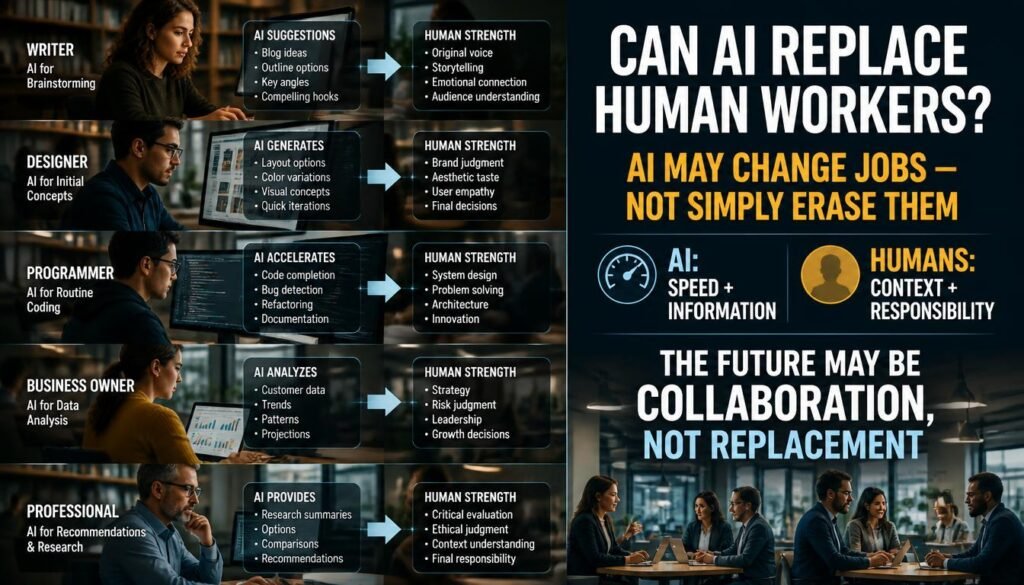
A writer may use AI to brainstorm ideas. A designer may use generative tools to create initial concepts. A programmer may use AI to accelerate routine coding. A business owner may use AI to analyze customer data.
In this model, AI becomes an assistant rather than a complete replacement.
The most valuable workers may increasingly be those who know how to combine **AI capability** with **human expertise**. AI can provide speed and information, while humans provide context, responsibility, communication, and judgment.
The strongest future may therefore involve collaboration rather than competition.
What About AI Consciousness and Superintelligence?
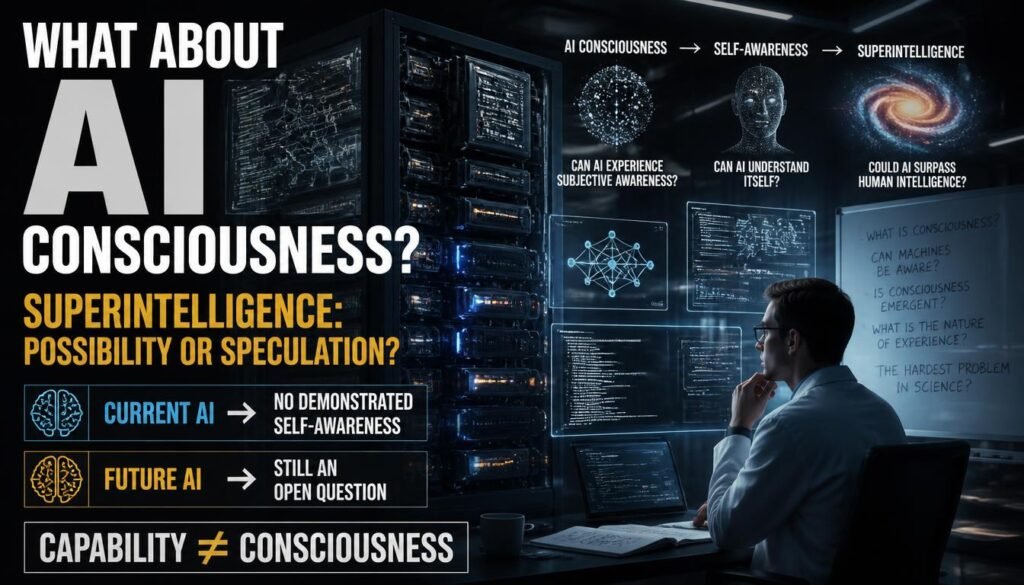
The idea of **AI consciousness** has fascinated scientists, philosophers, and science-fiction writers for decades.
Could a machine eventually become self-aware? Could **superintelligence** emerge? Could an advanced digital mind develop its own goals?
These questions are still open for debate.
However, current AI systems should not be confused with conscious beings. They do not have personal experiences, feelings, or demonstrated self-awareness. They process inputs and generate outputs according to their architecture, training, and objectives.
The idea of the **Singularity** — a hypothetical point where machine intelligence dramatically surpasses human intelligence — remains speculative. It is an important subject for discussion, but it should not be treated as an established prediction.
This distinction is essential when discussing the **AI threat**. Responsible AI conversations should separate realistic risks from science-fiction scenarios.
The Hidden Risk: AI Can Be Wrong:
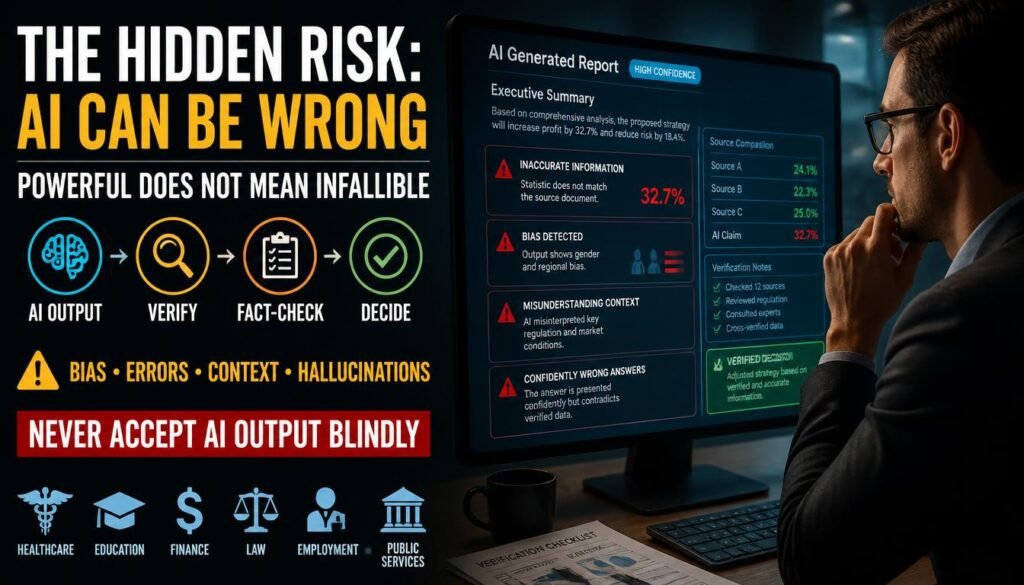
One of the biggest mistakes people make is assuming that a powerful AI system is always correct.
It isn’t.
AI can produce inaccurate information, reflect **cognitive bias** within its data, misunderstand context, or generate confident answers that are simply wrong. Its performance can also decline when it encounters situations significantly different from its training environment.
That is why **AI ethics** and **AI safety** matter.
Humans need to question AI outputs rather than blindly accepting them. This becomes particularly important when AI is used in healthcare, education, finance, law, employment, or public services.
Technology can assist with a decision, but responsibility should not disappear simply because an algorithm was involved.
AI vs Humans: A Better Way to Look at the Future
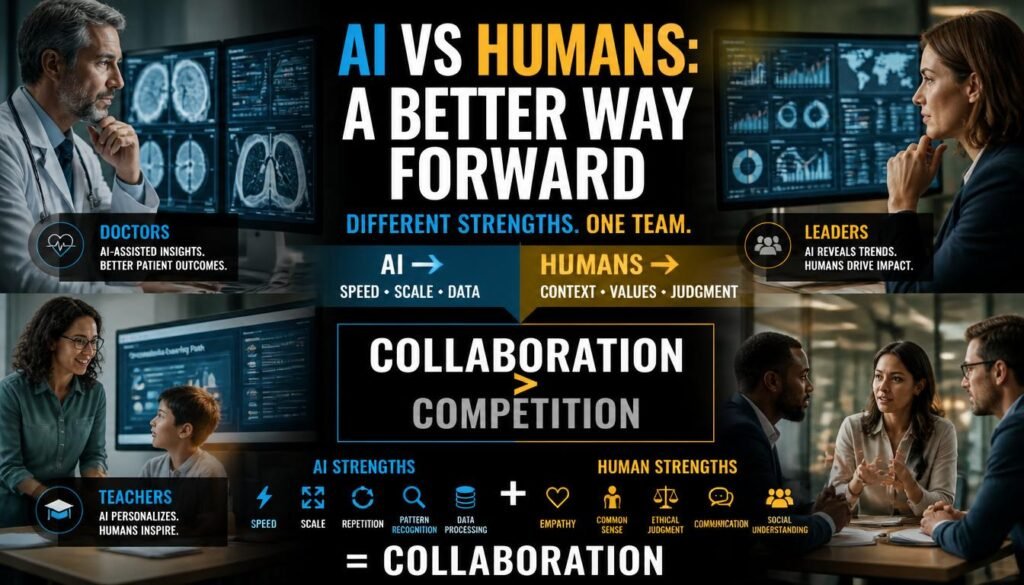
Perhaps the biggest mistake is treating **AI vs humans** as a competition where one side must defeat the other.
AI and humans are good at different things.
Machines excel at speed, scale, repetition, pattern recognition, and consistent data processing. Humans excel at emotional intelligence, common sense, ethical judgment, flexible reasoning, communication, and understanding complex social situations.
Put them together, and the result can be more powerful than either working alone.
A doctor supported by AI may analyze information faster while still relying on human judgment and communication. A teacher can use AI to personalize learning while providing encouragement and emotional support. A business leader can use AI analytics while considering values, people, and long-term consequences.
This is not **robot vs man**.
It is collaboration between technology and human expertise.
The Future of Human and AI Intelligence
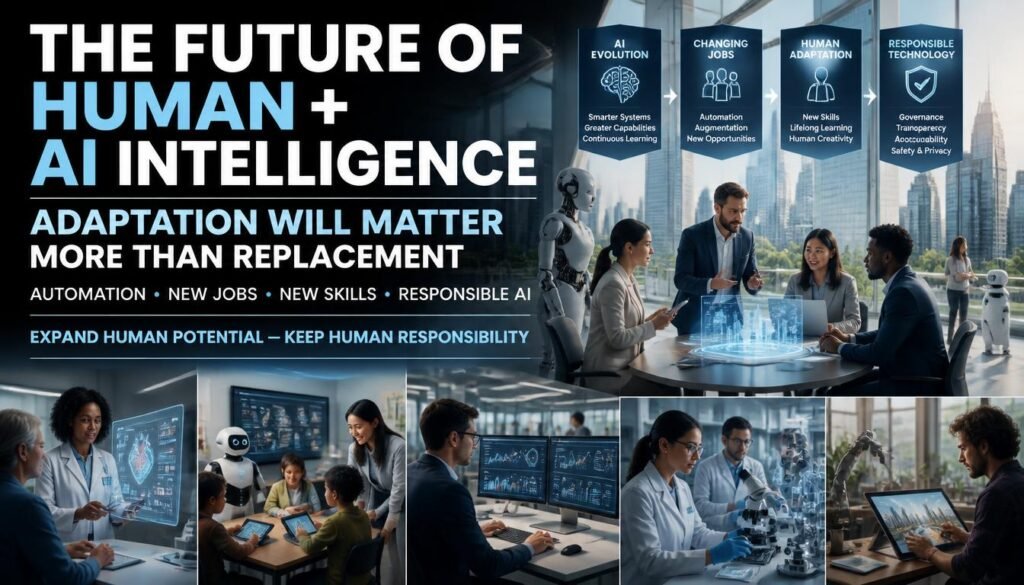
The “future of work” will almost certainly be shaped by AI. Automation will continue to change industries, new jobs will emerge, and many existing roles will evolve.
But humans will not suddenly become irrelevant.
Our greatest advantage may be our ability to adapt.
Humans can learn new skills, change goals, question assumptions, build relationships, and create meaning from experiences. Those abilities are central to the **human future**.
At the same time, humans must develop responsible ways to manage increasingly powerful technologies. **AI governance**, transparency, privacy, accountability, and safety will become increasingly important as AI becomes embedded in society.
The real goal should not be human superiority or machine dominance. It should be creating technology that expands human potential without removing human responsibility.
Final Verdict: AI or Humans?
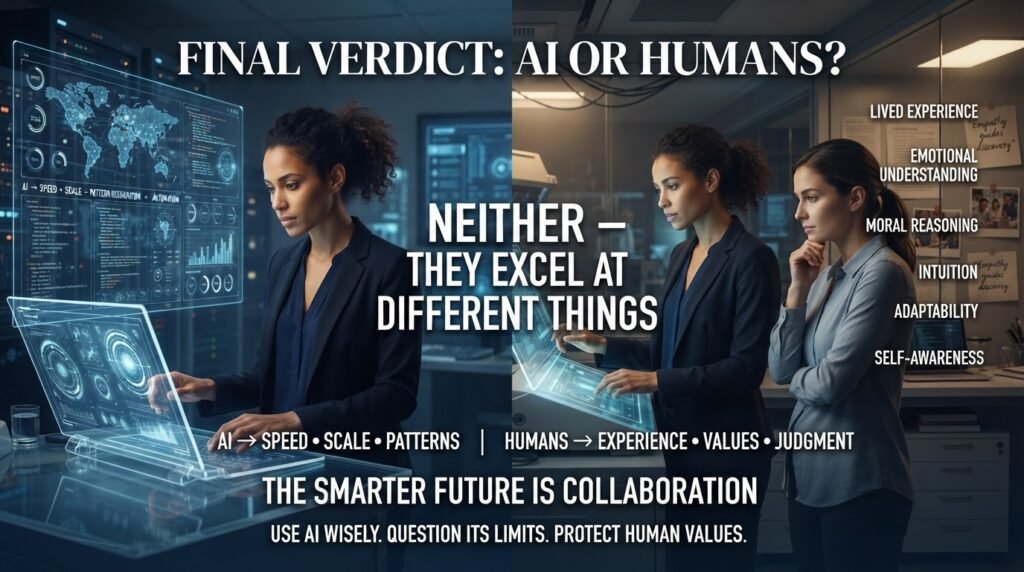
So, who wins the “AI vs humans” battle?
Neither — at least not in the simple way people imagine.
AI is already superior to humans at certain narrow tasks. It can process information faster, recognize patterns at enormous scale, automate repetitive work, and perform calculations with incredible speed.
But “human cognition” remains broader. Humans possess lived experience, emotional understanding, moral reasoning, intuition, flexible adaptation, and self-awareness in ways current AI does not.
The future is therefore less about choosing between a “machine vs mind” and more about learning how the two can work together.
AI may become more capable, but human judgment will remain essential. The smartest future is not one where humans surrender control to machines. It is one where humans use AI wisely, question its limitations, protect human values, and focus on the uniquely human qualities that technology cannot simply reproduce.
The real question isn’t whether AI will replace humanity.
It’s whether humanity will become better at using AI.