Introduction
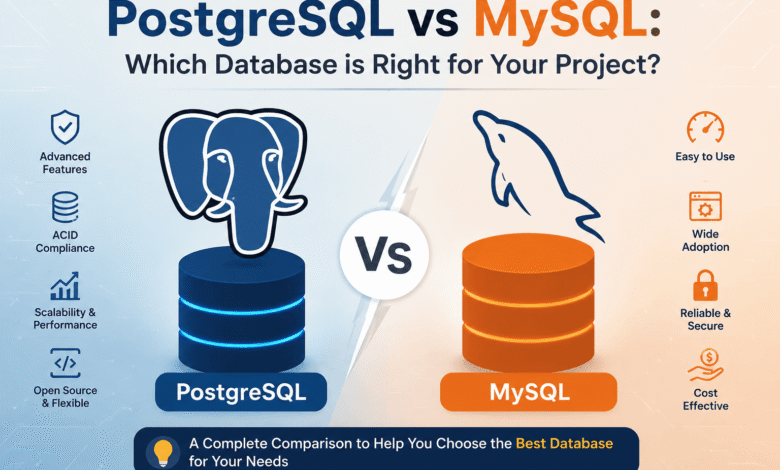
Choosing the right database for your project can have long-term consequences on performance, scalability, and development speed. Both PostgreSQL and MySQL are widely used relational database management systems, but each has unique strengths. Developers often ask what is PostgreSQL vs MySQL, and this question deserves careful consideration because the decision affects your data architecture, application reliability, and future growth. Selecting a database based on popularity alone can lead to unnecessary complexity or limited functionality down the line. Understanding the core differences, performance characteristics, and ideal use cases will help you make an informed decision.
What is PostgreSQL vs MySQL
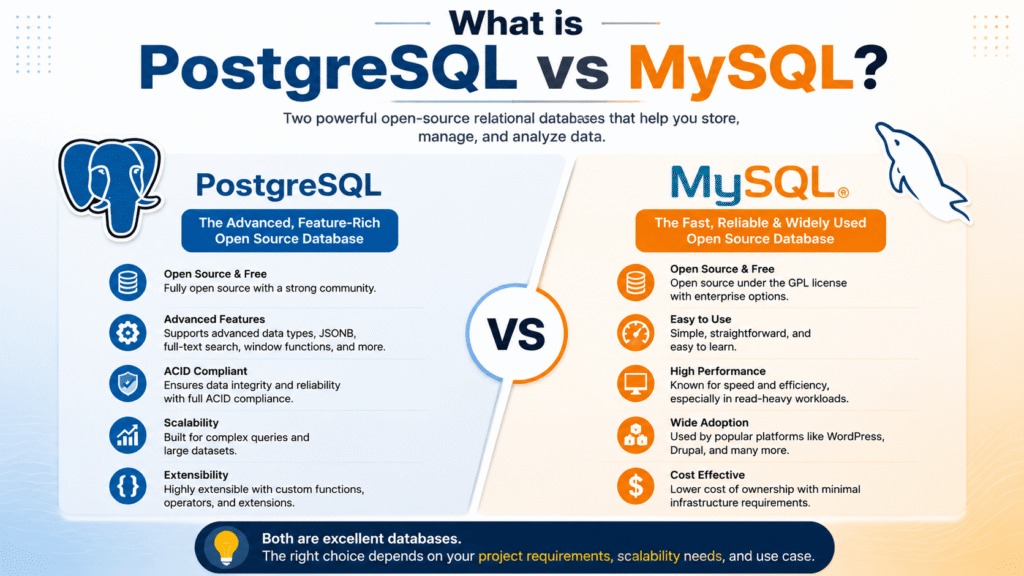
PostgreSQL is known as an object-relational database system with advanced features and extensibility. It follows SQL standards closely and offers strong support for complex queries, custom data types, and transactional integrity. PostgreSQL uses a robust multi-version concurrency control mechanism, allowing multiple users to read and write data without blocking operations. Developers appreciate its support for JSONB, arrays, and spatial data types, which provide flexibility when modeling complex data structures. Its advanced indexing options, such as GIN and GiST indexes, allow faster search and retrieval of large datasets. The system also supports stored procedures and extensions, making it highly customizable for specialized applications.
On the other hand, MySQL is a relational database system optimized for simplicity, speed, and reliability in web applications. It is widely used for content management systems, e-commerce platforms, and read-heavy applications. MySQL supports ACID transactions when using the InnoDB storage engine, ensuring data consistency for most common workloads. While it does not offer the same depth of extensibility as PostgreSQL, MySQL provides fast query performance, straightforward administration, and broad compatibility with popular frameworks. Many developers choose MySQL for quick deployment, predictable performance, and a large community of support and documentation. Understanding when to use PostgreSQL vs MySQL requires evaluating the complexity and concurrency requirements of your project.
Key Differences Between PostgreSQL and MySQL
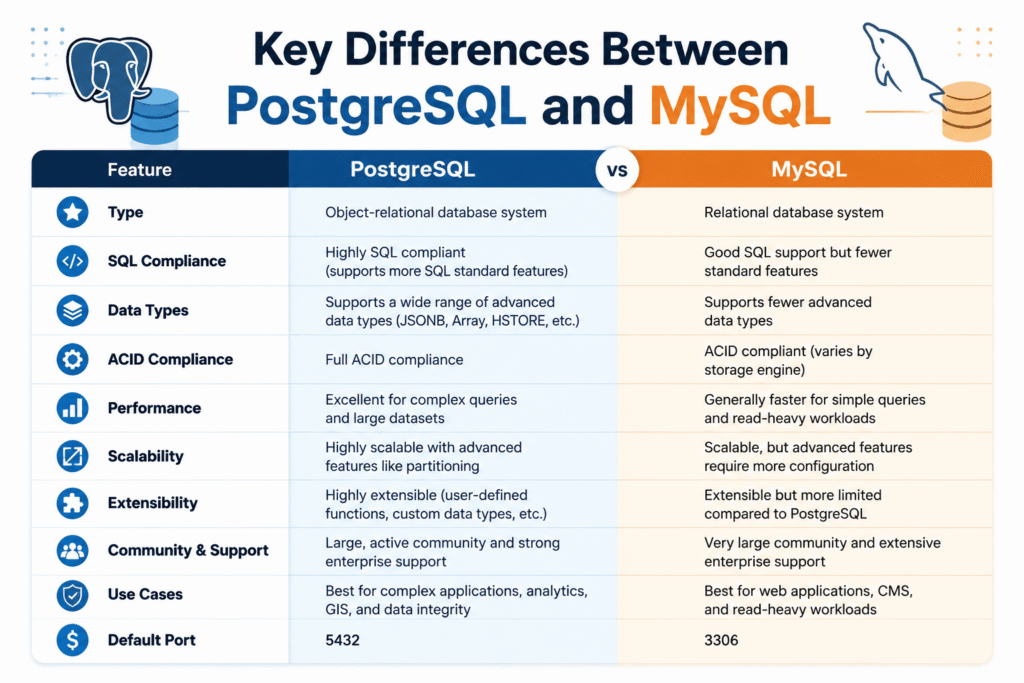
When deciding between PostgreSQL and MySQL, consider data complexity first. PostgreSQL is well-suited for applications requiring complex relationships, nested queries, or advanced data types. Projects involving analytics, geospatial data, or highly transactional workloads benefit from PostgreSQL’s architecture. Conversely, MySQL performs exceptionally well in simpler CRUD operations, read-heavy web applications, or scenarios where developer familiarity and ecosystem support matter most. For startups or small applications, MySQL allows quick setup with minimal overhead, whereas PostgreSQL may require slightly more expertise to leverage advanced capabilities effectively.
Another critical factor is performance under concurrency. PostgreSQL’s multi-version concurrency control allows multiple operations to occur simultaneously without blocking other processes, making it ideal for large-scale, high-concurrency systems. MySQL also supports concurrent access but may require additional tuning for write-heavy workloads to achieve similar performance levels. Benchmark tests demonstrate that PostgreSQL often outperforms MySQL in mixed workloads involving inserts, updates, and complex queries, challenging the outdated assumption that MySQL is always faster. However, for read-heavy applications with straightforward queries, MySQL remains highly efficient.
Advantages and Extensibility
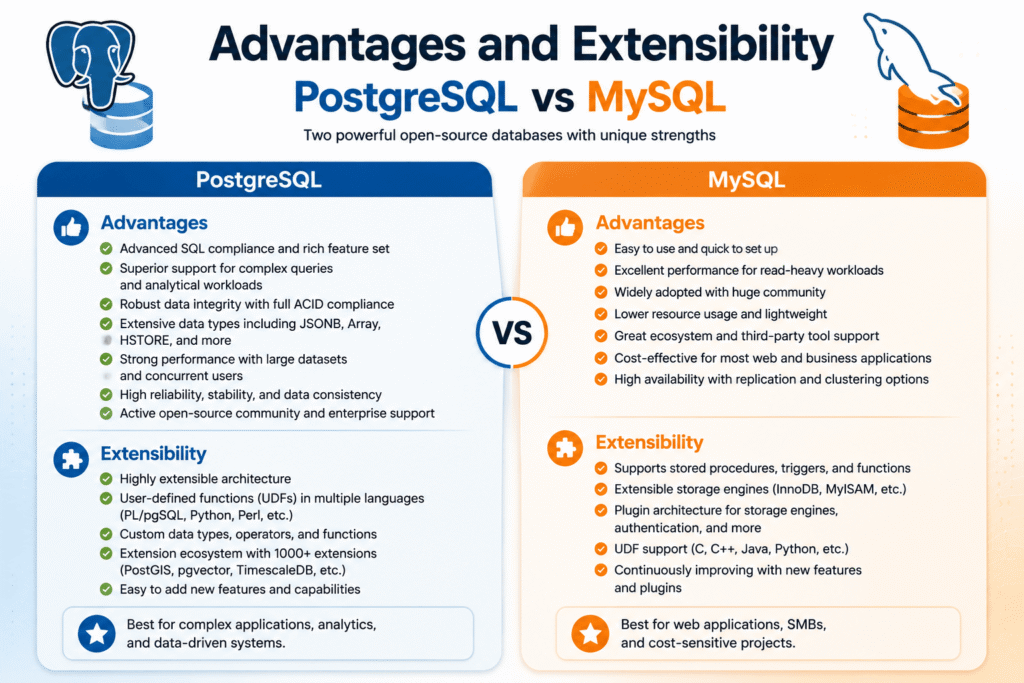
Extensibility and feature support also influence the choice. PostgreSQL provides support for custom extensions, materialized views, advanced indexing methods, and procedural languages like PL/pgSQL. Developers can implement custom functions and use plugins such as PostGIS for geospatial analysis or pg_partman for automated partitioning. MySQL, while less flexible, still offers stored procedures, triggers, and JSON support. Choosing PostgreSQL enables applications to evolve with complex data requirements, whereas MySQL is more rigid but simpler to maintain for common use cases.
When to Use PostgreSQL vs MySQL
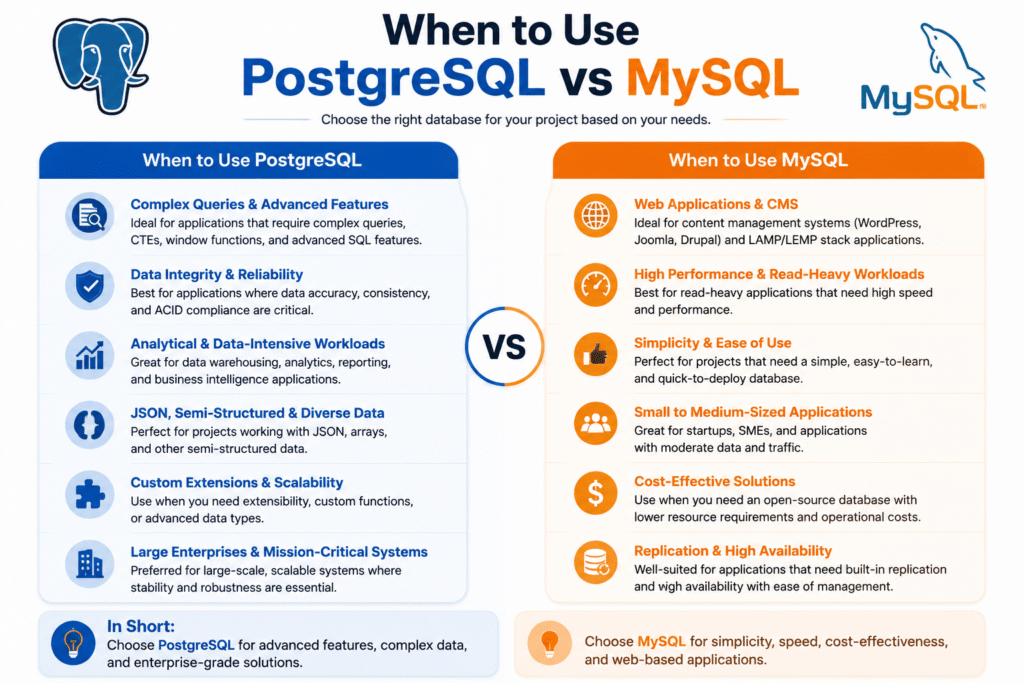
Understanding why use PostgreSQL vs MySQL often depends on future scalability requirements. PostgreSQL is designed to handle complex, evolving schemas without major restructuring. Applications anticipating high transaction volumes, detailed reporting, or multi-dimensional data analysis benefit from PostgreSQL’s robustness. MySQL provides predictable performance and ease of use, making it suitable for applications where complexity is limited, or rapid deployment is required. Developers also consider community support, ecosystem integration, and availability of libraries when making the choice.
Cost of maintenance is another practical consideration. PostgreSQL may require slightly more expertise to configure and optimize, but this upfront investment pays off with greater long-term flexibility. MySQL can be easier to manage for teams with standard web development experience and integrates seamlessly with many hosting environments. Both databases are open source, so licensing costs are minimal, but operational costs differ depending on workload, expertise, and scaling requirements. Evaluating these factors will help you determine when to use PostgreSQL vs MySQL for your specific project needs.
Common Misconceptions
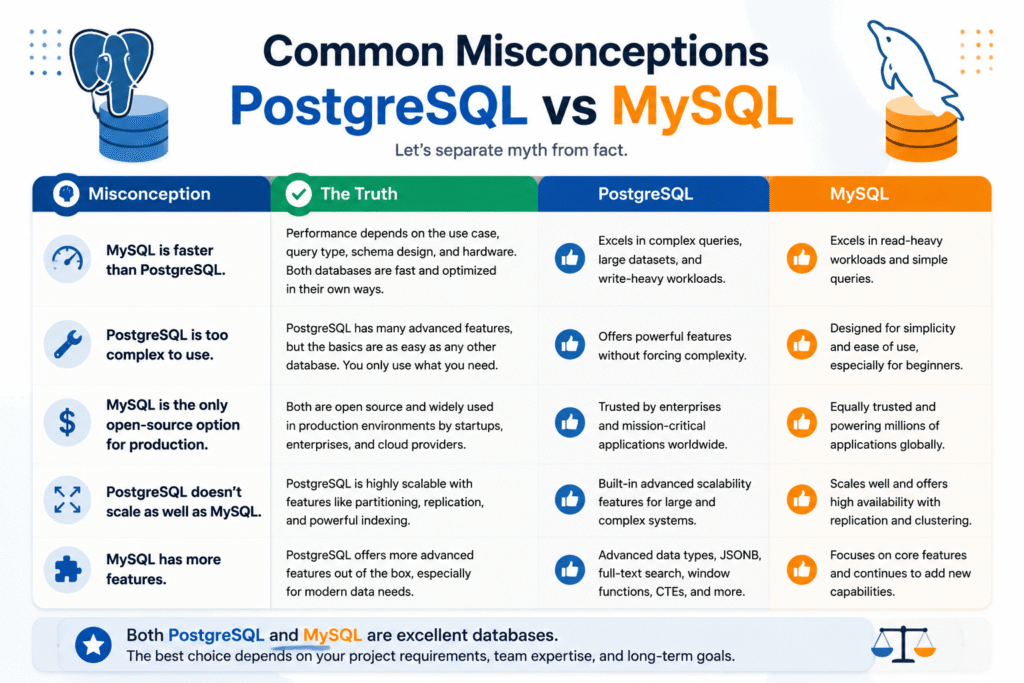
Despite common misconceptions, PostgreSQL is not inherently slower than MySQL, and MySQL is not automatically better for all web applications. Real-world performance depends heavily on query patterns, indexing strategies, and workload types. PostgreSQL shines in analytics, complex joins, and high-concurrency write operations. MySQL excels in simple, read-heavy applications and scenarios requiring minimal setup. Making a choice based solely on outdated speed comparisons can lead to future technical debt.
Decision-Making Guide
For developers unsure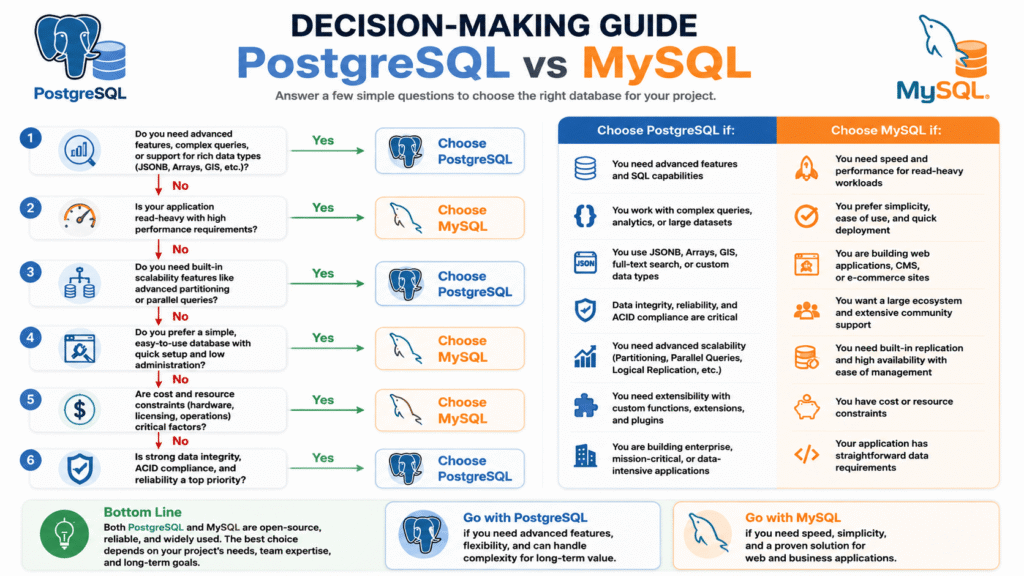 which database fits best, consider these practical questions. Does your project require advanced data types, complex queries, or high concurrency? Are you working with spatial or hierarchical data? Do you prioritize rapid deployment and broad framework support? Your answers will clarify whether PostgreSQL’s robustness or MySQL’s simplicity aligns with your goals. At Its Tech Club, we recommend matching database choice to project complexity and future growth potential rather than following trends or assumptions.
Conclusion
In conclusion, the decision between PostgreSQL vs MySQL should be based on workload characteristics, data complexity, concurrency demands, and extensibility requirements. PostgreSQL provides advanced features, strict SQL compliance, and strong support for complex applications. MySQL offers simplicity, speed, and widespread ecosystem compatibility, ideal for straightforward web applications. By carefully analyzing project needs, developers can choose the database that ensures both performance and maintainability. Remember, the best choice is rarely about popularity and always about matching technical requirements to long-term project goals. Exploring further tutorials or guides at Its Tech Club can help optimize database selection for your applications.