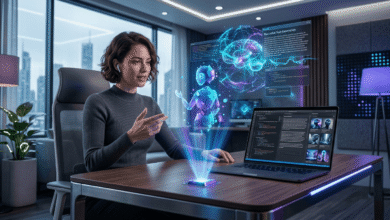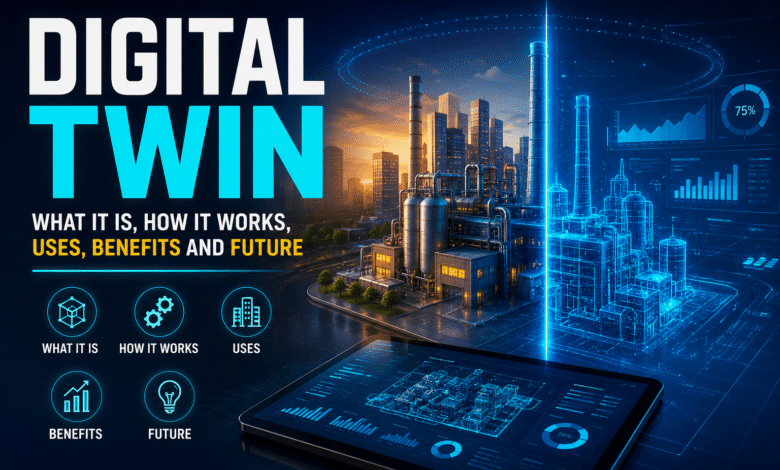
A digital twin is changing how businesses design, monitor, test, and improve physical objects and systems. Instead of depending only on physical prototypes or manual inspections, organizations can create a digital representation of a real-world object and continuously update it with data. At Its Tech Club, we explore emerging technologies that are moving from concepts into practical applications, and digital twin technology is a strong example of that transformation.
From manufacturing machines and vehicles to buildings, healthcare systems, energy infrastructure, and smart cities, digital twins can connect physical assets with sensors, real-time data, simulations, analytics, and artificial intelligence. This connection can help organizations understand performance, identify potential problems, test scenarios, and make better decisions.
What Is a Digital Twin?
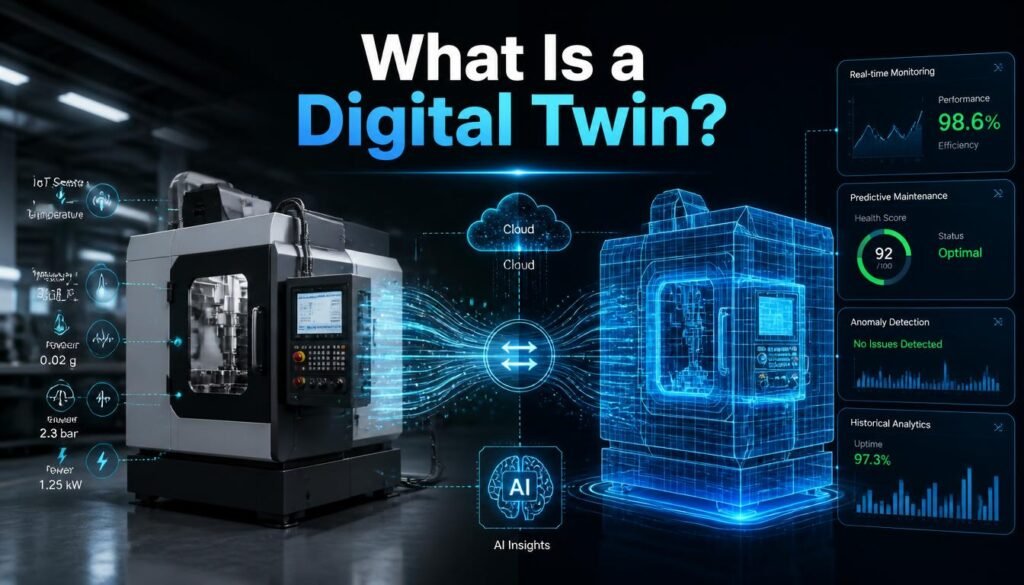
A digital twin is a virtual representation of a physical object, process, environment, or system that uses real-world data to reflect its condition and behavior. Unlike a simple 3D model, a digital twin can change as the physical asset changes.
For example, imagine a large machine inside a factory. Sensors attached to the machine can collect information about temperature, vibration, pressure, speed, energy consumption, and operating conditions. This information can be transferred to the digital model, giving engineers a clearer picture of how the actual machine is performing.
A digital twin does not have to represent only one object. It can represent a production line, entire factory, building, transportation network, energy system, or city. Connected digital models can provide a broader view of how different components interact.
The technology can also be useful throughout an asset’s lifecycle. A company might use a digital twin during design, testing, manufacturing, operation, maintenance, and replacement.
The key difference between a digital twin and a static digital model is the connection to the physical world. The more useful and reliable the incoming data is, the more accurately the digital twin can represent the real system.
How Does a Digital Twin Work?
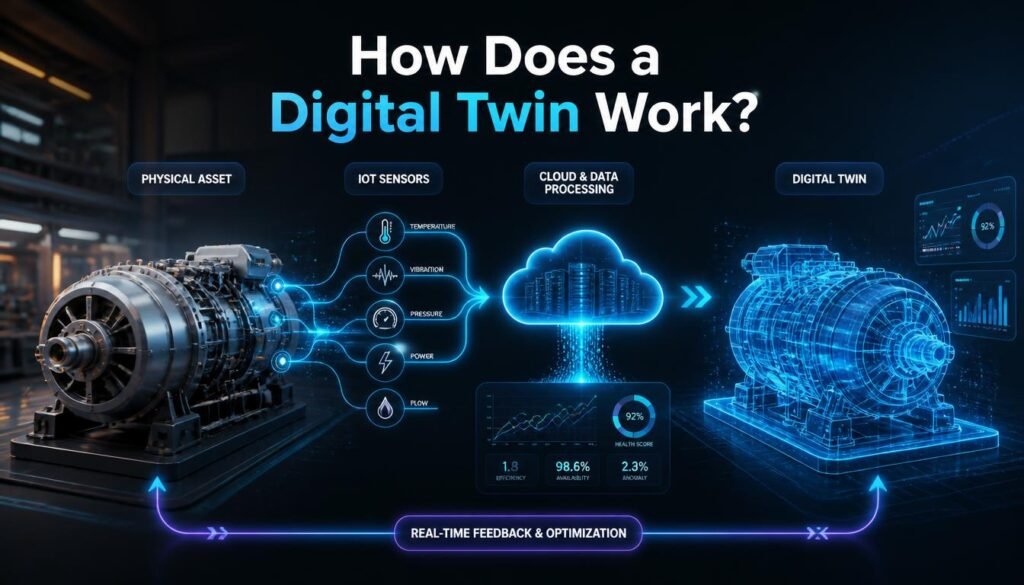
A digital twin generally works by connecting a physical asset with a digital model through data.
The process often starts with sensors and Internet of Things devices collecting information from the physical environment. Depending on the application, sensors may measure temperature, pressure, movement, location, energy consumption, vibration, humidity, or equipment status.
That information is sent to a digital platform where it can be stored, processed, analyzed, and visualized. The digital twin then uses the information to represent the current condition of the physical asset.
A simplified digital twin process looks like this:
Physical asset → Sensors → Data collection → Digital model → Analysis → Insights → Physical action
The real value comes from what organizations can do with the resulting information. Engineers can investigate unusual equipment behavior, operators can monitor performance, and managers can use insights to make more informed decisions.
For example, if a machine begins producing unusual vibration, its digital twin can help engineers investigate whether the change could indicate a developing mechanical problem. Instead of waiting for a complete failure, maintenance teams may be able to investigate the issue earlier.
Artificial intelligence can make digital twins even more powerful. AI can analyze large amounts of information, identify patterns, generate predictions, and help organizations understand complicated systems.
What Are the Applications of Digital Twin Technology?
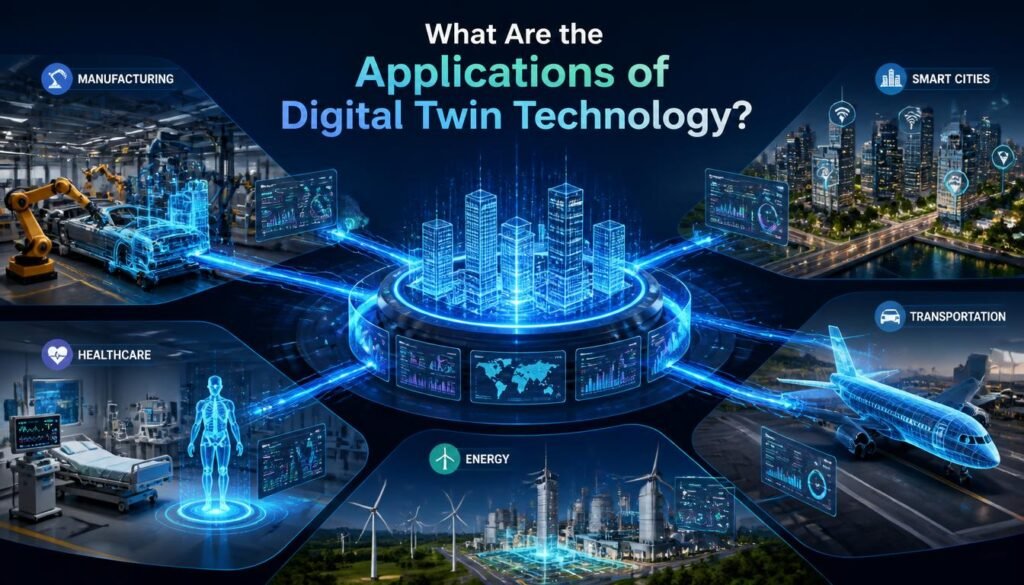
Digital twin applications are expanding across industries because many physical objects and systems can be measured and represented digitally.
Manufacturing is one of the most important applications. Manufacturers can create digital twins of machines, production lines, factories, and products. Engineers can use these models to study production processes, identify bottlenecks, monitor equipment, and test potential improvements before changing physical operations.
Digital twins can also support predictive maintenance. Rather than depending entirely on fixed maintenance schedules, organizations can analyze equipment data and look for unusual patterns that could indicate potential problems.
The automotive industry can use digital twins during vehicle design, development, testing, and operation. Engineers can digitally examine components and systems under different conditions before making expensive physical changes.
Aerospace is another significant application. Aircraft and their components operate under demanding conditions and produce substantial amounts of operational data. Digital models can help engineers understand performance, investigate potential issues, and improve maintenance strategies.
In healthcare, digital twin technology is being explored for medical equipment, hospital operations, research, and other applications. A digital representation of a hospital could help administrators understand how patients, staff, rooms, and equipment interact.
Smart buildings can also benefit from digital twins. A building model can connect information from heating, cooling, lighting, security, elevators, and energy systems. Building operators can then monitor performance and identify opportunities to improve efficiency.
At a larger scale, digital twins can represent infrastructure and cities. Transportation systems, buildings, roads, utilities, and other urban components can be modeled to help planners understand how potential changes might affect the wider environment.
Energy companies can also use digital twins to monitor infrastructure, industrial equipment, and energy systems, helping improve maintenance and operational planning.
What Are the Benefits of Digital Twin Technology?
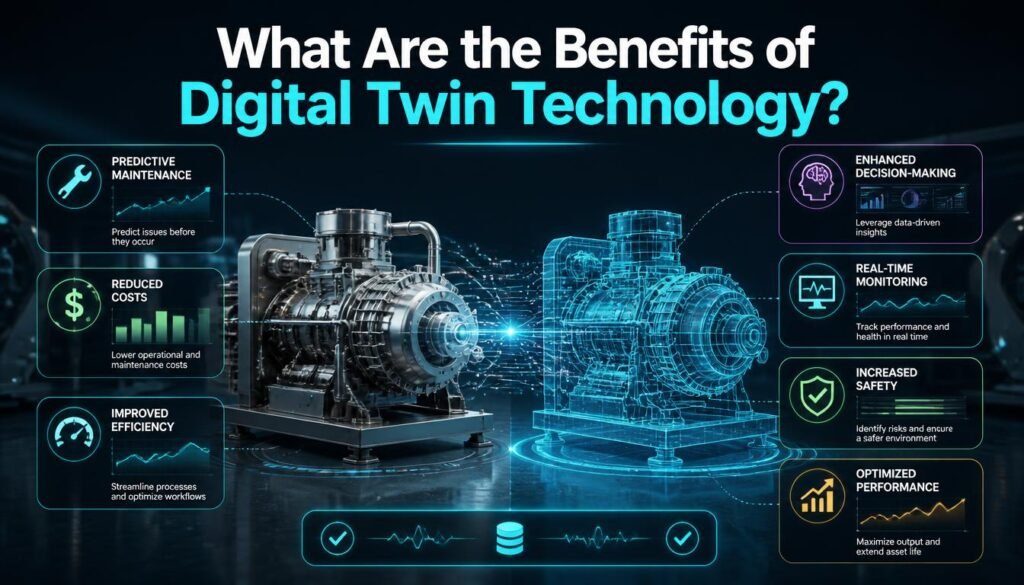
One of the biggest benefits of a digital twin is the ability to connect real-world operations with digital information. Instead of examining individual data points separately, organizations can build a broader understanding of how an asset or system is performing.
Better decision-making is an important advantage. When businesses have access to current operational data and digital simulations, they can make decisions based on more than historical reports.
Another benefit is predictive maintenance. Continuous monitoring can help teams detect unusual patterns and investigate potential equipment problems before they result in major failures.
Digital twins can also reduce the cost and risk associated with product development. Engineers can test different configurations and operating conditions digitally before creating physical prototypes or changing real-world equipment.
Operational efficiency is another potential benefit. By analyzing how machines, buildings, or systems operate, organizations may discover energy waste, production bottlenecks, inefficient processes, or underperforming equipment.
Key benefits include:
- Better equipment monitoring
- Reduced unexpected downtime
- Improved maintenance planning
- Faster product development
- More efficient resource use
- Better visibility into complex systems
- Safer digital testing
- More informed decisions
Digital twins can also support an asset throughout its lifecycle. The same digital representation can potentially remain useful after design and manufacturing by continuing into operation and maintenance.
However, organizations must consider implementation challenges. A digital twin requires reliable data, suitable sensors, secure infrastructure, accurate models, and a clear objective. Poor data can lead to unreliable results, while disconnected systems can make it difficult to create an accurate representation.
What Is the Difference Between a Digital Twin and a Simulation?
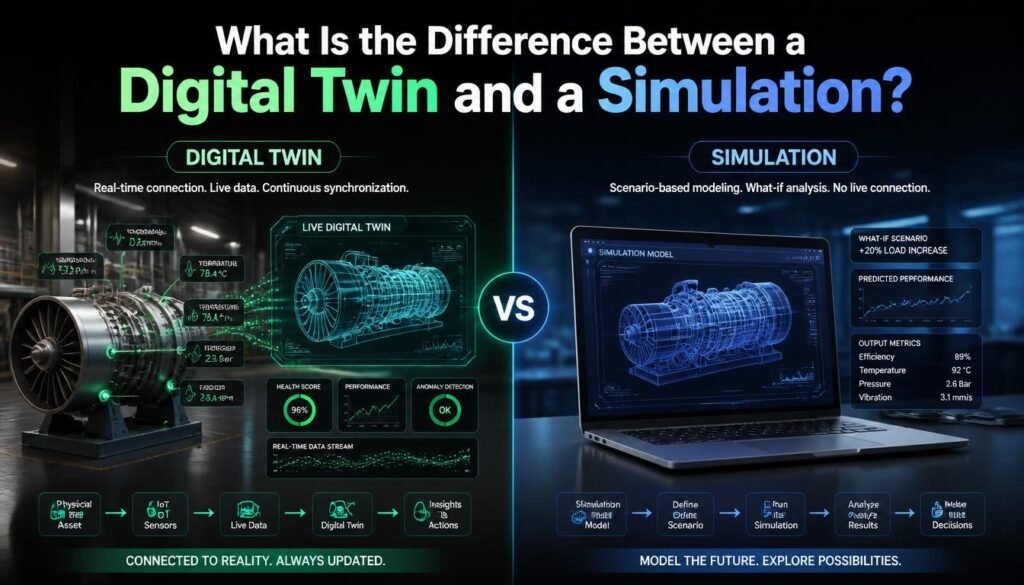
A digital twin and simulation are closely related, but they are not the same technology.
A simulation generally models how a system could behave under specific conditions. Engineers can change variables and observe potential outcomes in a controlled digital environment.
A digital twin can use simulations, but it also maintains a connection with a physical object or system through real-world data.
A simple way to understand the difference is:
Simulation: What could happen if we change this condition?
Digital twin: What is happening with the physical system now, and what could happen if we change something?
For example, an engineer might create a simulation to determine how a machine would respond to increased temperatures. A digital twin could combine that simulation with information from the actual machine, including its temperature, vibration, workload, and operating history.
A basic 3D model is different as well. A 3D model can accurately represent an object’s appearance without receiving live information. A digital twin focuses more on the object’s condition, behavior, relationships, and performance.
Digital twins and simulations can work together. A digital twin can use simulation models to explore possible outcomes, while real-world data can help make those simulations more relevant to actual operating conditions.
What Is the Future of Digital Twin Technology?
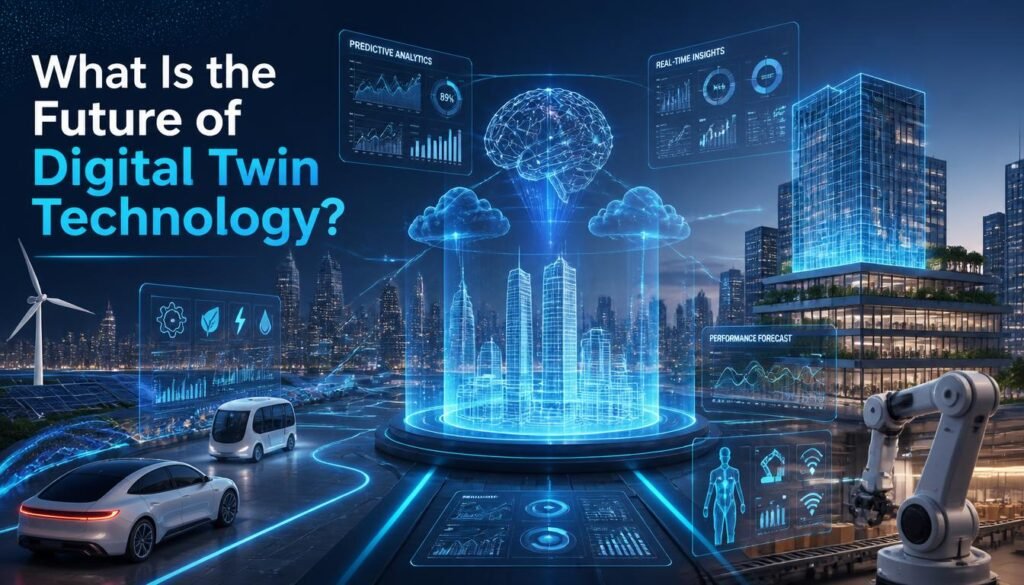
The future of digital twin technology is closely connected to artificial intelligence, IoT, cloud computing, automation, advanced analytics, and simulation.
One major development is the integration of AI with digital twins. Traditional digital twins can help organizations visualize and analyze operational information, while AI can help identify patterns, make predictions, and support complex decisions.
For example, an AI-powered digital twin could analyze historical and real-time equipment data to identify conditions associated with previous failures. If similar patterns appear again, the system could alert maintenance teams to investigate.
Digital twins are also moving beyond individual machines and products. Organizations can connect multiple models to represent entire facilities, supply chains, transportation networks, or cities. This can provide a broader understanding of systems where one change may affect many other components.
Another important use is scenario planning. Organizations can potentially test different decisions in a digital environment before implementing them in the physical world. This could help with factory redesigns, energy planning, transportation changes, infrastructure projects, and other complex decisions.
As sensors, connectivity, computing power, and AI improve, digital twins may become increasingly detailed and responsive.
However, their future will also depend on data security, privacy, interoperability, cost, and accuracy. The most valuable digital twins will likely be those that solve specific real-world problems instead of simply creating complex digital models without a clear purpose.
Conclusion
A digital twin creates a connection between the physical and digital worlds by combining real-world data, sensors, connected devices, digital models, simulations, analytics, and artificial intelligence. It can help organizations monitor assets, understand complex systems, predict potential problems, test scenarios, and make better decisions.
From manufacturing and automotive engineering to healthcare, smart buildings, energy, aerospace, and cities, digital twin technology has a growing range of applications. As AI and connected technologies continue to develop, these virtual representations are likely to become more intelligent and useful.
The biggest opportunity is not simply creating a digital copy of something physical. It is using that representation to understand what is happening, explore what could happen next, and determine which actions may produce better results. At Its Tech Club, digital twin technology is an excellent example of how modern technology can transform real-world data into practical intelligence.