
Artificial intelligence has moved far beyond answering questions and generating text. Today, AI can research information, write content, create images, analyze data, interact with customers, write code, and handle tasks that once required an entire team.
The most interesting development, however, is the rise of AI agents.
Unlike traditional AI tools that simply respond to a prompt, AI agents can be designed to complete a series of tasks. They can use different tools, follow a workflow, make decisions within defined boundaries, and keep working toward a specific goal.
That opens up an entirely new question: can you actually make money with AI agents?
The answer is yes—but probably not in the way social media makes it sound.
There is no magic “make money AI” button. The real opportunity is using AI to solve problems faster, provide valuable services, reduce business costs, or create products that people are willing to pay for.
Let’s look at some realistic ways to turn AI agents into an income stream.
What Makes AI Agents Different?
Before thinking about money, it helps to understand what makes AI agents different from ordinary AI tools.
A chatbot might answer a customer’s question.
An AI agent could potentially receive the customer’s message, understand the request, check relevant information, update a system, prepare a response, and escalate the conversation if human assistance is required.
That difference matters.
AI agents are designed around actions and outcomes rather than simply generating an answer.
This is part of the broader Agentic AI movement, where AI systems are becoming capable of handling increasingly complex workflows.
For entrepreneurs, that means one person can potentially automate tasks that previously required several hours of manual work.
Start With AI Automation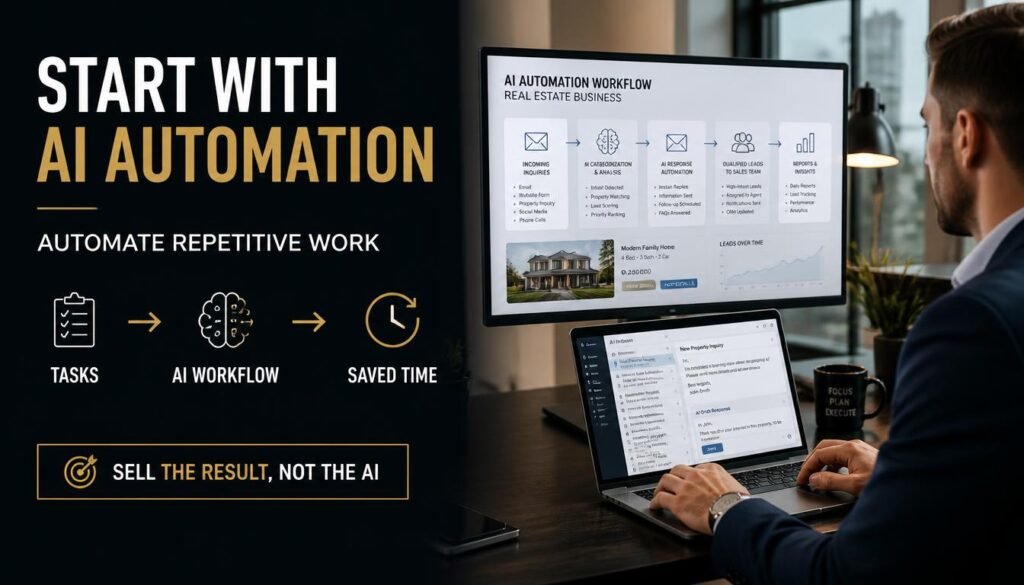
One of the most practical ways to make money with AI agents is through AI automation.
Businesses have plenty of repetitive tasks.
They respond to similar emails, organize leads, schedule appointments, create reports, update spreadsheets, process documents, and answer routine customer questions.
You can build systems that automate some of these processes.
For example, imagine a small real-estate company receiving dozens of inquiries every day. An AI workflow could collect the customer’s requirements, categorize the lead, draft an appropriate response, and send the information to the sales team.
The company isn’t really buying an AI agent.
It is buying saved time.
That’s an important distinction when starting an AI business.
Don’t sell “artificial intelligence.”
Sell the result it creates.
Offer AI Freelancing Services
You don’t need to build an AI startup to benefit from this technology.
AI freelancing can be one of the easiest ways to get started.
Consider services that businesses already pay freelancers to provide:
- Content writing
- Research
- Lead generation
- Social media management
- Customer support
- Data organization
- Email marketing
- Graphic design
- Website development
- Administrative work
AI tools can help you complete many of these tasks faster.
For example, instead of manually researching dozens of competitors, you can use AI to organize the information and identify useful patterns. Instead of starting every article from a blank document, you can use AI to create a research structure and first draft before adding your own expertise.
The important part is not telling clients that you use AI.
They care about what you deliver.
Build AI Bots for Small Businesses
AI bots can also become a practical business opportunity.
Many companies receive the same customer questions repeatedly. Customers want information about prices, opening hours, services, availability, delivery, returns, and appointments.
A specialized AI bot can handle many routine conversations and pass complicated requests to a human employee.
For example, a restaurant might use an AI bot to answer menu questions and handle reservation inquiries. A property company might use one to qualify potential buyers. An online store might use one to help customers find the right product.
The opportunity is not necessarily to create the most advanced AI bot in existence.
It is to create one that solves a specific business problem reliably.
Create AI Workflows and Sell Them
Another interesting opportunity lies in AI workflows.
Instead of building a single AI agent, you can create a complete process that connects several AI tools.
Imagine a content workflow that researches a topic, organizes the findings, creates an outline, prepares a first draft, generates social media ideas, and sends everything to a human for review.
Or consider a sales workflow that collects new leads, analyzes them, categorizes their potential value, and prepares personalized follow-up messages.
Once you’ve created a useful workflow, you can customize it for clients or potentially package it as a reusable product.
This is where AI tools become much more powerful.
The value isn’t necessarily in one tool.
It’s in knowing how several tools can work together.
Turn AI Into an AI Side Hustle
You don’t have to leave your job to experiment with AI.
An AI side hustle can start with just a few hours each week.
You could offer automation services, create content packages, build customer-support bots, sell workflow templates, provide AI-assisted research, or help small companies introduce AI into their daily operations.
The smartest approach is to start small.
Find one problem.
Create one solution.
Get one customer.
Then improve it.
Many people make the mistake of spending months building a complicated AI system without checking whether anyone actually wants it. Instead, talk to potential customers first and find out what they would genuinely pay to have solved.
A paying customer is better validation than hundreds of likes on an AI-related social media post.
Explore Practical AI Business Ideas
There are endless AI business ideas, but the best ones usually have something in common: they solve a specific and expensive problem.
“I’m building an AI assistant” is too broad.
“I’m building an AI assistant that helps dental clinics handle appointment inquiries” is much more specific.
Look at industries where employees spend significant amounts of time on repetitive information-based work.
Real estate, education, recruitment, e-commerce, hospitality, marketing, professional services, and many other industries could benefit from carefully designed automation.
Ask yourself:
What task wastes the most time?
What process is repetitive?
What information has to be processed again and again?
What would become more valuable if it happened faster?
Those questions can lead you toward much better AI business ideas than simply following whatever tool is trending.
Can AI Really Create Passive Income?
The phrase “Passive income AI” gets a lot of attention, but it’s worth being realistic.
AI doesn’t automatically create passive income.
A product still needs to be built. Customers still need to find it. Problems still need to be fixed. Marketing, updates, payments, and customer support still exist.
However, AI can make certain businesses more scalable.
For example, you could create digital products, workflow templates, specialized AI software, or subscription services. Once established, these products may require less direct labor per customer than a traditional service business.
That’s the real opportunity.
AI can help separate your income from the number of hours you personally spend doing the work.
Build Specialized AI Software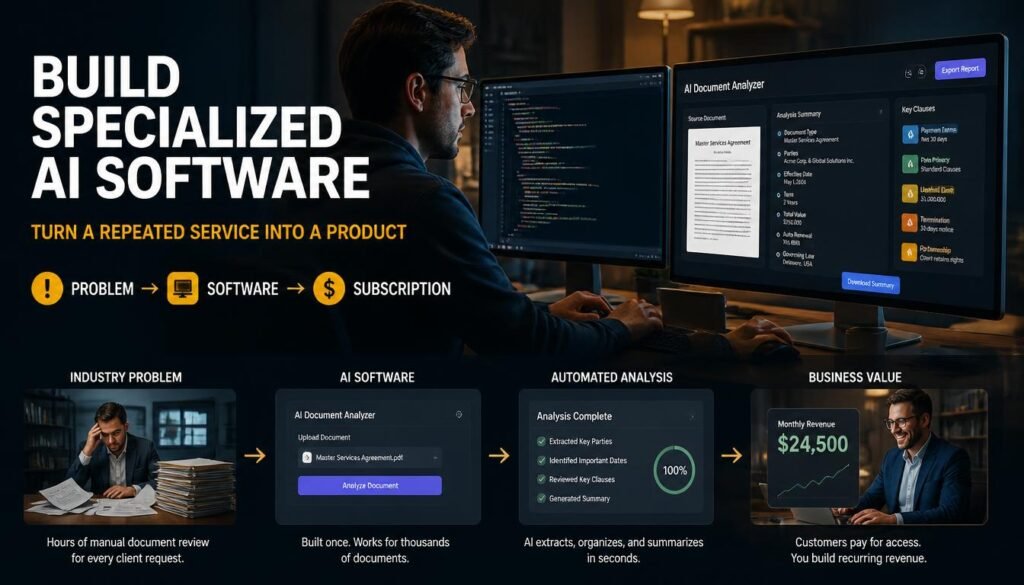
If you have programming skills—or can work with someone who does—AI software can offer an even bigger opportunity.
Instead of manually performing the same service for every client, you can turn the process into a product.
Suppose you discover that a particular industry spends hours analyzing a certain type of document. You could build AI software that handles the initial analysis automatically.
The business pays for access to the software rather than paying you to perform the task manually every time.
This is one path toward building an AI startup.
And you don’t necessarily need to invent a revolutionary new AI model.
Many successful software businesses are built by applying existing technology to a specific industry or problem.
Combine AI Tools Instead of Building Everything

One reason AI entrepreneurship is becoming more accessible is that you don’t have to build every component yourself.
Modern AI tools can provide language models, image generation, automation, databases, research capabilities, coding assistance, and other functions.
Your job can be to combine those capabilities into something useful.
This is where AI workflows and AI automation become powerful.
A business owner doesn’t necessarily care which AI model is behind your system.
They care that their reports are completed faster, their leads are organized, their customers receive quicker responses, or their employees spend less time on repetitive work.
Technology is the engine.
The solution is the product.
Don’t Make Everything Autonomous
There is another important point that is often ignored in discussions about AI agents.
More autonomy isn’t always better.
An agent can misunderstand an instruction. It can produce inaccurate information or make an inappropriate decision. If it is connected to business systems, a mistake could have real consequences.
That’s why human oversight remains important.
Let an agent collect information and prepare recommendations, but require human approval before sensitive actions.
Allow AI to draft customer responses, but let an employee handle serious complaints.
Use automation for routine processes while keeping humans responsible for important decisions.
The goal shouldn’t be complete autonomy.
The goal should be dependable automation.
How to Find Your First Customer
If you’re serious about making money with AI agents, don’t begin by asking, “Which AI tool should I sell?”
Start by looking for problems.
Talk to small business owners. Speak to freelancers. Look at online communities where professionals discuss frustrating tasks. Pay attention to processes people repeatedly describe as slow, expensive, or boring.
Then build a small demonstration.
Show someone how the process could work with AI.
For example, if you want to sell an AI customer-support solution, demonstrate how an incoming customer question can be categorized, answered, and escalated when necessary.
A working example can be much more convincing than telling someone that AI is the future.
Focus on Results, Not Hype
The AI industry is full of exciting claims.
You’ll hear about fully autonomous companies, effortless passive income, AI employees, and businesses that supposedly run themselves.
Some of these ideas may eventually become reality. But building a sustainable business today requires something much simpler: value.
Can you save someone five hours a week?
Can you help a company respond to customers faster?
Can you reduce repetitive administrative work?
Can you help a freelancer serve more clients?
Can you turn an expensive manual process into an affordable software product?
If the answer is yes, you may have a genuine business opportunity.
The Future of AI Entrepreneurship
AI agents are likely to become more capable, more affordable, and easier to integrate into everyday software.
That could give individuals an unusual amount of leverage.
A freelancer may be able to operate like a small agency. A small business may automate work that previously required additional employees. A developer may build and test products much faster. An entrepreneur may be able to launch an idea with fewer resources.
But AI won’t remove the need for business skills.
You still need to understand customers, communicate clearly, market your service, manage expectations, solve problems, and deliver consistent results.
AI gives you leverage.
It doesn’t give you a business automatically.
Conclusion:
Making money with AI agents isn’t about finding a secret tool that prints money. It’s about finding valuable problems and using AI to solve them more efficiently.
You can start with AI automation, offer AI freelancing services, build specialized AI bots, create AI workflows, experiment with an AI side hustle, or eventually develop AI software and build an AI startup.
The strongest opportunities will likely come from combining Agentic AI with real industry knowledge.
So don’t ask only, “How can I make money with AI?”
Ask a better question:
“What problem can I solve better, faster, or more affordably because AI now exists?”
That shift in thinking is where the real opportunity begins.