Gaming consoles have transformed the way people play video games by providing dedicated devices designed specifically for interactive entertainment. Unlike general-purpose computers, gaming consoles are built around a controlled hardware and software environment that makes it easier for developers to optimize games and for players to start gaming without complicated setup. Over the years, consoles have evolved from simple machines designed to play basic arcade-style games into powerful entertainment systems capable of producing high-resolution graphics, online multiplayer experiences, digital downloads, streaming features, and immersive gameplay.
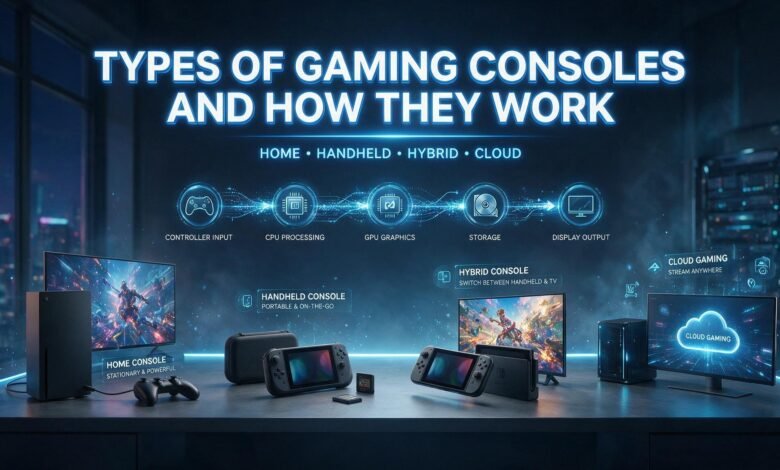
Today, there are several types of gaming consoles, including home consoles, handheld consoles, hybrid systems, retro consoles, and cloud-based gaming devices. Each type has a different design and purpose, but they all follow the same basic concept. A player provides commands through a controller or another input device, the console processes those commands using its hardware and software, and the game produces visual and audio feedback. Understanding how these systems work helps explain why different consoles offer different levels of performance, portability, and gaming experiences.
What Is a Gaming Console and How Does It Work?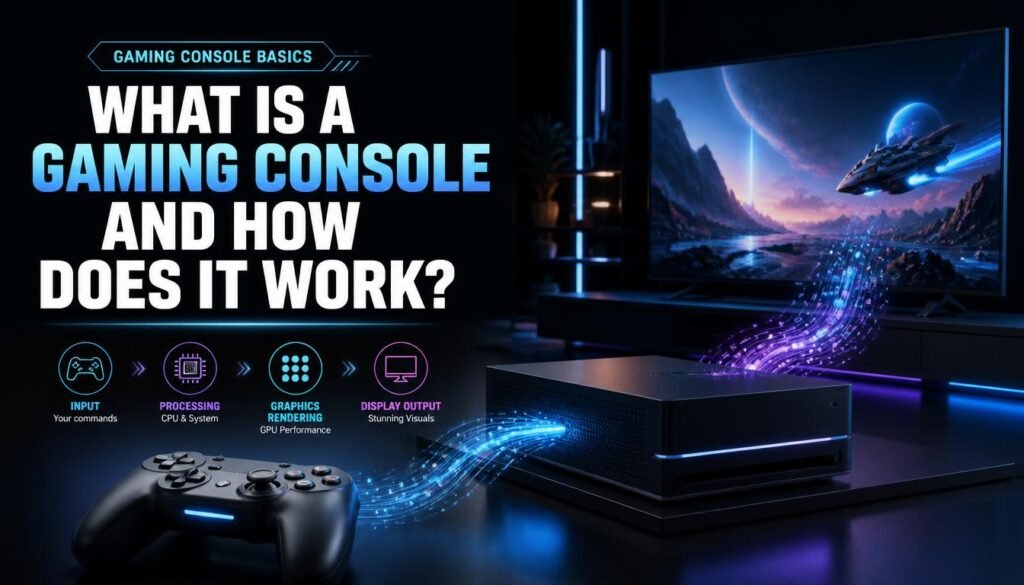
A gaming console is a specialized electronic device primarily designed to run video games. It contains several important components, including a central processing unit (CPU), graphics processing unit (GPU), RAM, internal storage, operating system, networking hardware, and input controls. These components work together to execute game software and create the images, sounds, physics, artificial intelligence, and interactions that players experience during gameplay.
The CPU handles many of the calculations required by a game. It manages game logic, character behavior, physics calculations, input processing, and communication between different parts of the system. The GPU focuses mainly on graphics and is responsible for rendering objects, environments, lighting, shadows, textures, animations, and other visual elements. RAM provides temporary high-speed space where the game stores information that needs to be accessed quickly, while storage keeps game installations, saved files, updates, applications, and system data.
When a player presses a button, moves an analog stick, or pulls a trigger, the controller sends an input signal to the console. The CPU and game software interpret that signal and determine what should happen. The GPU then creates the appropriate visual changes, and the console sends the resulting video and audio to the display and speakers. This process happens repeatedly and extremely quickly, allowing players to control characters and interact with virtual environments in real time.
Home Gaming Consoles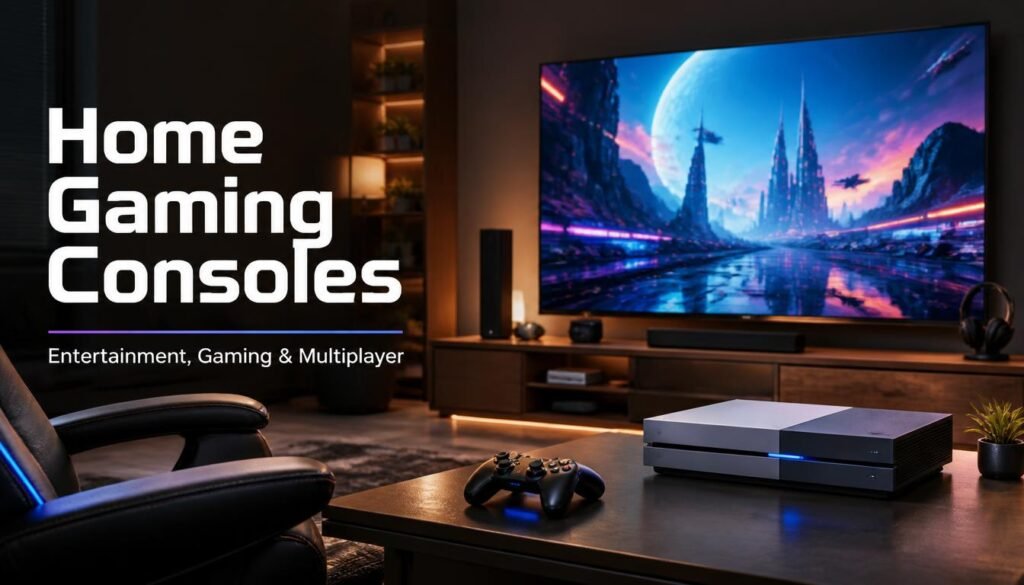
Home gaming consoles are the traditional type of gaming system designed to be connected to a television or monitor. They are generally built with powerful hardware because they do not need to prioritize portability or battery life. Their larger physical size provides more space for processors, cooling systems, storage, power components, and other hardware.
One of the biggest advantages of home consoles is their ability to provide high-quality gaming experiences on large displays. Modern systems can support high resolutions, high frame rates, advanced lighting, detailed textures, realistic shadows, sophisticated physics, and large open-world environments. Developers can optimize their games for a known hardware configuration, which helps them achieve consistent performance.
Home consoles are also designed for entertainment beyond traditional gaming. Many systems provide access to digital stores, video streaming applications, music services, web-based features, online multiplayer, voice communication, and other applications. This has turned modern consoles into complete entertainment platforms rather than devices used only for playing physical games.
Another important feature is local multiplayer. Several controllers can often be connected to the same console, allowing friends or family members to play together on one television. Online multiplayer expands this experience by allowing players to compete or cooperate with people around the world.
Handheld and Portable Gaming Consoles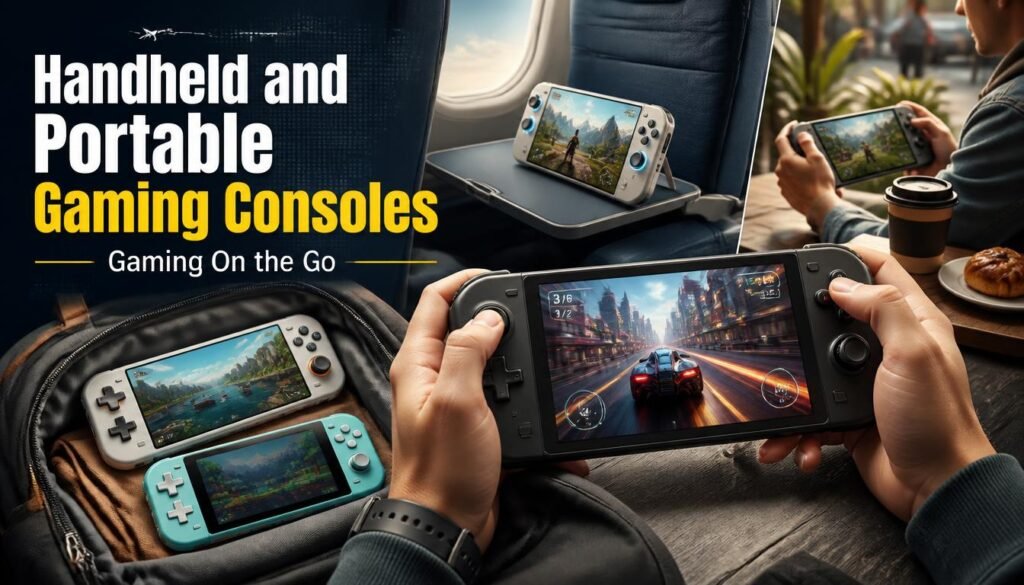
Handheld gaming consoles are designed to provide gaming experiences in a portable form. They usually include a built-in screen, controls, speakers, battery, processor, graphics hardware, and storage in a single compact device. This means players do not need a separate television or monitor to use them.
Portability is the main advantage of handheld consoles. Players can take them to school, work, while traveling, or anywhere else where carrying a larger gaming system would be inconvenient. Modern handheld devices can also provide wireless internet connectivity, allowing users to download games, install updates, communicate with other players, and sometimes participate in online multiplayer.
However, portable hardware has to deal with limitations that do not affect large home consoles to the same extent. A handheld system must carefully manage battery consumption and heat while maintaining acceptable performance. Smaller processors and graphics systems are often designed to provide a balance between performance and power efficiency. Cooling systems also have to remain compact enough for the device to be comfortable to hold.
Despite these limitations, modern portable gaming technology has improved significantly. More efficient processors, faster storage, better displays, improved batteries, and advanced cooling solutions allow handheld systems to run increasingly demanding games. This has made portable gaming an important part of the modern gaming industry.
Hybrid Gaming Consoles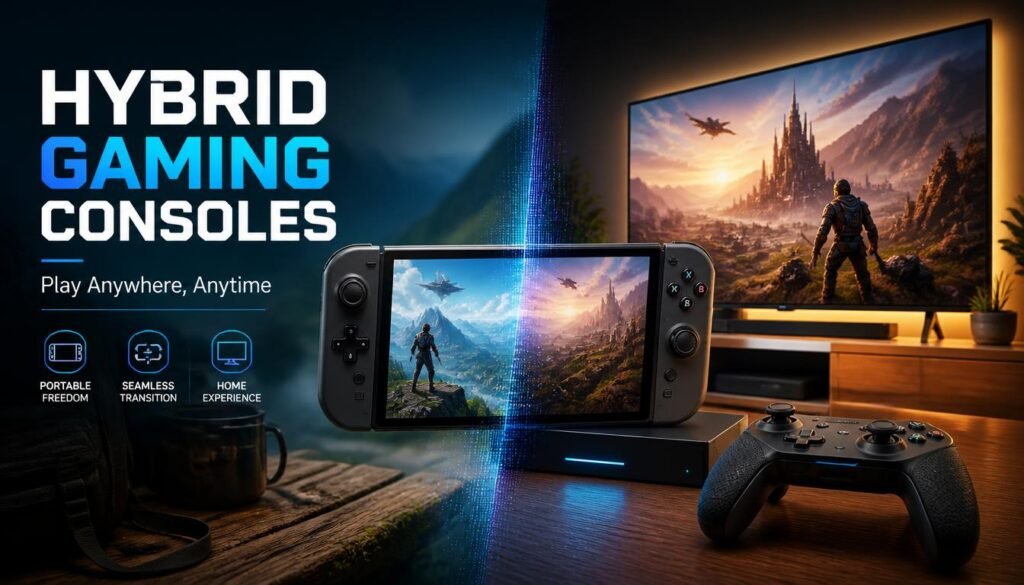
Hybrid gaming consoles combine the features of home and handheld systems. They are designed to function as portable devices while also offering the ability to connect to a television or external display. This provides players with greater flexibility because they can use the same system in different environments.
In portable mode, the console normally uses its built-in screen and controls. When connected to a compatible dock or external display system, it can send the video signal to a television. Some hybrid devices also allow controllers to be detached or rearranged, giving players multiple ways to interact with games.
The main challenge in designing a hybrid console is balancing performance, battery life, size, heat, and power consumption. A system that is powerful enough for demanding games can produce more heat and consume more energy, while a system designed for long battery life may need to use less powerful hardware. Manufacturers therefore use specialized processors and software optimization to achieve an appropriate balance.
Hybrid consoles are particularly attractive to players who want flexibility. Someone can play a game on a television at home and then continue playing the same game in portable mode. This eliminates the need to maintain separate home and portable gaming systems and allows gaming to fit more easily into different situations.
Retro Consoles, Digital Games, and Cloud Gaming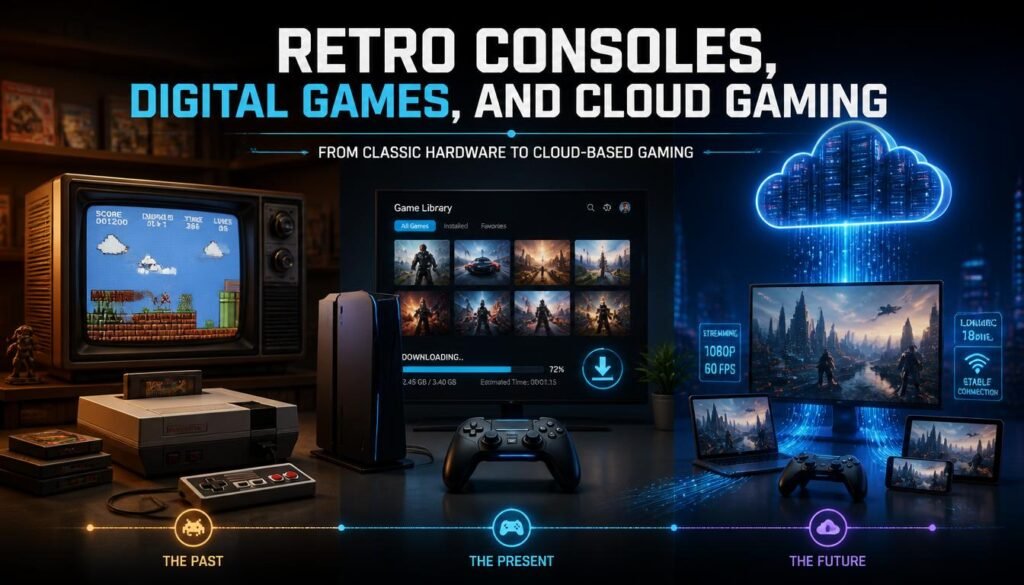
Retro gaming consoles represent another important category. These systems focus on older games and classic gaming experiences. Some retro consoles are original hardware from previous generations, while others are modern devices that reproduce classic systems or include collections of older games. They appeal to players who enjoy gaming history, classic gameplay mechanics, pixel-based graphics, and older game libraries.
Many modern retro systems use emulation. Emulation allows software to imitate the behavior of another gaming platform so that games created for older hardware can operate on newer devices. The emulator reproduces many of the functions expected by the original game, allowing modern hardware to run software designed for a completely different generation of technology.
Game distribution has also changed significantly. Traditional physical games were commonly distributed through discs or cartridges, but modern consoles increasingly support digital downloads. Digital games are downloaded directly to internal storage and can receive updates, patches, and downloadable content through internet connections. Physical media still remains important because many players prefer collecting games or owning a physical copy.
Cloud gaming introduces another approach. Instead of performing all game processing locally, cloud gaming services run games on powerful remote servers. The resulting video is streamed to the player’s device, while controller inputs are sent back to the server. This can reduce the hardware requirements on the user’s side, but it depends heavily on internet speed, stability, and latency. A poor connection can cause delays, image-quality problems, or interruptions.
Controllers, Accessories, and Online Connectivity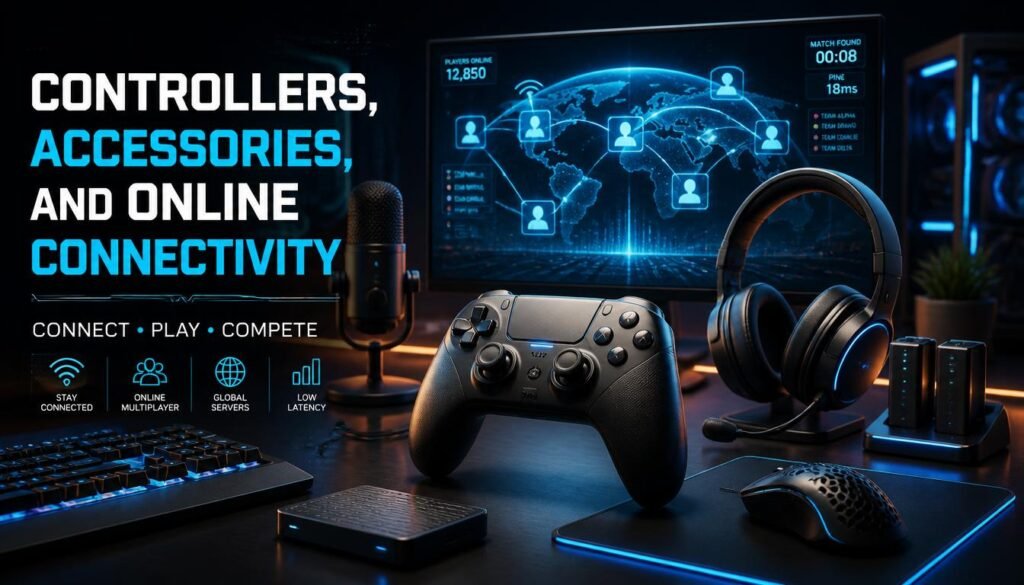
Controllers are one of the most important parts of the gaming console experience because they provide the connection between the player and the game. A typical controller includes analog sticks, directional controls, buttons, triggers, and shoulder buttons. Advanced controllers may also include vibration systems, motion sensors, touch-sensitive surfaces, speakers, microphones, or other technologies.
When a player performs an action, the controller converts that physical movement into an electronic signal. The console receives the signal and passes the information to the game software. The game determines how the action should affect the virtual environment and then updates the game state. This interaction happens continuously, which is why responsive controllers and low input latency are important for competitive and fast-paced games.
Consoles can also support specialized accessories. Racing wheels can improve driving games, arcade controllers can provide an experience similar to arcade machines, headsets allow players to communicate online, and motion-based accessories can introduce physical movement into gameplay. Accessibility controllers and adaptive devices can also help players with different physical requirements interact with games.
Internet connectivity has become another major part of modern console gaming. Consoles can connect to online services through Wi-Fi or wired Ethernet connections. Players can download games, install updates, synchronize saved data, communicate with friends, participate in multiplayer matches, and access digital stores. In online games, information must travel between the player’s console and game servers quickly. Low network latency is especially important because delays can affect the timing of player actions.
How to Choose the Right Gaming Console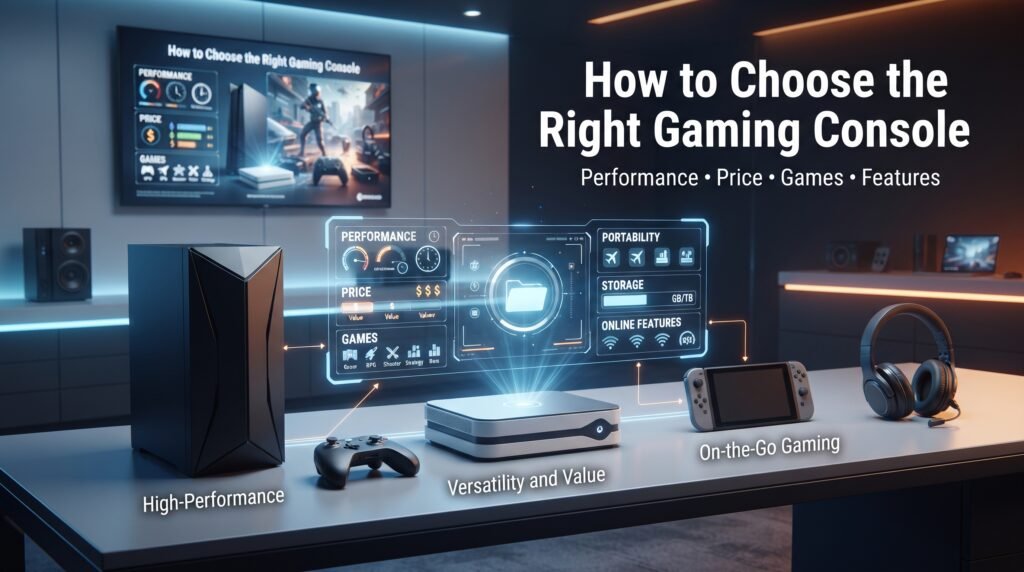
Choosing the right gaming console depends on the player’s priorities, budget, preferred games, and gaming environment. A home console is a strong choice for someone who wants high performance, large-screen gaming, powerful graphics, and a comfortable setup at home. A handheld console is more appropriate for players who value portability and want to play without a television. A hybrid system may be the best option for someone who wants both experiences in one device.
The available game library should also be considered carefully. Different platforms can have different exclusive games, services, accessories, and online features. Storage capacity is another important factor because modern games can occupy a large amount of space, especially when updates and downloadable content are included. Players should also consider controller comfort, display quality, online requirements, battery life for portable devices, and the long-term cost of games and accessories.
Ultimately, all gaming consoles are built around the same fundamental purpose: processing player input and game software to produce an interactive experience. The main differences come from how the hardware is designed and what the system prioritizes. Home consoles emphasize performance and large-screen gaming, handheld systems focus on portability, hybrid consoles combine both approaches, retro systems preserve classic gaming experiences, and cloud-based platforms move much of the processing to remote servers.
As technology continues to improve, the boundaries between these categories are becoming less distinct. Faster processors, better graphics hardware, improved battery technology, high-speed internet, SSD storage, and advanced software are allowing gaming systems to offer more powerful and flexible experiences. Whether someone prefers playing at home, gaming on the move, revisiting classic titles, or using cloud technology, there is now a wide range of console options designed to meet different gaming needs.