Full Stack Developer Guide: Skills, Tools, and Roadmap
Full Stack Developer Guide: Skills, Tools & Roadmap

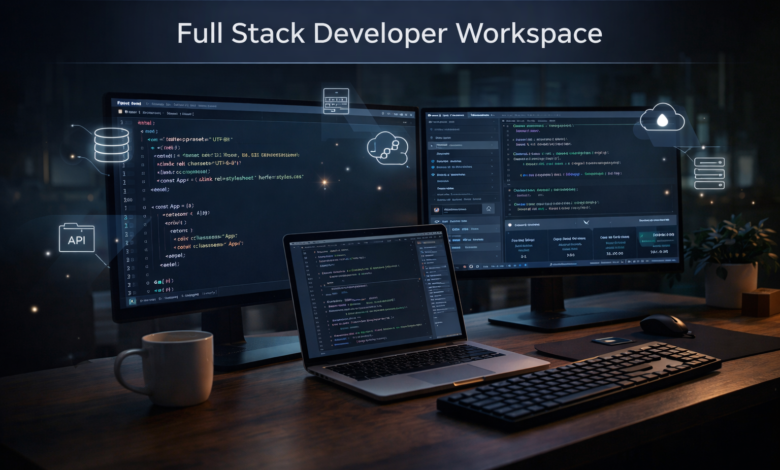
Technology is never the same. Due to this, firms desire developers with knowledge on both the front and the back end. This is possible for full stack developers. They construct complete programs between what the user would see and the database in the background.
It may appear difficult to become a full stack developer. Numerous tools, languages and frameworks exist. However, given a proper plan and the correct attitude, it is possible to learn it step-by-step.
This guide explains everything clearly. First, you will understand what full stack development means. Then, you will explore the required skills. Finally, you will see a practical roadmap to follow.
Full Stack Developers: What Is a Full Stack?
A full stack developer is the one who is dealing with both the client of the app and the server side. In simple terms, they deal with all that is seen by the user and all that is at the back of the scenes
The front-end is concerned with design and intercourse. The back end is associated with databases, servers and logic. These are interconnected by a full stack developer.
Firms such as the developers that are aware of the entire system rather than numerous specialists. It is the reason why there is a high demand for full stack developers.
What is the Rational for Full Stack Development?
Why then, you will ask, am I following this road. The answer is simple. It provides flexibility and good career development.
To begin with, you are aware of the entire project. Second, you become more talented in problem solving. Third, you can get more jobs. Full stack developers are also favored by the startups since they are able to perform numerous tasks.
It is easier to freelance when you are familiar with the entire stack. You are able to develop complete websites or applications on your own.
Core Skills You Must Learn
A number of areas need to be mastered in order to become a good full stack developer. Let’s look at them.
Front-End Development Skills.
The visual component of a web or application is created by the front end. It regulates design, structure and user interaction.
Essential Technologies:
- HTML- constructs web page framework.
- CSS- content structure and designs.
- JavaScript- introduces interactivity.
Once the fundamentals, frameworks of learning. For example:
- React
- Vue
- Angular
Frameworks assist you to make contemporary interfaces faster. Yet develop great knowledge of JavaScript first.
Back-End Development Skills
The back end handles logic. It handles orders and stores information.
Popular Back-End Languages:
- JavaScript (Node.js)
- Python
- PHP
- Java
The ecosystem in every language is different. JavaScript projects go well with node.js. Python is simple and clean
Also learn APIs. The APIs enable the front and back end to communicate. Apps do not have the ability to exchange data without APIs.
Database Knowledge
Apps need data storage. Database knowledge is necessary therefore.
Two Main Types:
- Relational Databases MySQL, postgreSQL
- NoSQL Databases – MongoDB
Tables are uniquely used in relational databases. NoSQL stores flexible data. Pick based on the project.
Study fundamentals of database operations: CRUD. These are the fundamentals of data management.
Version Control Systems
Track code changes with Git.
Git lets you:
- Save code versions
- Work with teams
- Manage updates
Store repositories in GitHub or GitLab. Employers expect this skill.

Basic DevOps and Deployment
Building an app is not enough. You must launch it.
Learn:
- Hosting basics
- Domain setup
- Cloud providers, such as AWS or Vercel.
Know how the environment variables and the server settings as well. These abilities assist in the operation of actual applications.
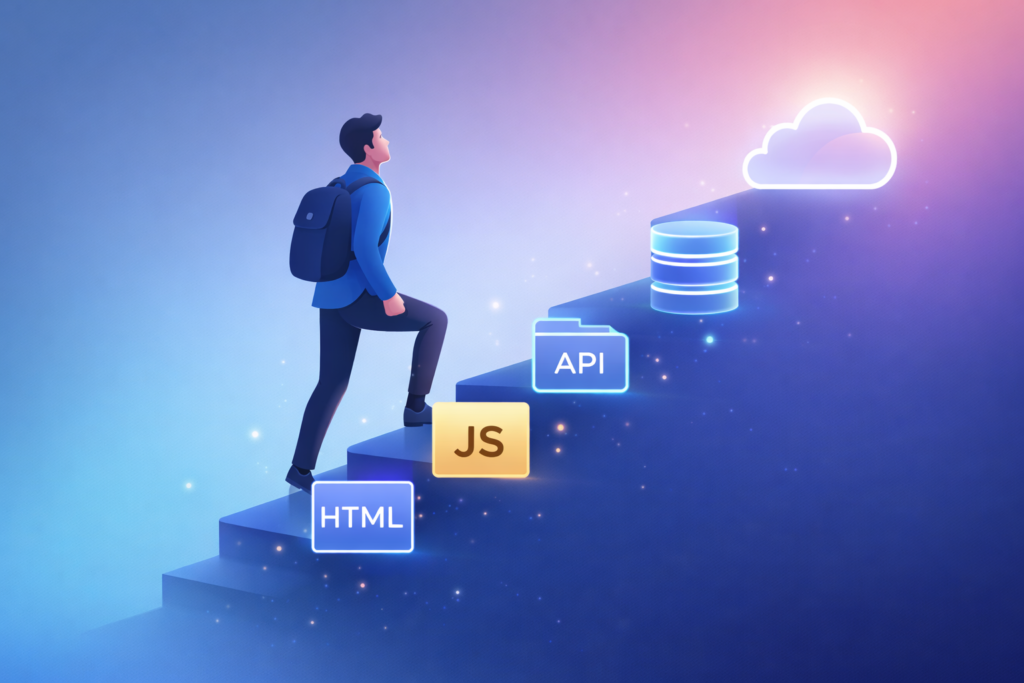
Full Stack Roadmap to Becoming a Developer
With the basic skills in mind, it is time to have a clear map.
Step 1: Learn the Basics.
Nobody starts with JavaScript or CSS. Build small projects like:
- A personal portfolio
- A simple calculator
- A to-do list app
Practice daily. Minor projects also contribute to the creation of confidence.
Step 2: Learn Git and GitHub
Track your code with Git. Push projects to GitHub. The portfolios are usually examined by the employers prior to the interviews. Have, not a complicated consistency, is better than have, not an intermediate consistency.
Step 3: Select a Front-End Framework.
Select one framework after JavaScript. React is famous and new user friendly. Pick what interests you.
Build dynamic apps such as:
- Weather app using an API
- Blog interface
- Movie search app
This is a step that develops practical skills.
Step 4: Transfer to Back-End Development.
Then study server-side programming. Begin with Node.js in case you know JavaScript and create REST APIs and integrate with your front end.
Create projects like:
- Authentication system
- Simple e-commerce backend
- Blog management system
This is when the thought process of a full stack developer begins.
Step 5: Learn Databases
Include databases into your backend. Take into account the user data and access information. Practice CRUD operations.
Construct a complete project which incorporates:
- Front end
- Back end
- Database
This is a full stack application.
Step 6: Implementation and Pro-Optimization.
Lastly, implement your project on the Internet. Use platforms like:
- Vercel
- Netlify
- Render
Ensure that the application operates well. Fix bugs. Improve performance.
The actual implementation draws beginners and professionals apart.
Essential Soft Skills
It is not sufficient that one knows certain technical things. You need soft skills too.
- Problem-solving mindset
- Good communication
- Time management
- Adaptability
Technology changes fast. Stay curious. Read docs. Follow tech blogs. Watch tutorials. Build regularly.
Common Mistakes to Avoid
Novices are prone to the same errors. Avoid them early.
- Switching between excessive models.
- Skipping fundamentals
- Duplicating knowledge without the knowledge.
- Ignoring deployment
Focus on depth over speed. Progress steadily.
How Long Does It Take?
The schedule will rely on the regularity with which you work. With the practice per day, you can be career-ready within 6 to 12 months. In programming, shortcuts are not very helpful.
Build projects. Solve problems. Keep learning
Final Thoughts
Full stack development is an exciting opportunity. It is an amalgamation of logic and creativity. It will allow you to create whole digital solutions.
Start with the basics. Practice often. Build real projects. Deploy them. Improve step by step.
Most importantly, be patient.