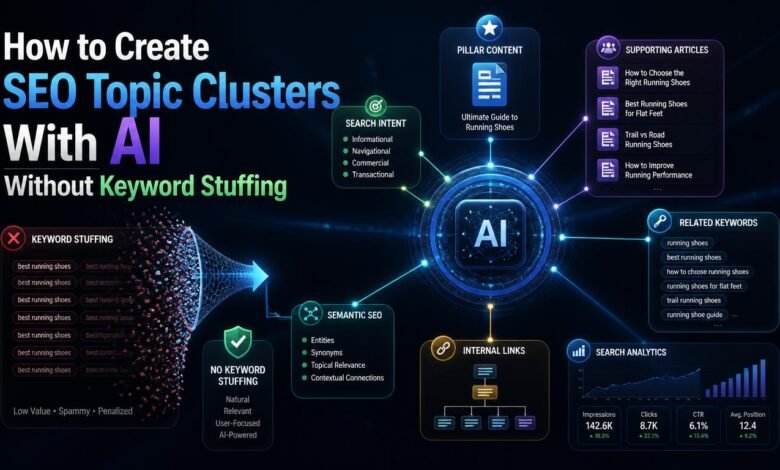
Search engine optimization has changed significantly as search engines have become better at understanding topics, context, relationships between concepts, and user intent. Instead of creating dozens of unrelated articles around individual keywords, websites can build SEO topic clusters that organize content around a central subject and several closely related subtopics. This approach helps create a logical website structure while giving readers more complete information about a subject.
Artificial intelligence can make this process much faster. AI can help identify related subtopics, organize keywords, analyze search intent, discover content gaps, and suggest internal linking opportunities. However, using AI incorrectly can lead to repetitive articles, unnatural keyword placement, and keyword stuffing. The goal should not be to insert the same keyword into every paragraph. Instead, AI should be used as a research and planning assistant while the final content remains useful, natural, and focused on the reader.
What Are SEO Topic Clusters?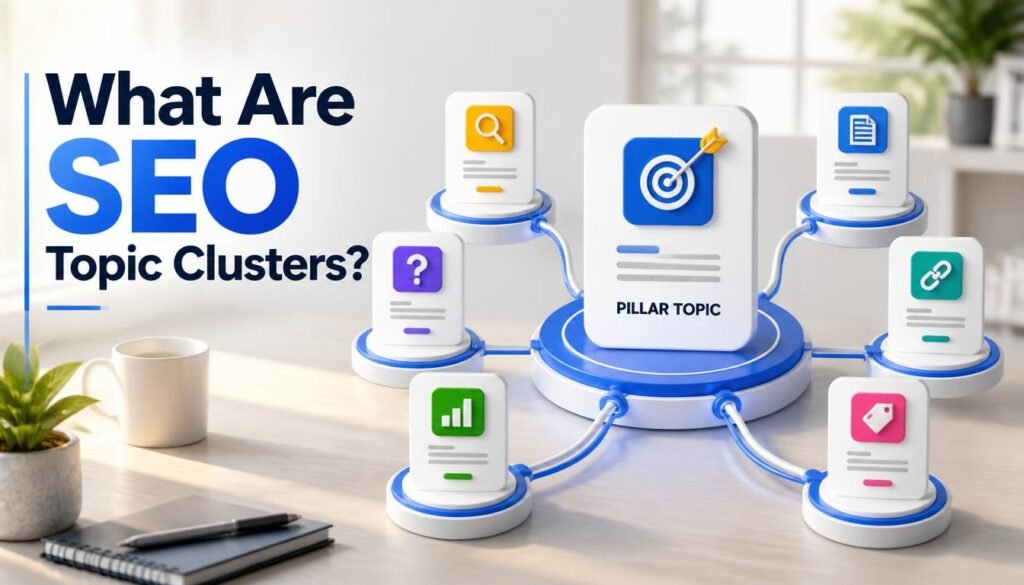
An SEO topic cluster is a group of interconnected pages that cover different aspects of one broad topic. The structure normally includes a pillar page, which provides a comprehensive overview of the main subject, and several supporting articles that answer more specific questions related to that subject. These supporting pages are connected to the pillar page and, where appropriate, to one another through internal links.
For example, suppose a website focuses on gaming. A pillar page could target the broad topic “PC Gaming.” Supporting articles could cover gaming laptop optimization, reducing game stuttering, choosing gaming RAM, improving FPS, controller troubleshooting, and graphics settings. Each article addresses a different search intent, but all of them contribute to the broader PC gaming topic.
This structure is useful because readers can move naturally from general information to more detailed answers. Search engines can also better understand the relationship between the pages. A well-organized cluster demonstrates that a website covers a subject comprehensively rather than publishing isolated articles simply because individual keywords have search volume.
Why Topic Clusters Matter for SEO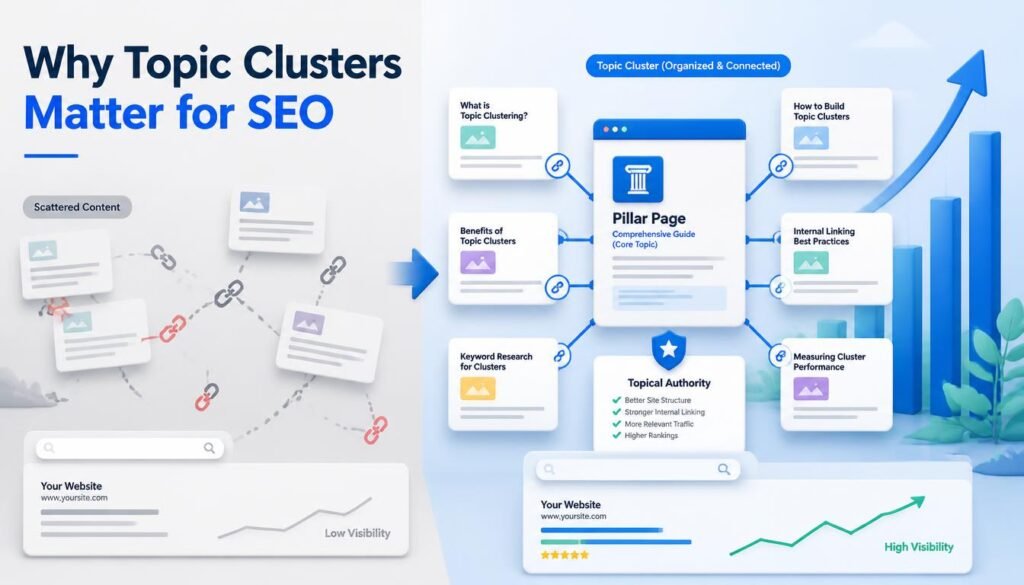
Topic clusters can help a website build topical relevance by covering a subject from multiple useful angles. When several high-quality pages discuss related concepts and are logically connected, the website develops a stronger content structure. This does not mean that creating more pages automatically produces better rankings. Every page still needs to satisfy its own search intent and provide genuinely useful information.
Another advantage is that topic clusters make content planning easier. Instead of constantly searching for completely new blog ideas, you can start with one major subject and expand it into dozens of related questions. This creates a long-term editorial strategy and reduces the possibility of publishing random topics that have little relationship to the rest of the website.
Topic clusters can also improve internal linking. A supporting article can link back to the main pillar page when readers need broader information, while the pillar page can link to detailed supporting articles. This creates a clear navigation path and helps users discover additional relevant content.
How AI Helps Build SEO Topic Clusters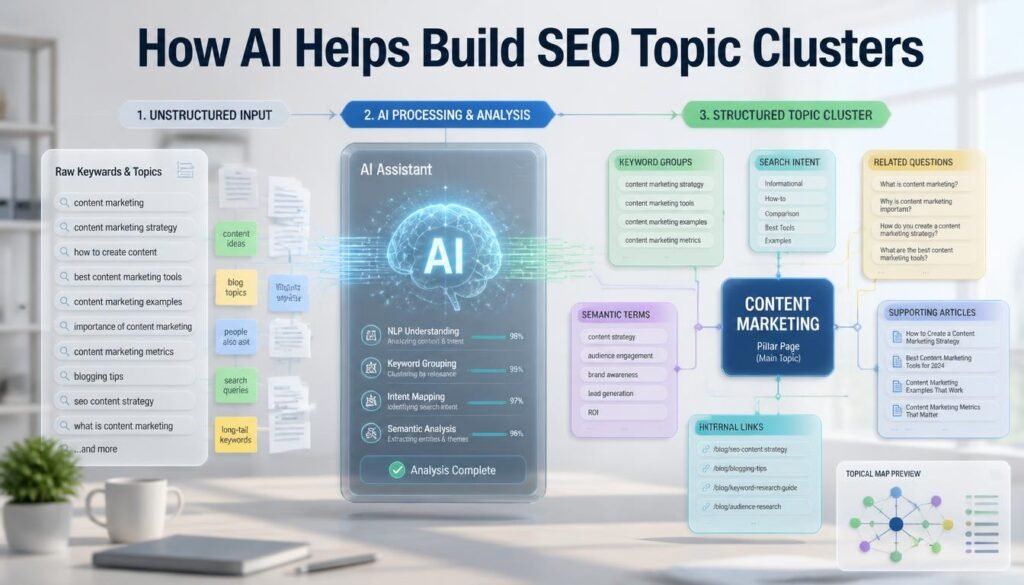
AI can significantly reduce the research and planning time required to create a topic cluster. Instead of manually brainstorming every possible subtopic, you can give an AI tool your primary subject and ask it to generate related concepts, questions, comparisons, problems, use cases, and beginner-to-advanced topics.
For example, if your primary topic is “Android phone performance,” AI might identify subtopics such as reducing background processes, freeing storage, managing battery usage, clearing unnecessary cache, improving gaming performance, troubleshooting overheating, and dealing with slow performance after updates.
The important point is that you should not blindly publish every AI-generated idea. AI-generated lists often contain overlapping subjects or topics that have little independent value. Review the suggestions and group similar ideas together. Some topics may deserve their own article, while others should be combined into a larger guide.
AI is particularly useful for identifying relationships between topics. You can ask it to categorize ideas according to search intent, such as informational, troubleshooting, comparison, commercial investigation, or how-to. This makes it easier to build a cluster where each page serves a distinct purpose.
How to Find a Main Topic and Supporting Subtopics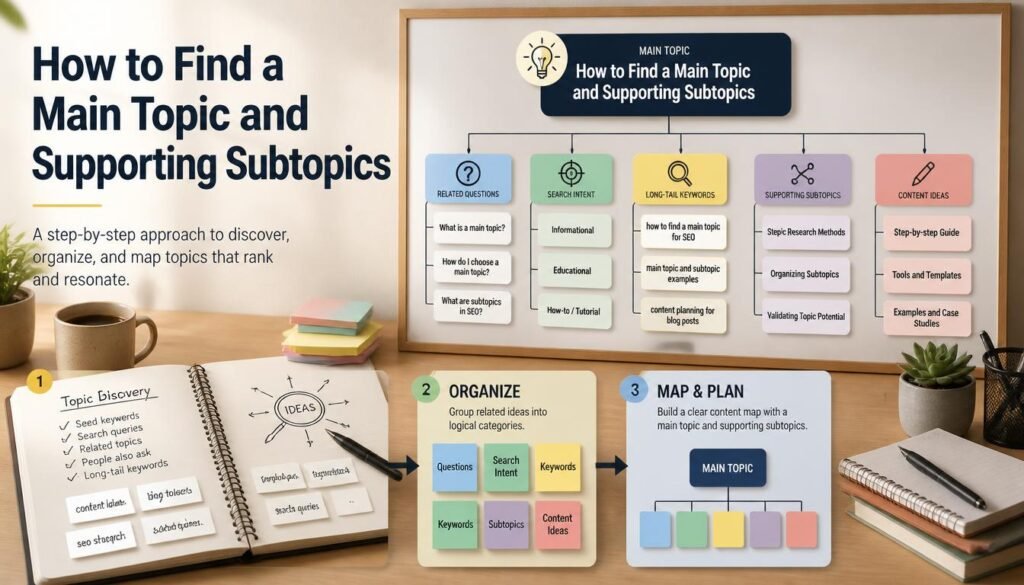
Start by selecting a broad topic that is directly relevant to your website. The main topic should be broad enough to support multiple useful articles but specific enough that your website can realistically develop authority around it.
Once you have the main topic, create a list of related questions and problems. AI can help generate these ideas, but combine AI research with real search behavior. Look at autocomplete suggestions, related searches, forums, discussions, competitor content, and questions people commonly ask about the subject.
Next, remove duplicate or nearly identical ideas. For example, “How to speed up an old Android phone” and “How to make an old Android phone faster” may represent the same search intent. Creating separate pages for both could produce unnecessary overlap. Instead, combine them into one stronger article.
You should also identify the search intent behind every subtopic. Two keywords may look different but have almost identical intent, while two similar keywords may require completely different pages. Your goal is to create a cluster where every article has a clear reason to exist.
How to Create a Strong Pillar Page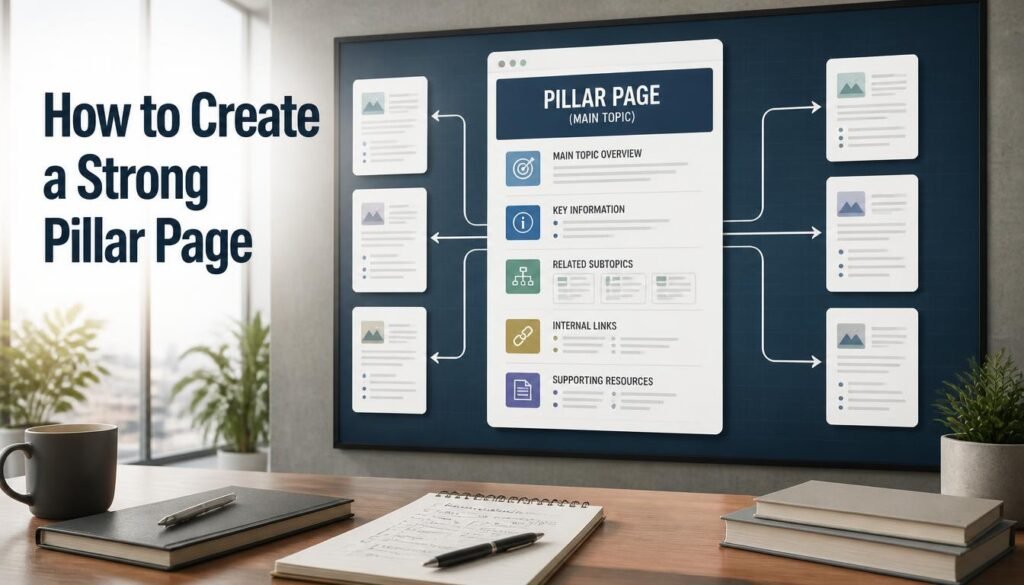
The pillar page should provide a broad and useful overview of the main subject without trying to answer every small question in extreme detail. It acts as the central resource from which readers can access more specialized information.
For example, a pillar article about “Android Phone Performance” could explain the major factors affecting performance, including storage, RAM, background applications, software updates, battery condition, thermal throttling, and device age. Each major area can then link to a dedicated supporting article that explains the subject in greater depth.
A good pillar page should be organized logically and should answer the most important beginner questions. It should also introduce readers to the supporting resources available on the website. However, avoid turning the pillar page into a collection of forced keyword variations. Write it as a genuinely useful guide first and optimize it naturally afterward.
The pillar page should also be periodically updated. As you publish new supporting content, review the main guide and add relevant internal links. This keeps the cluster connected and helps prevent the pillar page from becoming outdated.
How to Build Supporting Content and Internal Links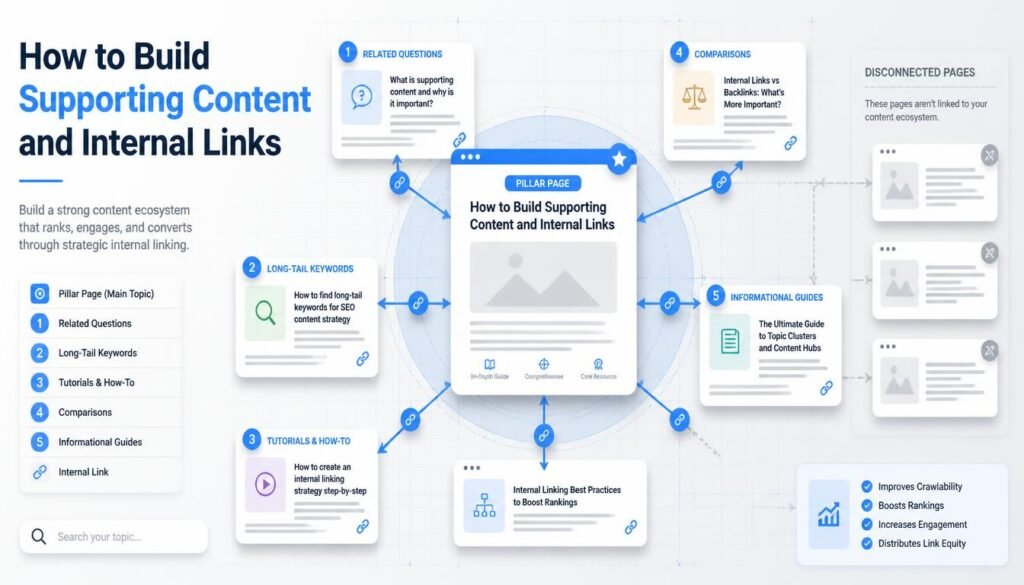
Supporting articles should focus on specific problems, questions, or subtopics connected to the main subject. Each article should have a clearly defined purpose. If two articles provide essentially the same answer, consider combining them instead of maintaining both.
Internal linking is one of the most important parts of a topic cluster. When writing a supporting article, link to the pillar page when readers may benefit from broader context. You can also link to other supporting articles when they provide additional information that naturally continues the discussion.
Use descriptive anchor text that tells readers what they will find after clicking. For example, instead of repeatedly using an exact keyword as the anchor, you could use natural phrases such as “our guide to reducing Android background activity” or “learn how to free up internal storage.”
Avoid creating links simply to increase the number of internal links on a page. Every link should have a purpose. A smaller number of highly relevant links is usually more useful than a large collection of unrelated links.
How to Use Keywords Naturally Without Keyword Stuffing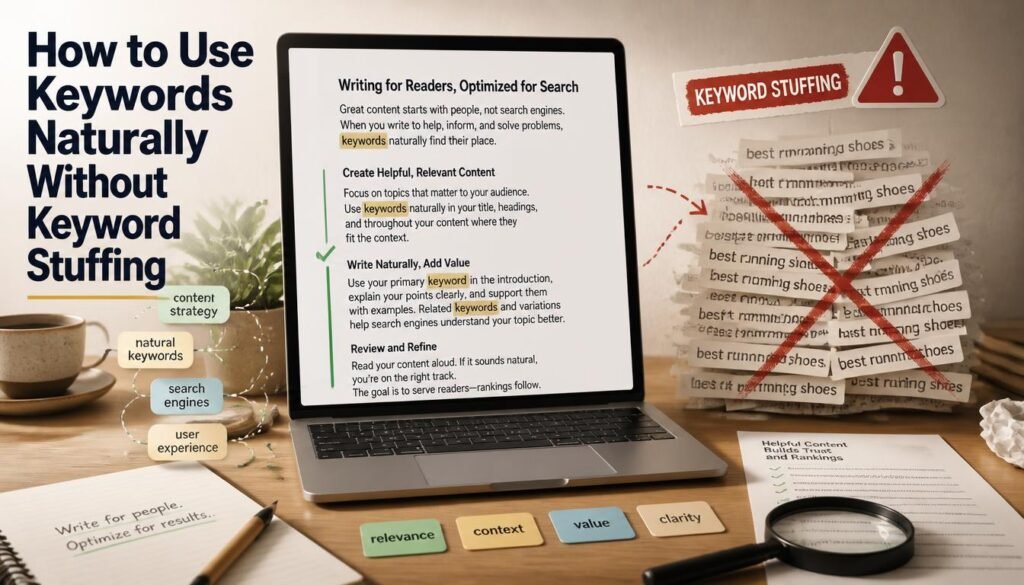
Keyword stuffing happens when keywords are inserted excessively or unnaturally in an attempt to manipulate search rankings. Repeating the exact same phrase in every heading, paragraph, image description, and link can make content difficult to read and may reduce its quality.
A better approach is to understand the topic behind the keyword. If your target phrase is “SEO topic clusters with AI,” you do not need to repeat that exact phrase throughout the article. You can naturally discuss related concepts such as content clusters, topical authority, semantic relationships, keyword grouping, pillar pages, supporting content, search intent, and internal linking.
AI can help identify related terminology, but it should not be used to generate artificial keyword variations merely for the purpose of increasing keyword frequency. Search engines increasingly rely on context and meaning, so comprehensive coverage is more valuable than repetitive wording.
A simple rule is to write for humans first. Include the primary keyword where it makes sense, particularly in important elements such as the title and introduction, but allow the language to vary naturally throughout the article. If removing a keyword would make a sentence sound more natural, remove it.
Common AI Topic Cluster Mistakes to Avoid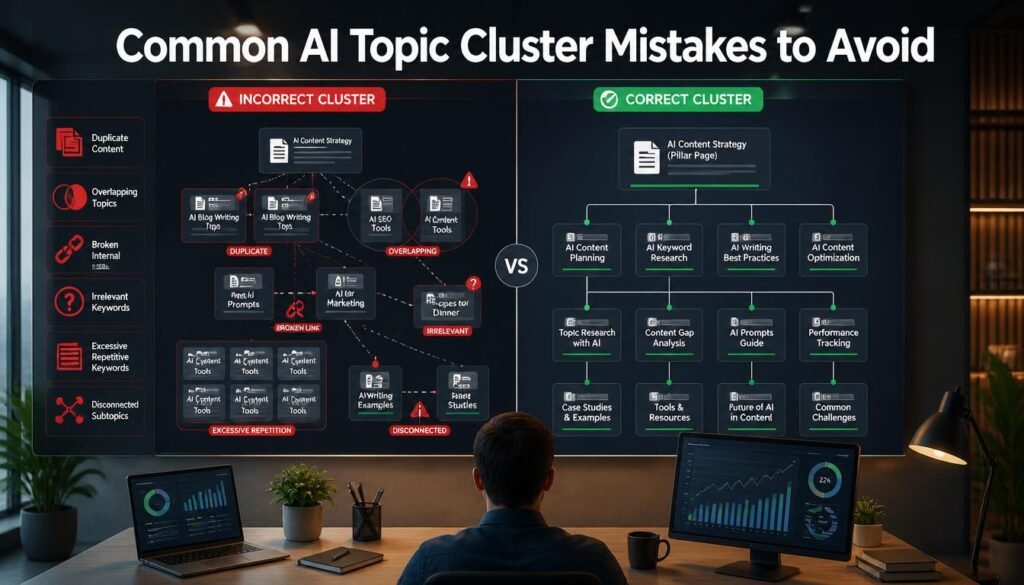
One of the biggest mistakes is allowing AI to generate dozens of articles without reviewing whether they provide unique value. This can result in content that repeatedly explains the same concepts using slightly different wording. Such a cluster may look large but lack genuine topical depth.
Another mistake is targeting every related keyword with a separate page. Keywords should not automatically become individual articles. Consider search intent, topic similarity, audience needs, and whether the proposed page offers enough unique information to justify its existence.
AI-generated content can also contain factual errors, outdated recommendations, generic explanations, or unnecessary repetition. Human review remains essential, particularly for technical topics where software versions, hardware specifications, security recommendations, and procedures can change.
Finally, do not use AI simply to produce content faster. The real advantage comes from using AI for research, organization, ideation, comparison, and content planning while maintaining editorial judgment over what should actually be published.
How to Measure and Improve Your Topic Cluster
After publishing a topic cluster, monitor how individual pages perform rather than judging the entire cluster as one unit. Look at impressions, clicks, rankings, engagement, and the queries bringing visitors to each page. This can reveal which subtopics are attracting interest and where additional content may be useful.
You may discover that one supporting article begins ranking for several related queries. That can indicate an opportunity to expand the article, improve its internal links, or create another highly relevant supporting page. On the other hand, if two pages compete for very similar queries, consider whether they should be combined or differentiated more clearly.
Review your internal links regularly and make sure important pages are connected logically. Update outdated information and remove unnecessary content where appropriate. A topic cluster should be treated as an evolving information system rather than a collection of articles that is published once and forgotten.
The most effective AI-assisted SEO strategy is therefore not about producing the largest possible number of pages or repeating keywords as frequently as possible. It is about understanding a subject, organizing it into meaningful subtopics, matching each page to a specific search intent, and connecting those pages into a useful information structure. When AI is used for research and organization rather than keyword manipulation, it can help you build topic clusters that are more comprehensive, natural, and valuable to both readers and search engines.
Conclusion
Creating SEO topic clusters with AI is an effective way to organize your website around important subjects while building a stronger and more useful content strategy. AI can help you discover related subtopics, group keywords, understand search intent, identify content gaps, and plan supporting articles much faster. However, the goal should never be to create as many pages as possible or repeat the same keyword throughout every article.
A successful topic cluster depends on useful content, clear topical relationships, strong internal linking, and a logical structure that helps readers find the information they need. Your pillar page should cover the main subject comprehensively, while supporting articles should answer specific questions and provide additional depth.
Most importantly, use keywords naturally and focus on covering the subject rather than manipulating keyword frequency. When AI is used as a research and planning assistant instead of a replacement for editorial judgment, it can help you build organized, comprehensive, and reader-focused topic clusters that support long-term SEO growth.