Choosing the right laptop can feel difficult when several trusted brands offer similar options. Dell and HP remain popular choices for students, professionals, creators, and everyday users. Both companies offer laptops across different prices, performance levels, and user requirements. However, their individual models can differ significantly in features and overall value.
If you are comparing dell vs hp laptops, understanding those differences can simplify your buying decision. Your ideal choice depends on performance, portability, battery life, display quality, and budget. In this guide, Its Tech club compares Dell and HP laptops across important buying factors. The goal is helping you choose a laptop that matches your everyday needs.
Dell vs HP Laptops: Quick Comparison
Dell and HP both offer laptops designed for different types of users. Dell currently separates its consumer, professional, workstation, and gaming offerings. Its lineup includes Dell, XPS, Dell Pro, Precision, and Alienware families.
HP similarly provides several laptop families covering everyday and professional requirements. Its current lineup includes OmniBook, EliteBook, ProBook, ZBook, OMEN, and Victus models.
| Feature | Dell Laptops | HP Laptops |
|---|---|---|
| Everyday use | Strong selection | Strong selection |
| Premium laptops | XPS | OmniBook Ultra |
| Business laptops | Dell Pro | EliteBook and ProBook |
| Gaming | Alienware | OMEN and Victus |
| Workstations | Precision and Pro Max | ZBook |
| Portability | Excellent on premium models | Excellent on selected models |
| Battery life | Depends strongly on model | Depends strongly on model |
| Value | Strong across different budgets | Strong across different budgets |
This comparison shows why choosing a specific model matters more than choosing brands alone. Both companies provide suitable options for different performance and budget requirements.
Dell vs HP: Performance
Performance depends mainly on the processor, memory, storage, cooling, and graphics hardware. Therefore, neither brand automatically wins every performance comparison. A higher specification laptop from either company can outperform weaker competing models.
Dell offers laptops using modern Intel, AMD, and other processor platforms. Its premium XPS range focuses on portable performance and demanding productivity. Alienware models target gaming and graphics-intensive workloads with dedicated hardware.
HP also offers modern processors across its OmniBook and professional laptop families. Current OmniBook models include Intel, AMD, and Snapdragon processor options. Higher-end OmniBook models support demanding creative and technical workloads.
For everyday browsing, office work, and studying, both brands provide sufficient performance. For demanding workloads, compare individual processors, RAM capacities, and graphics hardware carefully.
Dell vs HP: Build Quality and Design
Build quality can strongly influence how comfortable and reliable your laptop feels. Dell offers several premium laptops designed with portability and refined construction. Current XPS models use premium materials and focus heavily on thin, lightweight designs.
HP also provides premium designs across several modern laptop families. Its OmniBook lineup ranges from affordable everyday machines to premium professional models. Some models combine lightweight construction with high-resolution OLED displays and flexible designs.
Dell may appeal more to users who prefer minimalist premium construction. HP provides similarly attractive choices across consumer and professional categories. Always inspect the exact model before deciding based on design alone.
Dell vs HP: Battery Life
Battery life depends on several factors beyond the laptop manufacturer. Processor efficiency, screen resolution, battery capacity, brightness, and applications affect real-world runtime. Therefore, published battery figures should always be treated as model-specific estimates.
Dell’s current XPS lineup emphasizes portability and extended battery performance. For example, Dell lists different battery estimates across its XPS models. The company currently positions XPS as its premium lightweight laptop family.
HP also offers battery-focused laptops across its current OmniBook portfolio. Some OmniBook models emphasize efficient processors and extended battery performance. These options can benefit students and professionals who frequently work away from outlets.
For the best battery experience, compare specific configurations instead of entire brands. A lower-resolution display can sometimes provide better endurance than premium high-resolution alternatives.
Dell vs HP: Display Quality
Display quality has become increasingly important for work, entertainment, and creative activities. Dell offers high-resolution displays across premium XPS models and selected mainstream laptops. Some current XPS configurations include advanced OLED display options.
HP also provides OLED displays across selected OmniBook models and premium configurations. Certain OmniBook models offer displays reaching 3K resolution and high color accuracy. These features can benefit photographers, designers, editors, and multimedia enthusiasts.
However, display quality varies considerably between individual laptop configurations. Always check resolution, brightness, refresh rate, panel technology, and color coverage before purchasing.
Dell vs HP for Students
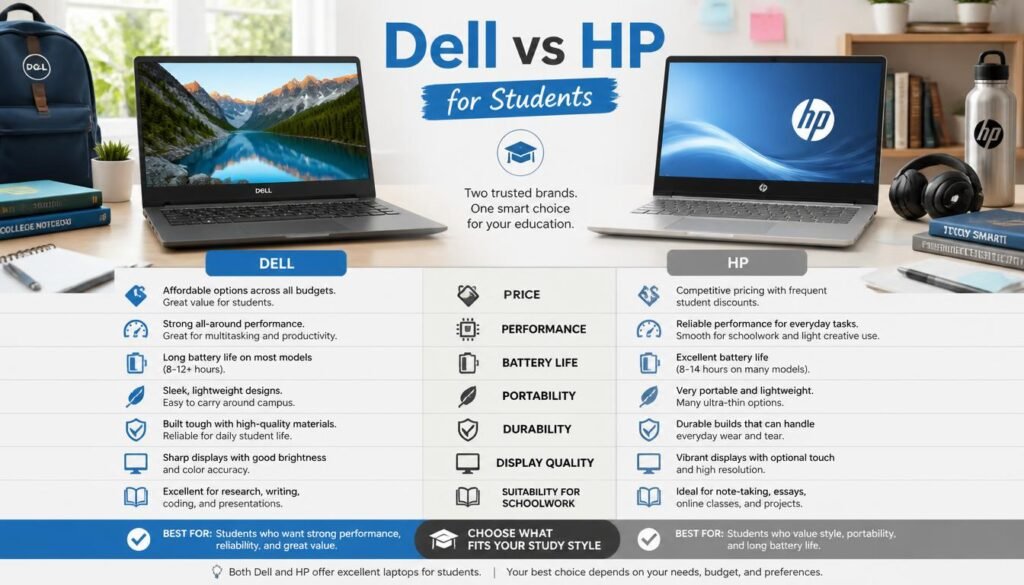
Students usually need affordable performance, good battery life, portability, and comfortable keyboards. Both Dell and HP offer laptops suitable for school, university, and general productivity. Your choice should depend on your coursework and expected workload.
Dell provides everyday laptops alongside premium XPS options for students needing additional performance. Dell’s current portfolio also includes education-focused devices and different screen sizes.
HP offers OmniBook models specifically positioned for students and everyday home users. Its current lineup includes affordable options alongside more powerful portable computers.
For basic documents, browsing, presentations, and online classes, either brand can work well. Students studying demanding subjects should prioritize RAM, processor performance, storage, and battery capacity.
Dell vs HP for Business
Business users often prioritize security, reliability, manageability, and long-term productivity. Dell’s professional portfolio includes Dell Pro and workstation-focused Precision families. Dell describes its professional systems as designed for security, manageability, and productivity.
HP provides professional options through EliteBook and ProBook families. Enterprise-focused HP laptops can include security and management technologies for organizational environments. Its ZBook range targets professionals requiring more specialized workstation performance.
For office users, both brands provide strong business-focused choices. Companies should compare security features, warranty coverage, manageability, ports, and service options.
Dell vs HP for Gaming
Gaming laptops require powerful processors, dedicated graphics, effective cooling, and fast displays. Dell competes strongly through its Alienware gaming portfolio. Alienware focuses on high-performance gaming alongside demanding creative and graphics-intensive workloads.
HP competes through its OMEN and Victus gaming laptop families. OMEN generally targets higher-performance gaming, while Victus provides more accessible gaming options.
Gamers should compare graphics cards, cooling systems, display refresh rates, and upgrade options. These specifications matter more than the brand name when gaming performance matters most.
Dell vs HP: Price and Value
Price remains one of the biggest factors when choosing between Dell and HP laptops. Both brands offer affordable, mid-range, premium, business, and gaming options. Therefore, comparing equivalent specifications provides a more useful value assessment.
Dell provides mainstream laptops alongside premium XPS and specialized Alienware machines. HP offers everyday OmniBook systems alongside premium and professional alternatives.
A cheaper laptop is not automatically better value for your requirements. Consider processor performance, RAM, storage, display quality, battery life, warranty, and upgradeability. Paying slightly more can provide better long-term value when specifications significantly improve.
Which Is Better, Dell or HP?
There is no single answer that makes one brand better for everyone. Dell can be an excellent choice for premium portability, business computing, and gaming. HP also provides strong choices for students, professionals, creators, and everyday users.
Your intended workload should guide the final decision instead of brand loyalty. Students should prioritize portability, battery life, and sufficient performance for their coursework. Professionals should focus on security, reliability, connectivity, and long-term productivity.
Gamers should compare graphics performance, cooling, screen refresh rates, and gaming-specific features. Creators should prioritize display quality, processor performance, memory, storage, and dedicated graphics.
Final Verdict
The dell vs hp laptops comparison does not produce one universal winner for every buyer. Both brands offer impressive choices across everyday, premium, professional, gaming, and workstation categories. The best laptop depends on your budget, workload, preferred features, and expected usage.
Dell is worth considering when premium portability, business features, or gaming performance matter most. HP can be equally compelling when you want flexible consumer, professional, or creator-focused choices.
Before buying, compare the exact models rather than judging the entire brands. Check the processor, RAM, SSD, display, battery, graphics, ports, warranty, and upgrade options carefully. This approach helps you avoid paying for features that your everyday workload does not require.
For readers of Its Tech Club, the simplest advice remains choosing specifications around your actual needs. A well-matched laptop from either brand can deliver excellent performance for several years.