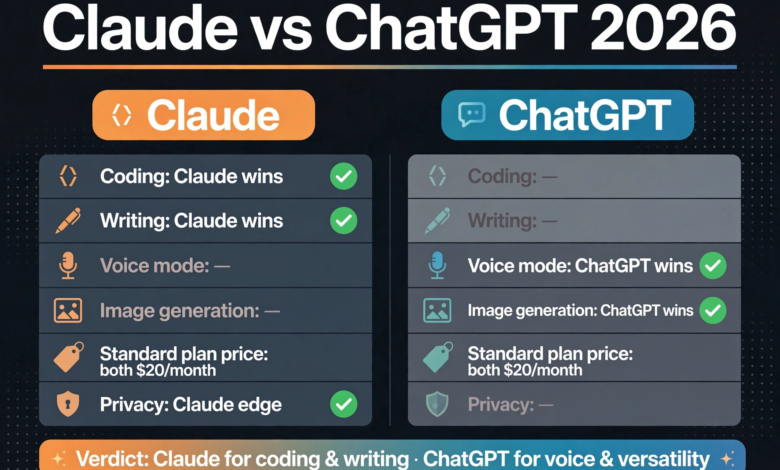
If you are choosing between Claude and ChatGPT in 2026, both are better than ever. The claude vs chatgpt 2026 race is closer than ever, with Claude shipping its 5.5 model family (Opus 5.5, Sonnet 5.5 and Haiku 5.5, plus the highest tier Fable 5.1) while OpenAI rolled out GPT 6 across all ChatGPT plans in October 2026. The GPT 6 update adds a new Intelligent UI that turns answers into interactive charts, calculators and tools, and this guide compares the two across coding, writing, research, voice, images, price and privacy so you can pick the right one.
Quick verdict: For most people, there is no single winner. Claude leads at coding, long document work, and careful reasoning, while ChatGPT leads at voice conversations, image generation, and everyday versatility. Pick Claude if you code or write for a living. Pick ChatGPT for one assistant that does a bit of everything.
Which AI assistant is better for coding in 2026?
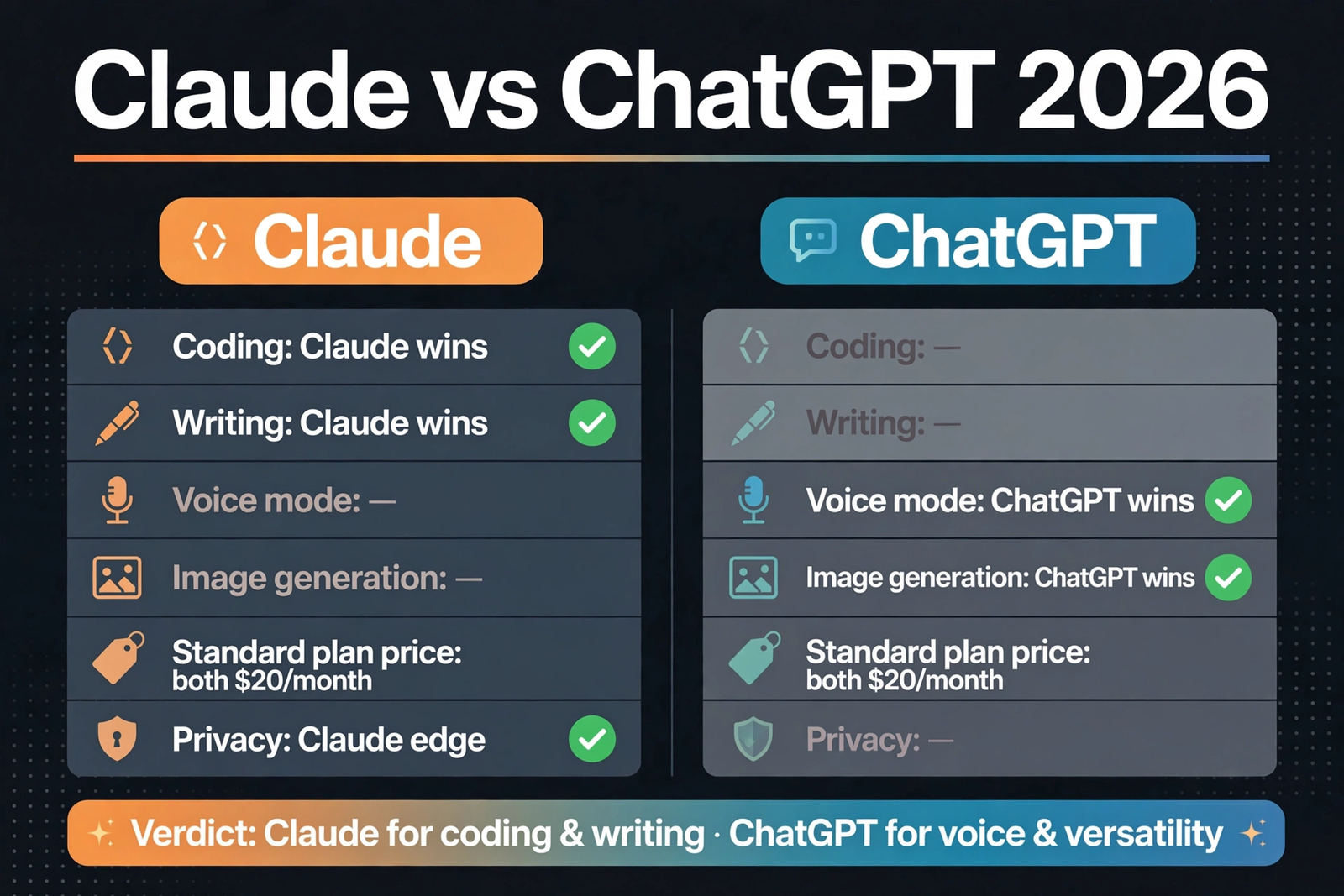
Claude is still the stronger choice for serious coding in 2026. Claude Code, Anthropic’s dedicated agentic coding tool, lives in your terminal and handles large codebases, and it is included with every paid Claude plan. Opus 5.5 and Sonnet 5.5 also ship with a 1 million token context window, so Claude can read entire projects without losing track.
ChatGPT counters with Codex, OpenAI’s coding agent, and GPT 6 is a strong coder. Even so, developers often praise Claude for following instructions precisely and writing cleaner first drafts. For serious programming, Claude edges ahead, while ChatGPT’s Canvas workspace stays handy for lighter coding and editing.
Which is better for writing and long documents?
Claude wins for writing. Its tone is naturally measured and human, and it is noticeably better at following style instructions and structuring long form content. With a 1 million token context window, Claude can digest entire reports, books or research papers and summarize them accurately.
ChatGPT writes well too, and its Projects and Canvas features help organize long term writing. But Claude’s drafts usually need less rewriting, for emails, reports, essays and creative writing alike. If writing is your daily job, Claude’s edge is hard to ignore.
Which has better web research and browsing in 2026?
This one is close. ChatGPT’s Deep Research is a polished product: it explores multiple online sources and returns structured, cited reports, and OpenAI says GPT 6 is better at deciding when it actually needs to search.
Claude’s deep research mode also returns cited, structured reports, and its source handling is careful and transparent. But ChatGPT’s ecosystem of apps, connectors and Scheduled Tasks makes it the stronger research sidekick when you want recurring research delivered on a schedule. For one off deep dives, they are close.
Which AI assistant is better for voice conversations in 2026?

ChatGPT is the clear winner for voice. Rebuilt around its full duplex GPT Live model, it lets you talk naturally, interrupt, and be heard and answered almost simultaneously, with live translation and visual cards built in. Plus and Pro subscribers can even draft documents or summarize emails by voice on mobile.
Claude offers a real time voice mode in its mobile apps, but it is a simpler experience, closer to voice input than a true conversational companion. If hands free conversation matters, ChatGPT is the one to beat.
Which is better for images, visuals and interactive answers?
ChatGPT wins on visuals by a wide margin. It has built in image generation (ChatGPT Images), and the October 2026 GPT 6 update added Intelligent UI. ChatGPT can now generate interactive diagrams, charts, comparison layouts and even small working tools like calculators right inside the chat.
Claude is a text first assistant. Its Artifacts, interactive charts, diagrams and small web apps inside the chat, are excellent for data visualization, but image generation is not its focus. For illustrations, mockups or visual brainstorming, ChatGPT is the obvious pick.
Claude vs ChatGPT 2026: which is cheaper?

Both start at $0, and both charge $20 for the standard plan. Here is how the paid plans compare as of October 2026.
- Free: $0 on both, best for casual users. Note that ChatGPT Free is ad supported.
- Budget tier: Claude offers nothing here. ChatGPT Go costs $8/month and suits frequent casual users.
- Standard: Claude Pro costs $20/month ($17/month billed annually). ChatGPT Plus costs $20/month. Best for daily individual use.
- Power tier: Claude Max 5x costs $100/month. ChatGPT Pro costs $100/month. Best for heavy daily users and coding agents.
- Top tier: Claude Max 20x costs $200/month. ChatGPT Pro costs $200/month. Best for power users, researchers and parallel workloads.
Two things stand out. ChatGPT’s $8 Go plan fills the gap between Free and Plus, a budget step Claude does not offer, and both companies’ top tiers scale at 5x and 20x the standard plan’s usage. On both sides, the $20 plan is where most individuals land, though prices change, so check the official pricing pages before subscribing.
Which AI assistant is better for privacy?
Claude has the stronger privacy reputation. Anthropic positions itself as safety first and says it does not train its models on private consumer conversations by default. Its business and team plans add enterprise grade controls, and features like computer use sit behind careful permission systems.
ChatGPT offers privacy controls too, including memory management, conversation deletion and data settings. But its free and Go tiers are ad supported. If privacy is your top concern, Claude is the safer choice, though you should read both companies’ current privacy policies, since these details change.
Claude vs ChatGPT 2026: feature by feature comparison
Flagship model (October 2026)
Claude: Opus 5.5 and Sonnet 5.5 with a 1 million token context window. ChatGPT: GPT 6 Sol on paid plans and Luna on the free plan.
Coding agent
Claude: Claude Code, a terminal tool included on paid plans. ChatGPT: Codex.
Voice mode
Claude: voice mode in its mobile apps. ChatGPT: full duplex GPT Live voice.
Image generation
Claude: text first, with Artifacts for charts and diagrams. ChatGPT: built in image generation plus Intelligent UI.
Web research
Claude: deep research with citations. ChatGPT: Deep Research plus Scheduled Tasks.
Memory
Claude: yes. ChatGPT: yes.
Computer use
Claude: research preview for Pro and Max. ChatGPT: Agent and Work tools.
App connectors
Claude: MCP connectors for Slack, Drive and GitHub. ChatGPT: apps, Custom GPTs and plugins.
Free tier ads
Claude: no ads reported. ChatGPT: yes, on Free and Go.
Key takeaways: Claude vs ChatGPT in 2026
- Pick Claude if you code regularly, write for a living, work with long documents, or want the strongest privacy posture. Claude Pro ($20/month) is one of the best value AI subscriptions.
- Pick ChatGPT if you want voice conversations, image generation, interactive answers, or one assistant for everything from homework to trip planning. Plus ($20/month) remains the most versatile mainstream option.
- Students and casual users get a lot for free on both. But note that ChatGPT’s free tier shows ads.
- Power users face a mirror image choice: Claude Max ($100/$200) vs ChatGPT Pro ($100/$200). Claude Code heavy users lean Claude, while research and voice users lean ChatGPT.
- You can use both. Many professionals keep Claude Pro for coding and writing plus ChatGPT (free or Plus) for voice, images and research, still cheaper than either company’s $100 power tier.
The bottom line
The claude vs chatgpt 2026 comparison has no single winner. It has two winners for different jobs. Claude is the craftsman’s tool: better code, better prose, deeper focus, stronger privacy. ChatGPT is the all rounder: better voice, better visuals, broader ecosystem, and a budget friendly $8 Go tier.
Match the assistant to your main use case, and you cannot go far wrong. Or pay for both if you use AI all day.
FAQs
What is the difference between Claude and ChatGPT?
Claude is Anthropic’s AI assistant, known for careful reasoning, strong coding with Claude Code, and natural writing. ChatGPT is OpenAI’s AI assistant, known for versatility, voice conversations, image generation and a huge app ecosystem. As of October 2026, Claude runs on the 5.5 model family while ChatGPT runs on GPT 6.
Which is better, Claude or ChatGPT, for students?
Both work well, and both have free tiers. ChatGPT’s free tier includes Study Mode and voice conversations, which suit learning, though it shows ads. Claude’s free tier is excellent for essay writing and understanding complex topics. For a $20 upgrade, students who code or write should lean Claude, while students who study by voice or need images should lean ChatGPT.
Is Claude better than ChatGPT for coding?
Yes, in most developers’ experience. Claude Code is a dedicated agentic coding tool included with paid Claude plans, and Claude’s models are widely praised for clean, correct code. ChatGPT’s Codex is capable, but Claude remains the first choice for serious software development in 2026.
How much do Claude and ChatGPT cost in 2026?
Both cost $20/month for their standard plans (Claude Pro and ChatGPT Plus). ChatGPT also offers an $8/month Go plan, while Claude has no budget tier. Both offer power tiers at $100 and $200 per month (Claude Max and ChatGPT Pro), and both have free tiers, with ChatGPT’s being ad supported.
Can I use Claude and ChatGPT together?
Absolutely, and many professionals do. A common setup is Claude Pro ($20/month) for coding and writing alongside ChatGPT’s free tier or Plus for voice, images and research. Neither company locks you in, so you can subscribe monthly and cancel anytime.