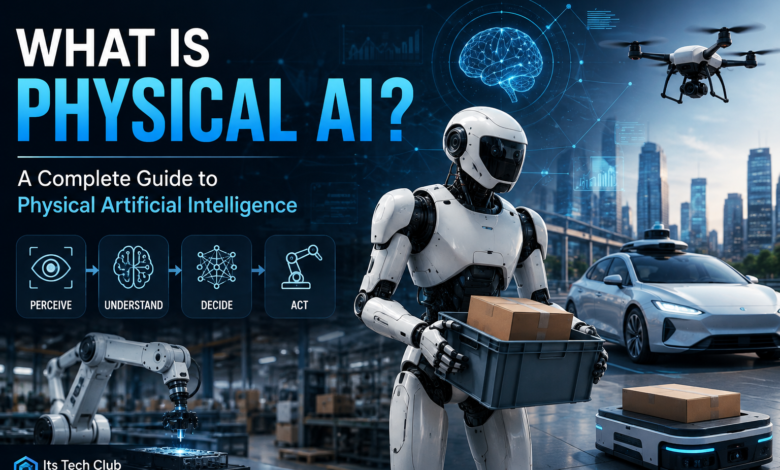
Artificial intelligence has mostly transformed digital tasks, information processing, and online experiences. Now, AI is increasingly moving beyond screens and into physical environments. This emerging technology is commonly known as physical AI.
Physical AI allows intelligent systems to perceive their surroundings and respond accordingly. These systems can process sensor information, understand environments, make decisions, and perform actions. Unlike traditional software, these systems can directly interact with the physical world.
From autonomous vehicles to humanoid robots, applications are expanding rapidly. Physical AI could transform manufacturing, healthcare, transportation, logistics, agriculture, and many other industries. This guide from Its Tech Club explains how physical AI works and where it matters.
What Is Physical AI?
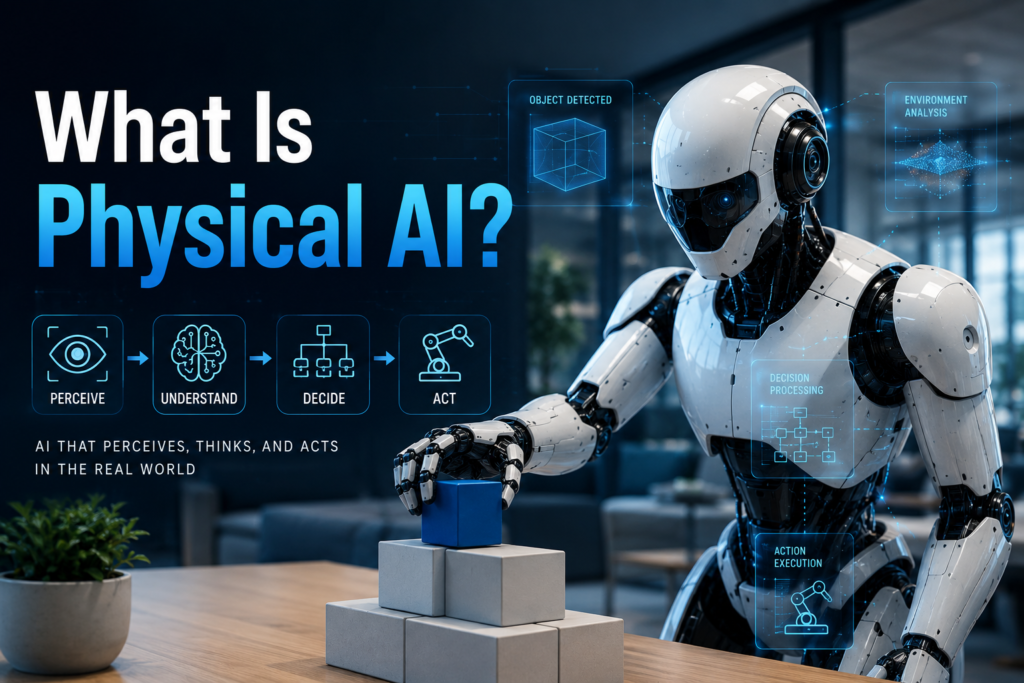
Physical AI refers to artificial intelligence systems that interact with physical environments. These systems combine AI models with sensors, hardware, actuators, and control technologies. This combination allows machines to perceive situations and respond through physical actions.
Traditional AI usually operates within digital environments using software and data. A chatbot can answer questions without physically changing its surroundings. Physical AI, however, can use cameras and sensors to understand real-world conditions.
A physical AI system might identify an object, calculate its position, and move accordingly. It can also respond to changing environments instead of following fixed instructions. This ability makes physical artificial intelligence especially valuable for autonomous machines.
Physical AI does not necessarily mean every system needs a humanoid body. Autonomous vehicles, robotic arms, warehouse machines, and smart spaces can also use physical AI.
How Does Physical AI Work?
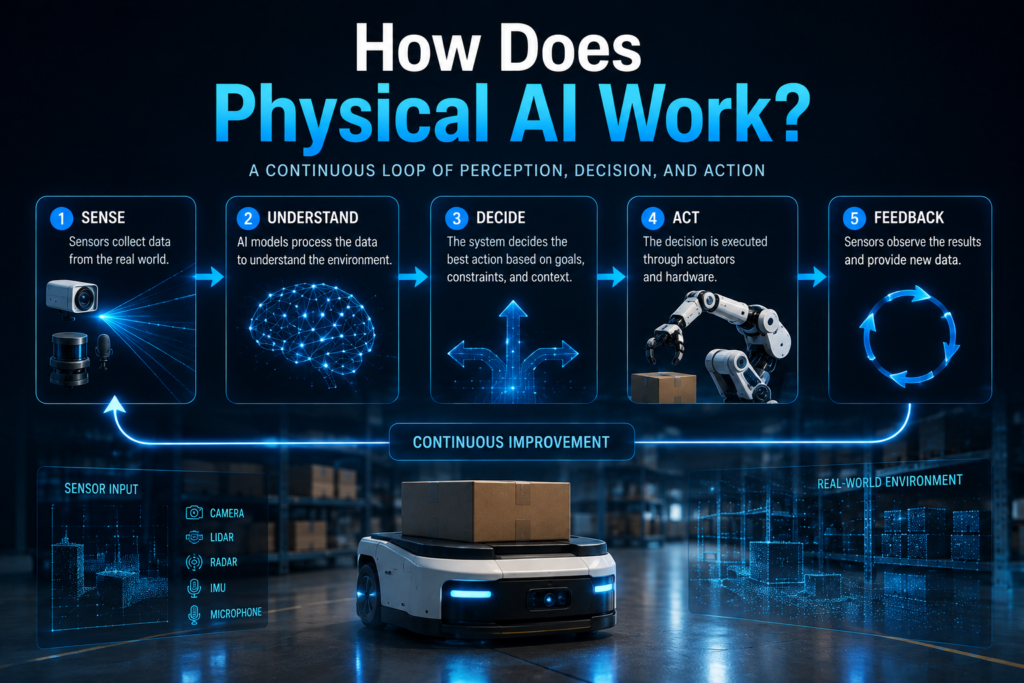
Understanding how physical AI works becomes easier when viewing it as a continuous process. First, sensors collect information from the surrounding physical environment. Cameras, microphones, lidar, radar, and other sensors provide valuable environmental information.
AI models then process this information to understand what happens around them. Computer vision can help identify objects, people, obstacles, and spatial relationships. Multimodal systems can combine visual information with language, audio, and sensor information.
After understanding the environment, the system determines an appropriate response. Its decision-making process considers objectives, surroundings, physical constraints, and available actions. The machine then converts its decision into physical movement.
Motors, robotic arms, wheels, grippers, and other actuators can execute those decisions. Sensors continuously provide additional information after each physical action occurs. This creates a feedback loop that helps systems respond to changing conditions.
What Technology Powers Physical AI?
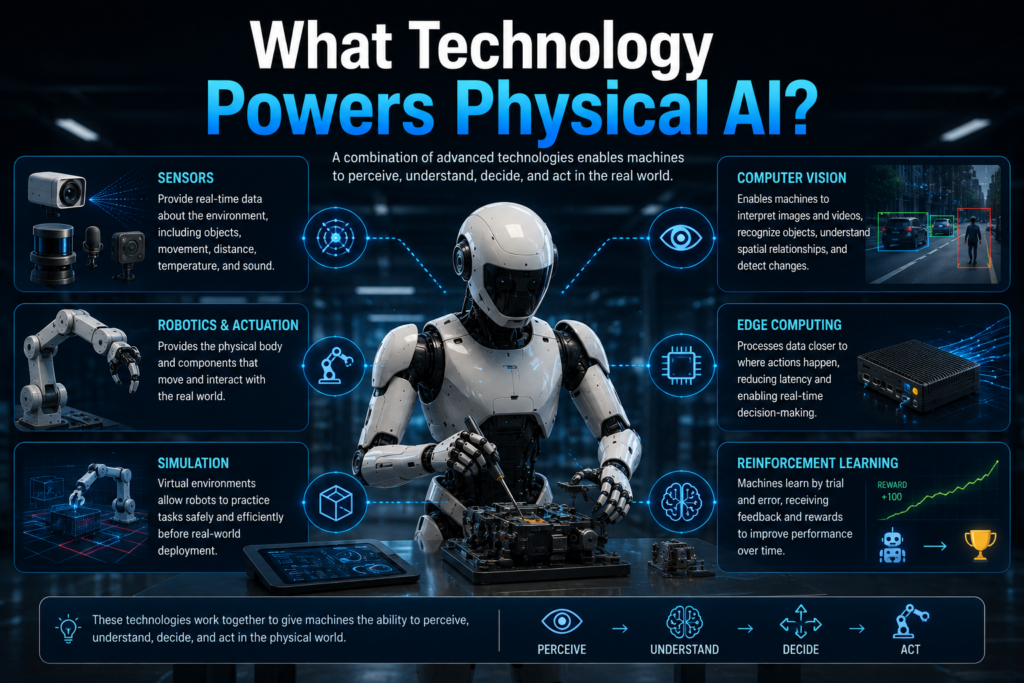
Several technologies work together to create modern physical AI systems. Sensors provide information about objects, movement, distance, temperature, sound, and surroundings. Without reliable sensing, autonomous systems would struggle to understand their environments.
Computer vision helps machines interpret images and videos from cameras. AI models can recognize objects, understand positions, and identify important environmental changes. Spatial understanding also helps machines reason about three-dimensional environments.
Robotics provides the physical hardware required for movement and manipulation. Actuators, motors, wheels, robotic arms, and grippers allow machines to perform actions. Edge computing can also help systems process information closer to where actions occur.
Simulation is another important component of physical AI development. Developers can create virtual environments where machines practice tasks safely. Reinforcement learning allows systems to improve through repeated trials and rewards.
Physical AI Examples
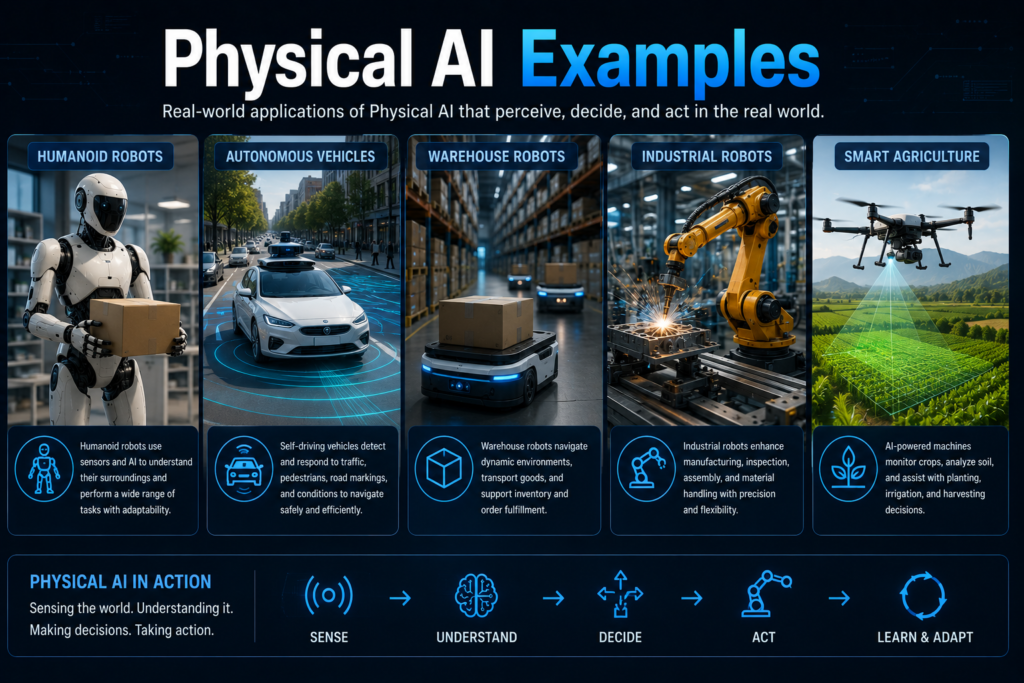
There are already several important physical AI examples across different industries today. These examples demonstrate how intelligent software can influence physical actions.
1) Humanoid Robots
Humanoid robots represent one of the most visible physical AI applications. These machines can use cameras and sensors to understand surrounding environments. Advanced models can help them perform different tasks with greater adaptability.
2) Autonomous Vehicles
Self-driving vehicles use sensors and AI models to understand surrounding traffic. They can detect vehicles, pedestrians, road markings, and environmental conditions. Physical AI helps these systems make decisions while navigating changing situations.
3) Warehouse Robots
Warehouse robots can navigate facilities while avoiding people and other obstacles. They can transport goods, locate inventory, and support picking operations. Their ability to respond to changing surroundings makes them more flexible.
4) Industrial Robots
Factories already use robots for manufacturing, inspection, assembly, and material handling. Physical AI can make these systems more adaptable than traditional programmed machines. This can become particularly useful when production environments frequently change.
5) Surgical Robots
Surgical robotics represents another specialized area for physical AI development. Intelligent systems can support precise movements during complicated procedures. However, medical applications require rigorous testing, safety controls, and appropriate professional oversight.
Physical AI Applications Across Industries
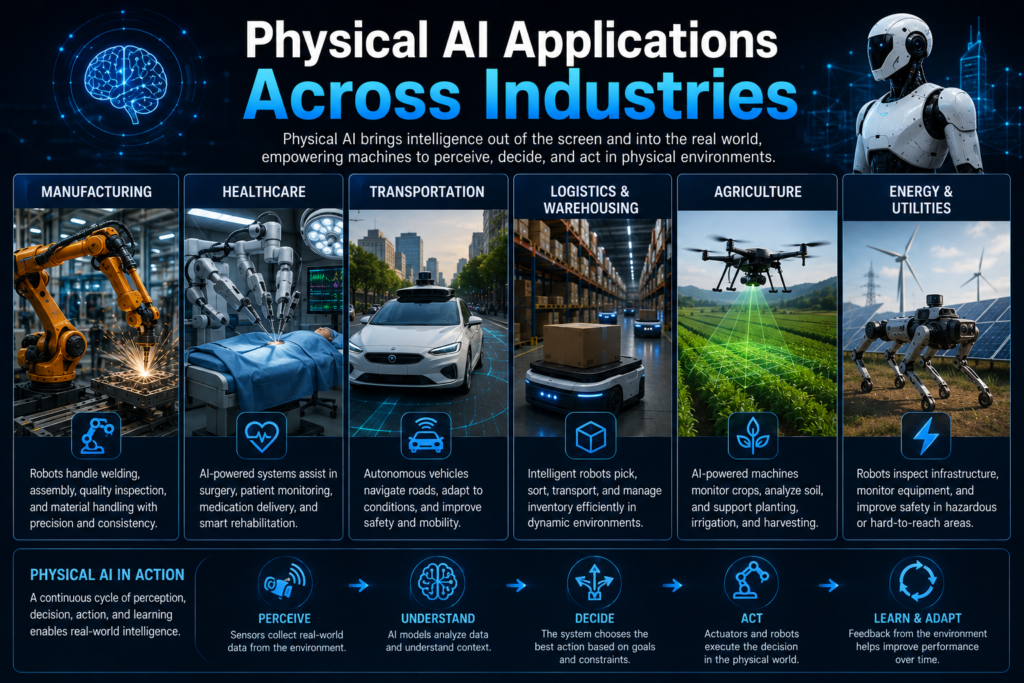
The potential physical AI applications extend well beyond robotics and transportation. Different industries can use these systems to automate physical processes and improve operational efficiency.
Manufacturing companies can use intelligent machines for assembly, inspection, maintenance, and material handling. These systems can respond to changing production conditions more effectively. NIST also identifies sensing, navigation, manipulation, and manufacturing robotics among important research areas.
Healthcare organizations can explore robotic assistance for surgery and hospital automation. Logistics companies can use autonomous systems for warehouses and delivery operations. Agriculture could benefit from intelligent machines that monitor crops and perform physical farming tasks.
Smart buildings and industrial facilities can also benefit from physical AI technology. Cameras and computer vision systems can monitor movement and identify unusual situations. These capabilities can support safer environments and more efficient operations.
Physical AI vs Traditional AI
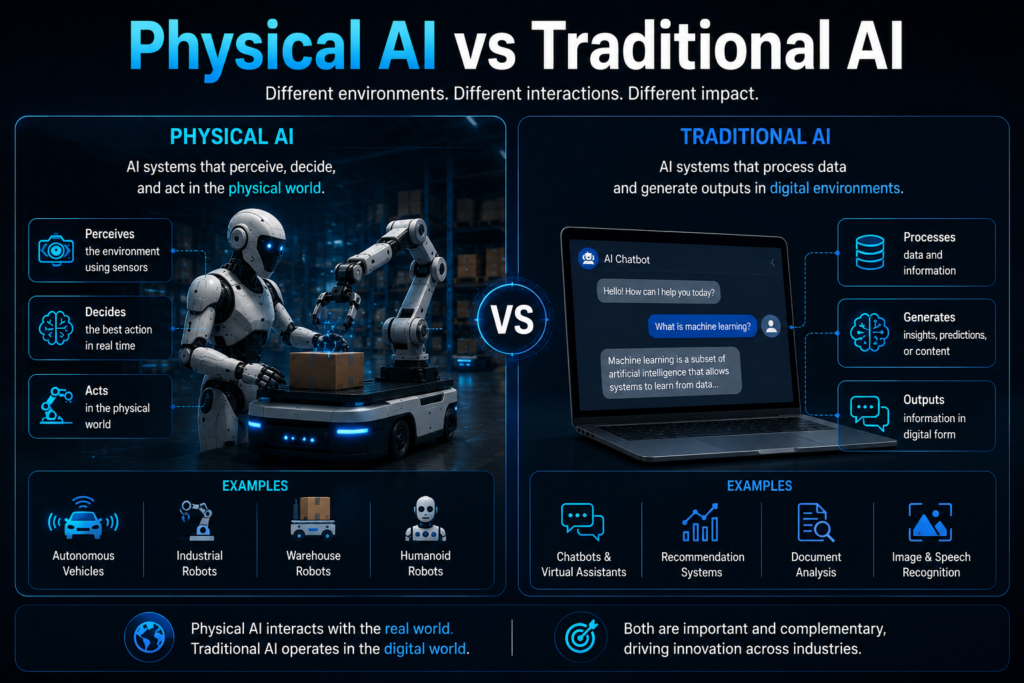
Traditional AI and physical AI share many underlying artificial intelligence principles. However, their environments, objectives, and interactions can differ significantly.
Traditional AI usually produces digital outputs such as text, recommendations, predictions, or images. Physical AI can produce those outputs while also controlling physical systems. This requires additional capabilities for sensing, movement, timing, and environmental interaction.
Physical AI must also deal with real-world uncertainty and physical limitations. Objects can move unexpectedly, sensors can produce noisy information, and environments constantly change. These challenges make physical AI considerably different from purely digital AI systems.
In simple terms, traditional AI mainly operates within digital spaces. Physical AI brings intelligence into machines that interact with real-world environments.
What Role Does Simulation Play?
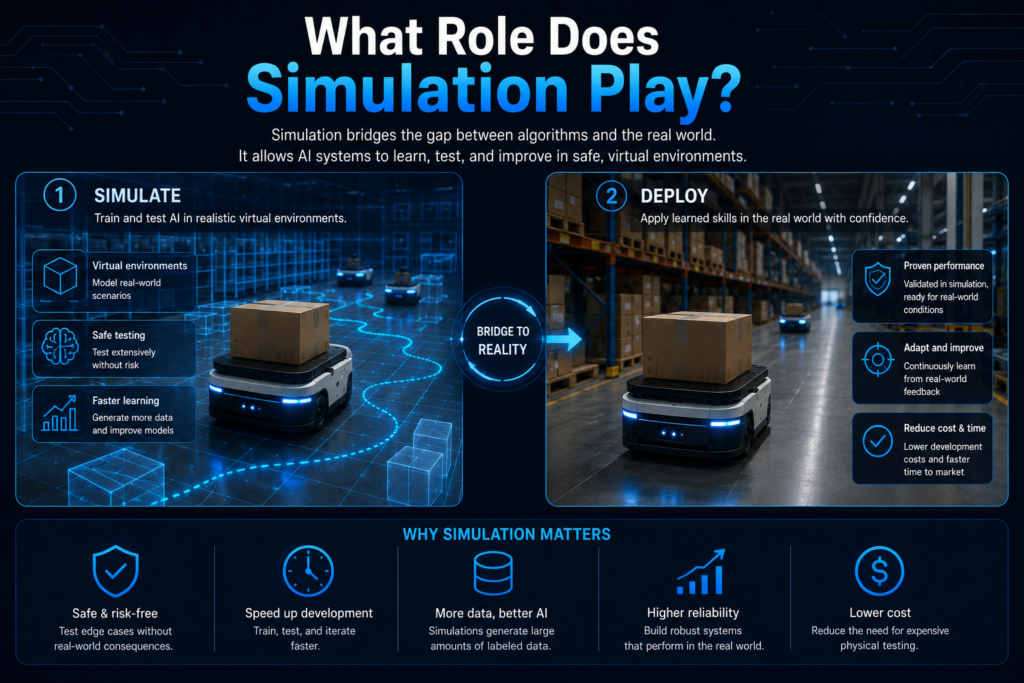
Training physical AI directly in the real world can become expensive, slow, and potentially dangerous. Developers therefore use simulated environments to train and test intelligent systems. These environments can reproduce different physical situations without risking expensive equipment.
A digital simulation can recreate factories, roads, warehouses, objects, weather conditions, and other scenarios. Machines can then practice tasks repeatedly under controlled conditions. This approach can generate useful synthetic data for training AI models.
Reinforcement learning can further improve these systems through repeated trial and error. Successful behaviors receive positive rewards, encouraging the model to repeat effective actions. Developers can then transfer trained behaviors toward real-world environments.
However, simulation cannot perfectly reproduce every real-world condition. Physical environments contain unexpected movements, imperfect surfaces, sensor noise, and unpredictable human behavior. Therefore, systems usually require careful real-world testing before broader deployment.
Benefits of Physical AI
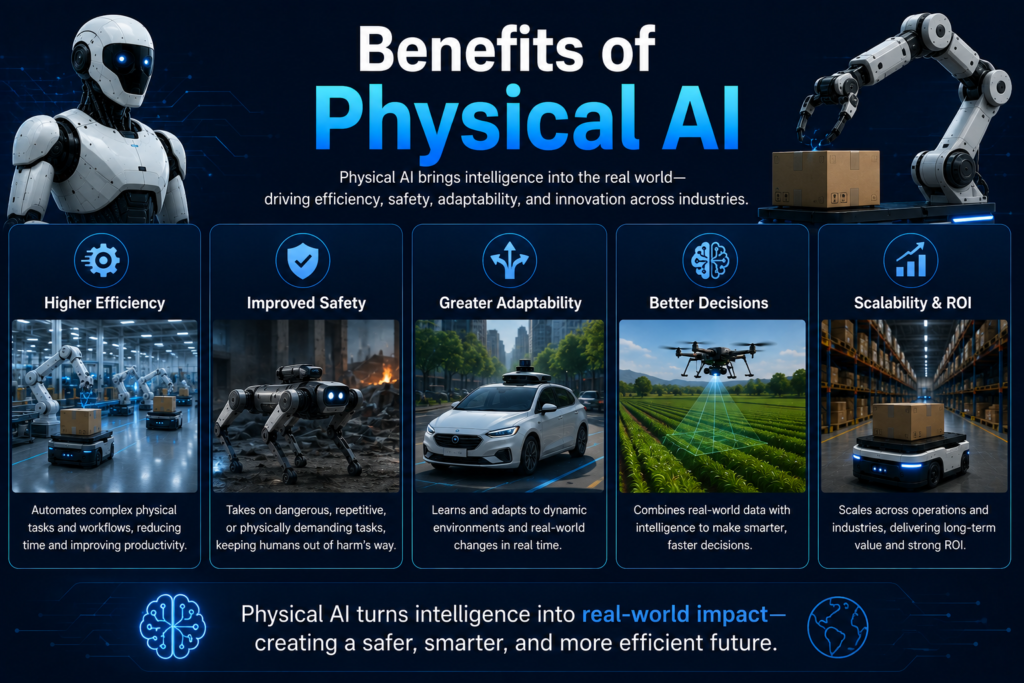
Physical AI can provide several important benefits across different industries. One major advantage is increased automation for repetitive or physically demanding tasks. Intelligent machines can also operate in environments that may be dangerous for people.
Another benefit involves greater adaptability compared with rigid automation systems. Traditional machines often require detailed programming for specific situations. Physical AI systems can potentially respond more intelligently when conditions change.
These technologies may also improve precision, operational efficiency, and workplace safety. In manufacturing, intelligent robots can support consistent production and inspection processes. In transportation, autonomous systems can process environmental information continuously.
However, these benefits depend on reliable hardware, accurate models, appropriate testing, and strong safety measures. Physical AI should therefore be viewed as an evolving technology rather than instant automation.
Challenges of Physical Artificial Intelligence
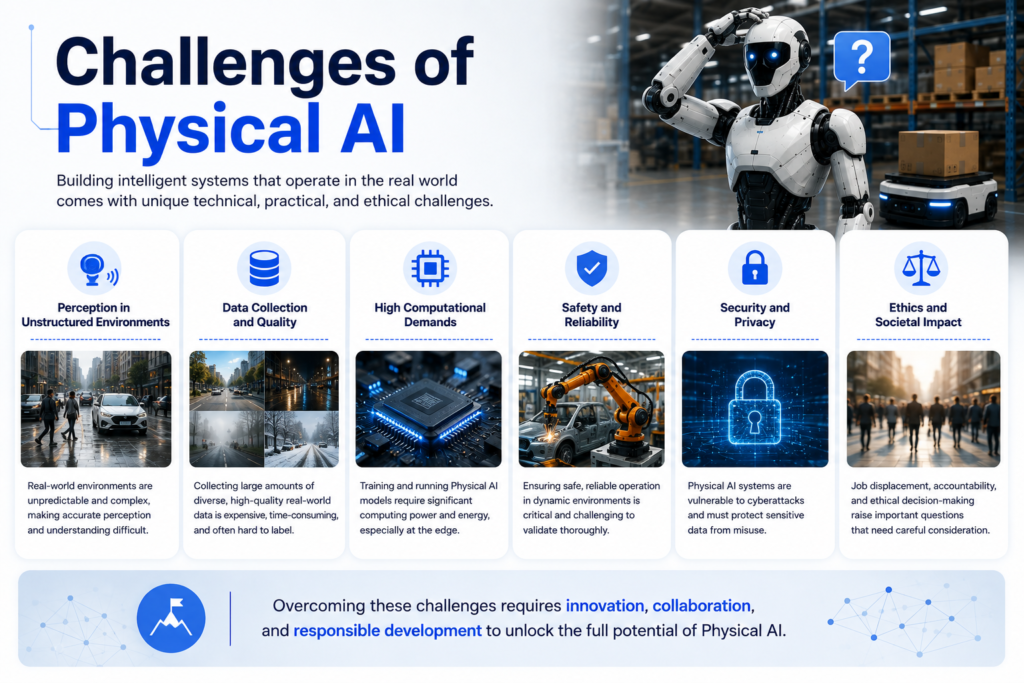
Despite its potential, physical artificial intelligence faces several significant challenges. Real-world environments are considerably harder to predict than digital environments. Machines must deal with physics, uncertainty, unexpected events, and changing conditions.
Training data can also become expensive because physical interactions require real equipment and environments. A robot cannot simply download every possible experience from the internet. Data collection often requires machines to perform physical actions repeatedly.
Safety presents another major challenge for physical AI systems. Autonomous machines may operate near workers, customers, patients, or pedestrians. Developers must therefore test systems carefully before allowing greater levels of independence.
The gap between simulation and reality can create additional difficulties. A model performing well inside simulation may behave differently outside controlled environments. Researchers continue developing better testing methods and evaluation approaches for these systems.
Is Physical AI the Future of Robotics?
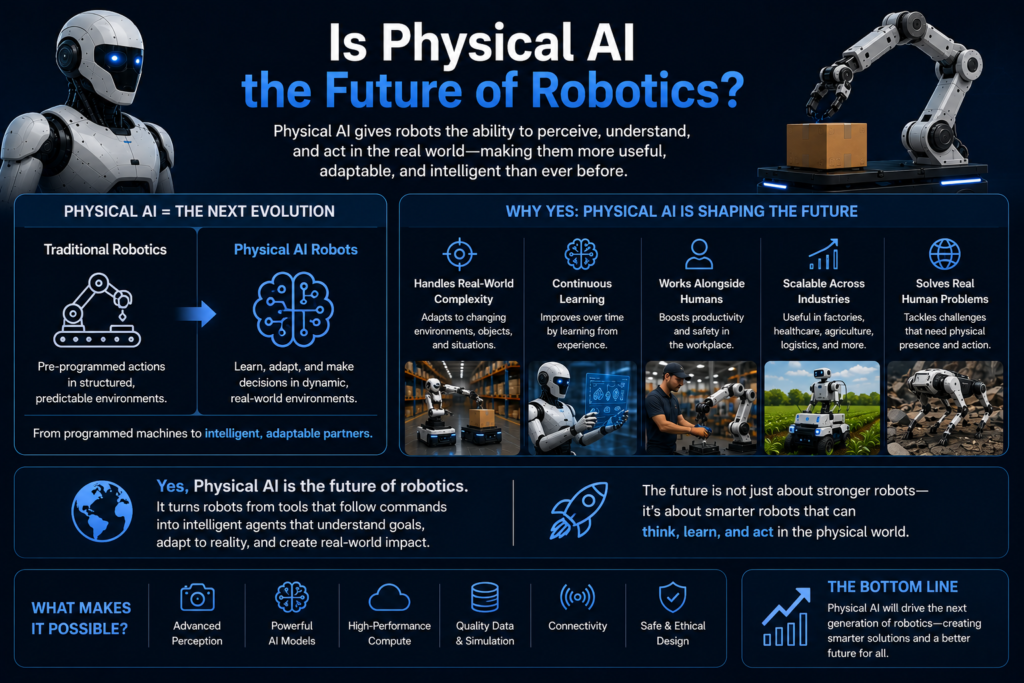
Physical AI could become an important foundation for the next generation of robotics. Modern systems are increasingly designed to understand environments instead of simply following fixed commands.
This development could make robots more useful across factories, warehouses, hospitals, homes, and public environments. Autonomous vehicles could similarly become more capable as perception and decision-making models improve.
The technology is still developing, and widespread adoption will depend on cost and reliability. Safety standards, hardware improvements, computing resources, and suitable regulations will also influence future adoption.
Research organizations and technology companies are actively working toward more capable physical AI systems. NIST, for example, focuses on practical evaluation methods for AI-enabled robotic systems.
Conclusion
Physical AI represents an important evolution in artificial intelligence technology. Instead of operating only through digital interfaces, these systems can interact directly with physical environments.
The technology combines AI models, sensors, robotics, computing, simulation, and learning techniques. Together, these components allow machines to perceive surroundings and perform increasingly complex actions.
From autonomous vehicles and humanoid robots to industrial automation, physical AI applications are expanding steadily. Challenges involving safety, data, cost, and real-world reliability still require significant attention.
As technology improves, physical AI could change how humans work alongside intelligent machines. Understanding this technology today can help businesses and technology enthusiasts prepare for that future.