
Your small business has outgrown a single ChatGPT Plus or Claude Pro login. Two or three people now share one account, or everyone pays for their own plan and nobody can see what the team is doing. That is the moment to look at a team plan, and in 2026 the choice comes down to two products: ChatGPT Business from OpenAI and Claude Team from Anthropic.
Both plans cost exactly the same per seat, both keep your business data out of training by default, and both give your team a shared workspace with admin controls. The differences sit in the models, the daily limits, the integrations and the kind of work each assistant does best. This guide compares them side by side so you can pick the right one the first time.
If you are still choosing your first AI tool, our roundup of the best AI tools for small business owners covers the full starter stack before you commit to a team plan.
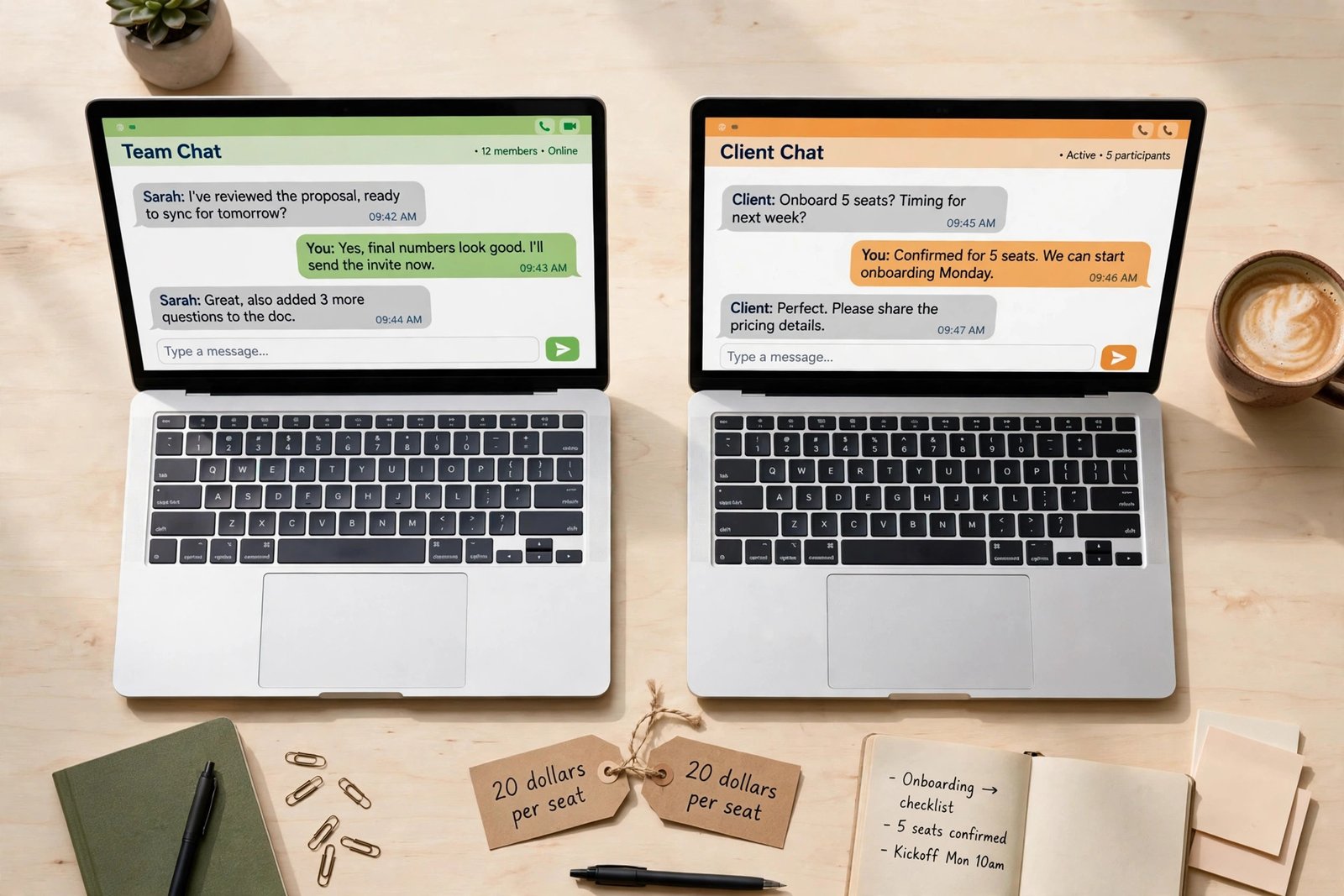
ChatGPT Business and Claude Team both cost 20 dollars per seat per month on annual billing, with a two seat minimum and a premium seat at 100 dollars. Pick ChatGPT Business for voice, images and research. Pick Claude Team for coding, long documents and careful writing, since Claude Code is included with every seat.
What Are ChatGPT Business and Claude Team?
ChatGPT Business is OpenAI’s self serve workspace plan for teams of 2 to 200 people. It is the plan OpenAI previously sold as ChatGPT Team, renamed in 2026. It gives every seat access to OpenAI’s flagship models, a shared workspace, admin controls, single sign on and no training on your business data by default. OpenAI cut the standard seat price on April 2, 2026, from 25 dollars to 20 dollars a month on annual billing, and added a premium seat in August 2026.
Claude Team is Anthropic’s equivalent for teams of 2 to 150 people. Anthropic restructured the plan on January 28, 2026, cutting the price of both seat types and lowering the minimum from 5 seats to 2, which opened the plan to very small teams. Every seat includes Claude Code, Anthropic’s agentic coding tool, and access to the Claude 5.5 model family. Like ChatGPT Business, it keeps your business data out of training by default.
Both plans are built for the same buyer: a small business that needs more than one login, wants an admin to control who can join, and needs basic privacy guarantees without paying enterprise prices.
How Much Do ChatGPT Business and Claude Team Cost?
Here is the surprise in this comparison: the price lists are identical. A standard seat costs 20 dollars per month billed annually or 25 dollars billed monthly on both plans. A premium seat costs 100 dollars per month billed annually or 125 dollars billed monthly on both, and gives about five times the usage of a standard seat. Both plans add monthly API credits of 20 dollars per standard seat and 100 dollars per premium seat, pooled across the workspace and capped at 500 dollars a month.
| Team size | ChatGPT Business, billed yearly | Claude Team, billed yearly |
|---|---|---|
| 2 seats | 480 dollars a year | 480 dollars a year |
| 5 seats | 1,200 dollars a year | 1,200 dollars a year |
| 10 seats | 2,400 dollars a year | 2,400 dollars a year |
| 25 seats | 6,000 dollars a year | 6,000 dollars a year |
Since the prices match to the dollar, price cannot decide this comparison. The decision comes down to what your team actually does all day. The premium seat is the one place where the value differs: a ChatGPT Business premium seat removes the five hour usage limit entirely, while a Claude Team premium seat keeps a five hour session limit set at 6.25 times the Pro allowance and adds Claude Fable models for up to 50 percent of weekly limits. If your heavy users hit session limits every day, the ChatGPT premium seat is the better fix.
Which Models Do You Get on Each Plan?
ChatGPT Business seats get OpenAI’s flagship models, with GPT 6 across paid plans since the October 2026 update. The update also added Intelligent UI, which turns answers into interactive charts, calculators and small working tools inside the chat. ChatGPT’s free tier runs a lighter model and shows ads, but Business seats get the full flagship experience with no ads.
Claude Team seats get the Claude 5.5 model family, including Opus 5.5 and Sonnet 5.5, with a 1 million token context window. That huge context window is the standout feature: Claude can read entire reports, books or codebases in one conversation without losing track. Premium seats add access to Claude Fable models for up to half of weekly limits, which is the top tier model family.
If your work means reading long documents or large codebases, Claude’s context window is a real advantage. If your work means generating images, building interactive answers or talking by voice, ChatGPT’s model set is the stronger pick. Our full Claude vs ChatGPT guide compares the individual plans in depth, including the 20 dollar Pro and Plus tiers.
Which Plan Is Better for Coding and Writing?
Claude Team is the stronger choice for serious coding. Claude Code, Anthropic’s dedicated agentic coding tool, lives in your terminal and handles large codebases, and it is included with every Claude Team seat at no extra cost. Developers consistently praise Claude for following instructions precisely and writing cleaner first drafts, and the 1 million token context window means it can hold an entire project in mind.
ChatGPT Business counters with Codex, OpenAI’s coding agent, and GPT 6 is a strong coder. For lighter coding and editing, ChatGPT’s Canvas workspace is handy. But for teams that build software every day, Claude Code bundled into the seat price is hard to beat, since buying a separate coding tool would cost extra on top of a ChatGPT plan.
For writing, Claude wins again. Its tone is naturally measured and human, it follows style instructions closely, and it handles long documents with care. Owners use it for proposals, contracts, training guides and any writing where tone and accuracy matter. ChatGPT writes well too, and its Projects feature helps organize long term writing, but Claude’s drafts usually need less rewriting.
If your team writes marketing copy at volume, either assistant works, and our guide on how to write AI product descriptions for Etsy and Shopify shows how to turn a general assistant into a reliable copy workflow.
How Do Privacy and Data Controls Compare?
Both plans keep your business data out of training by default, which is the baseline every small business should demand. OpenAI states that it does not train its models on your business data by default, and Anthropic states the same for Claude for Work and the API unless you opt in, for example by sending feedback.
The differences sit in the details. ChatGPT Business gives workspace admins control over how long data is retained, and admins can view, export and delete conversations. The Compliance API sits on Enterprise, not Business, so businesses that need a formal archive for client communications will still need their own system.
Claude Team gives admins billing and user controls, but custom data retention controls are listed on Enterprise, not on Team, and the help pages do not describe a native ediscovery archive. If your business handles client records or regulated data, plan how those conversations reach your existing archive before you choose. For most small businesses, both plans clear the privacy bar, and Claude carries the stronger privacy reputation overall.
What About Admin Controls and Integrations?
ChatGPT Business connects to Google Workspace, Slack, GitHub and Microsoft 365, so it plugs into the tools most small teams already use. Admins manage seats, set retention, control single sign on and multi factor authentication, and the workspace supports up to 200 paid seats, which leaves room to grow well past the small business stage.
Claude Team connects through MCP connectors for Slack, Drive and GitHub, and offers Claude in Chrome and Microsoft 365 on paid and Team plans. Admins manage seats and billing, and the plan caps at 150 seats. For teams between 151 and 200 people, ChatGPT Business is the only option of the two.
ChatGPT also brings Scheduled Tasks, which deliver recurring research on a schedule, and Deep Research, which explores multiple online sources and returns structured, cited reports. Claude has its own deep research mode with careful source handling, but ChatGPT’s ecosystem of apps and connectors makes it the stronger research sidekick for teams that want recurring briefings.
Which Plan Fits Your Small Business?
There is no single winner. There are two winners for different teams. Match the plan to your main use case and you cannot go far wrong.
Pick ChatGPT Business if your team needs one assistant that does a bit of everything. Voice conversations, image generation, interactive answers, research with scheduled delivery and the broadest app ecosystem all point to ChatGPT. Pick it too if your team has more than 150 people, or if your heavy users keep hitting session limits and need the premium seat that removes the five hour cap.
Pick Claude Team if your team codes every day, writes long documents, or works with large reports and codebases. Claude Code included in every seat, the 1 million token context window and the stronger writing quality make it the craftsman’s tool. Pick it too if privacy is your top concern, since Claude carries the stronger reputation there.
Pick neither yet if you are a solo owner. Both plans need at least two seats, so a one person business should stay on Plus or Pro at 20 dollars a month until a second person joins. And remember that you can use both: many professionals keep Claude Pro for coding and writing alongside ChatGPT Plus for voice, images and research, still cheaper than either company’s 100 dollar power tier.


Key Takeaways
- ChatGPT Business and Claude Team cost exactly the same: 20 dollars a seat a month on annual billing, 25 dollars month to month, premium seats at 100 dollars.
- Both plans need at least two seats, keep business data out of training by default, and add 20 dollars of monthly API credits per standard seat.
- Claude Team wins for coding and long documents, with Claude Code included in every seat and a 1 million token context window.
- ChatGPT Business wins for voice, images, interactive answers and research, with the broadest app ecosystem and a premium seat that removes the five hour usage limit.
- Choose by your main use case, not by price, since the price lists match to the dollar.
Frequently Asked Questions
What is the difference between ChatGPT Business and Claude Team?
ChatGPT Business is OpenAI’s team plan for 2 to 200 people, built around GPT 6, voice, images and a broad app ecosystem. Claude Team is Anthropic’s team plan for 2 to 150 people, built around the Claude 5.5 model family, Claude Code and long document work. Both cost 20 dollars a seat a month on annual billing and keep business data out of training by default.
How much does ChatGPT Business cost for a small team?
A standard seat costs 20 dollars per user per month billed annually, or 25 dollars billed monthly, with a two seat minimum. Five seats cost 1,200 dollars a year on annual billing, and ten seats cost 2,400 dollars a year. A premium seat costs 100 dollars a month billed annually and gives about five times the usage.
How much does Claude Team cost for a small team?
Claude Team costs the same as ChatGPT Business: 20 dollars per seat per month billed annually, or 25 dollars billed monthly, with a two seat minimum and a cap of 150 seats. Five seats cost 1,200 dollars a year on annual billing, and ten seats cost 2,400 dollars a year. Premium seats cost 100 dollars a month billed annually.
Can I use ChatGPT Business and Claude Team together?
Yes, and many professionals do. A common setup is Claude Team for coding and writing alongside ChatGPT Business for voice, images and research. Neither company locks you in, so you can subscribe monthly and cancel anytime, though annual billing saves 5 dollars a seat per month on both plans.
Which AI plan is better for a small business that writes a lot?
Claude Team is the better pick for writing heavy teams. Its tone is naturally measured, it follows style instructions closely, and the 1 million token context window handles long documents without losing track. ChatGPT Business is the better pick when the same team also needs voice, images and research in one plan.
The Bottom Line
The chatgpt business vs claude team comparison has no single winner, because the price lists are identical and each plan wins different jobs. Claude is the craftsman’s tool: better code, better prose, deeper focus and stronger privacy. ChatGPT is the all rounder: better voice, better visuals, broader ecosystem and a premium seat without usage limits. Match the assistant to your main use case, start with a two seat trial on annual billing, and let a month of real work decide whether it earns its place in your budget.