How to Invest in Index Funds: A Beginner’s Guide
How to Invest in Index Funds: Beginner’s Step-by-Step Guide


A good number of individuals desire to invest in the stock market. Nonetheless, they tend to be confused on which point to start. It appears to be complex to pick individual stocks. In addition, it is time-consuming, researched, and experienced.
An easy alternative is index funds. They allow the novices to invest in the entire market rather than individual shares.
Index funds are recommended to novice investors by many financial gurus.
This guide defines what index funds are and demonstrates how to invest in them step by step.
What Are Index Funds?
An index fund follows a given index on the market. It does not attempt to beat the market; rather, it merely has its performance.
As an example, an S&P 500 index fund holds the same companies in the S&P 500. Shareholders own tiny shares of hundreds of companies.
This is a method that provides automatic diversification.
Index funds have a passive approach. Fund managers hardly trade; they make amendments on the portfolio when the index is altered.
Due to this reason, the index funds are typically lower priced than the actively managed funds.
Why Investors Choose Index Funds
Index funds are preferred by the investors due to various reasons.
Low costs
The management costs are reduced as index funds have very low management fees.
Wide diversification
There are index funds which comprise hundreds of companies and this risk is widely distributed in many businesses.
Long‑term growth
Index funds reflect the market in general, which has been increasing with time.
Beginner‑friendly
There is no necessity to examine certain companies, investors just purchase the entire market.
These merits make index funds one of the most popular ones.

How to Invest in Index Funds Step-By-Step.
Investments in index funds are easy. Follow these steps to begin.
Step 1. Choose what Index you wish to follow.
Select the market index to suit your purposes first.
The various indexes represent various segments of the market. Common examples are:
- S&P 500 – tracks 500 large U.S. companies
- Nasdaq 100 – is specialized in technology.
- Total stock market index- consists of thousands of companies.
Determine your financial objectives and the level of risk that you tolerate before investing.
Certain index funds strive to increase; other funds are more diversified.
Step 2: Select the appropriate Index Fund.
Once an index has been chosen, a fund tracking it is selected.
There are numerous providers of index funds, and thus, you can compare a number of funds that track the same index.
In comparing funds, consider the following:
- Expenditure ratio (management fees)
- Fund size
- Tracking accuracy
- Provider reputation
Minor variations in the fees can have an impact on long-term returns.
The majority of investors select funds that have the lowest cost ratios.
Step 3: Open one Investment Account.
Then open a retirement account to invest in index funds.
A majority of individuals utilize an online brokering service.
It does not take more than a few minutes. Having registered, you are able to deposit money and invest.
The most popular platforms usually provide:
- Commission‑free trading
- ETFs and mutual funds.
- Research tools
After opening an account, you are able to buy index funds.
Step 4: Purchase Shares of the Index Fund.
Once an account is opened, purchase index fund shares.
There are two types of index funds:
Exchange‑Traded Funds (ETFs)
ETFs are traded as stocks and could be sold or purchased at any time of the trade.
Index Mutual Funds
The mutual funds are traded once in day at the end of the day prices.
Both alternatives expose you to the same index of the market.
Fractional shares are also available in many platforms and beginners can start with small sums.
Step 5: Invest Regularly
Consistency is the key to successful investing.
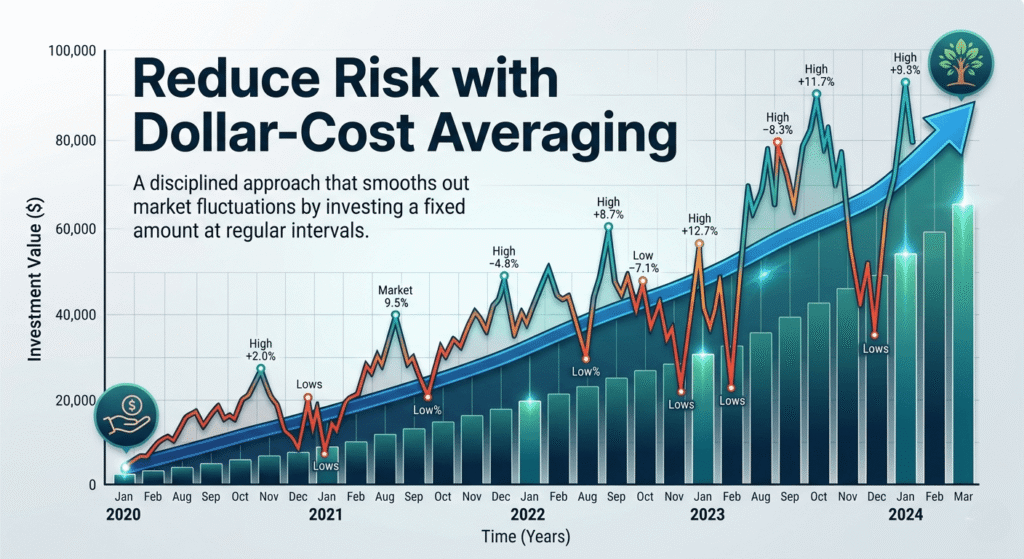
Dollar-cost averaging is employed by many investors.
This plan includes a fixed investment on a regular basis. For example:
- Invest $100 every month
- Buy: Add when the prices are dropping.
- Purchase fewer shares as prices are increasing.
This will lessen market fluctuations over a period of time.
It also assists investors to remain disciplined.
Successful Index Fund Investing Tips.
Although index funds are not complicated, smart habits do count.
Think long term
Invest in index funds over a long period so as to maximize returns.
Unnecessary stress comes about as a result of short-term market movements.
Keep costs low
Exorbitant charges eliminate returns in the long run. Select cheap funds as much as you can.
Diversify your investments
There are those investors who have multiple index funds. A diversified portfolio will contain:
- A total stock market index fund.
- An international index fund
- A bond index fund
This diversifies the risk among the markets.
Avoid emotional decisions
There is continuous up and down in markets.
Good investors do not lose sight of long-term expansion since there is not short-term movement.
Common Mistakes Beginners Should Avoid
New investors do get into the same pitfalls. Awareness of them can act as a preventive measure.
Trying to time the market
Market movements can hardly be predicted.
Ignoring fee
Minimal charges may reduce gains in the long run. Compare cost ratios and then select a fund.
Selling in falling markets
Market downturns happen. The long-term investors tend to appreciate remaining in place.
Final Thoughts
One of the simplest ways of investing in the stock market is through index funds.
They are diversified, low cost and long term growth.
Above all, the novices are able to invest without extensive financial education.
Select the most appropriate index, a low-cost fund and invest regularly.
During the years, a systematic investment accumulates a lot of wealth.
Investing in an index-fund might be one of the most prudent choices you can make today