Introduction:
Most startups today aren’t failing because of bad ideas.
They’re failing because founders are overloaded—trying to handle marketing, sales, content, design, customer support, and operations all at once.
Hiring teams is expensive. Doing everything manually is unsustainable.
This is exactly where AI changes the game.
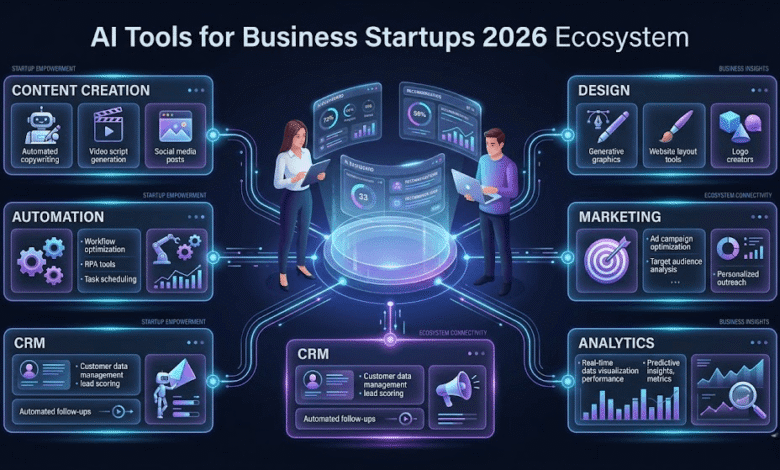
The right AI tools for business startups in 2026 don’t just save time—they act like a full digital team that works 24/7 without burnout.
In this guide, you’ll discover the most powerful AI tools that help startups automate, scale, and compete like industry leaders.
Best AI Tools for Business Startups in 2026
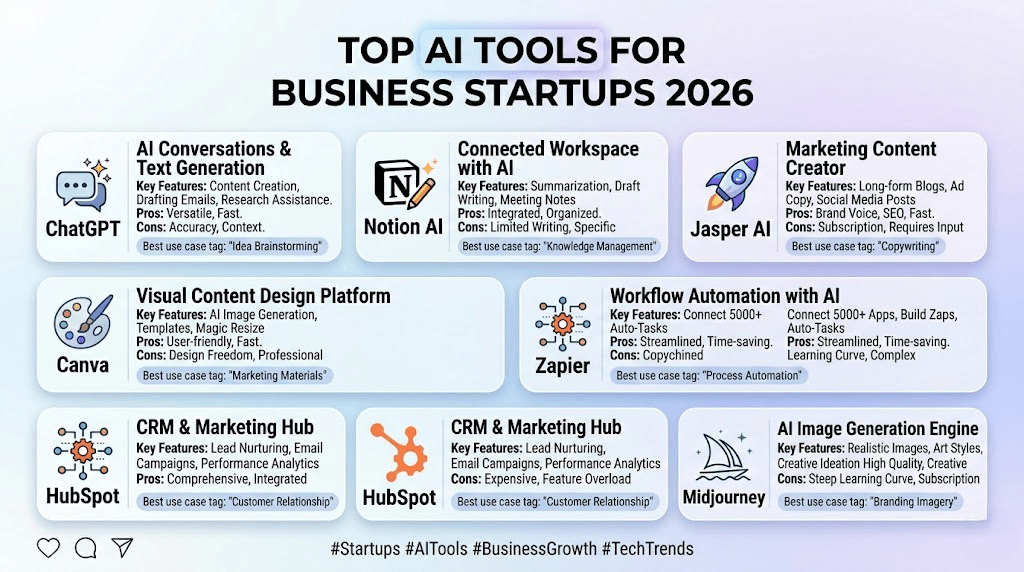
ChatGPT (OpenAI) – Your All-in-One Startup Assistant
ChatGPT is one of the most powerful tools for modern startups because it replaces multiple roles in one system.
What it does best:
- Writes blogs, ads, emails, and scripts
- Helps with coding and debugging
- Generates business ideas and strategies
- Automates customer replies
Limitations:
- Needs good prompts for best output
- Can sound generic if not guided properly
Notion AI – Smart Workspace for Fast-Moving Teams
Notion AI helps startups organize everything in one place while adding AI productivity features.
What it does best:
- Creates and summarizes documents
- Manages tasks and projects
- Builds startup knowledge systems
Why startups use it:
It replaces multiple tools like docs, wikis, and task boards.
Limitations:
- Takes time to master
- Not ideal for heavy project management alone
Jasper AI – High-Converting Marketing Content Engine
Jasper AI is built specifically for marketing-focused startups that want fast growth.
What it does best:
- Writes ad copies that convert
- Creates landing page content
- Builds email campaigns
Limitations:
- Higher cost than general AI tools
- Less flexible for technical tasks
Canva – Fast Design Without a Designer
Canva makes it possible for startups to create professional designs without hiring designers.
What it does best:
- Social media posts
- Branding kits
- AI-generated visuals
Limitations:
- Limited advanced design control
Zapier – Automation That Runs Your Business in the Background
Zapier connects apps and automates repetitive tasks without coding.
What it does best:
- Automates workflows between apps
- Sends automated emails and notifications
- Syncs data across tools
Limitations:
- Can become costly at scale
HubSpot – AI-Powered Sales Machine
HubSpot helps startups manage customers, sales pipelines, and marketing in one place.
What it does best:
- Tracks leads and customers
- Automates follow-ups
- Provides sales ins
Limitations:
- Advanced features can be expensive
Midjourney – AI for Viral Visual Content
Midjourney creates high-quality visuals from simple text prompts.
What it does best:
- Generates marketing visuals
- Creates brand concepts
- Produces creative ad graphics
Limitations:
- Requires prompt learning
- Uses Discord interface
How to Choose the Right AI Tools for Your Startup
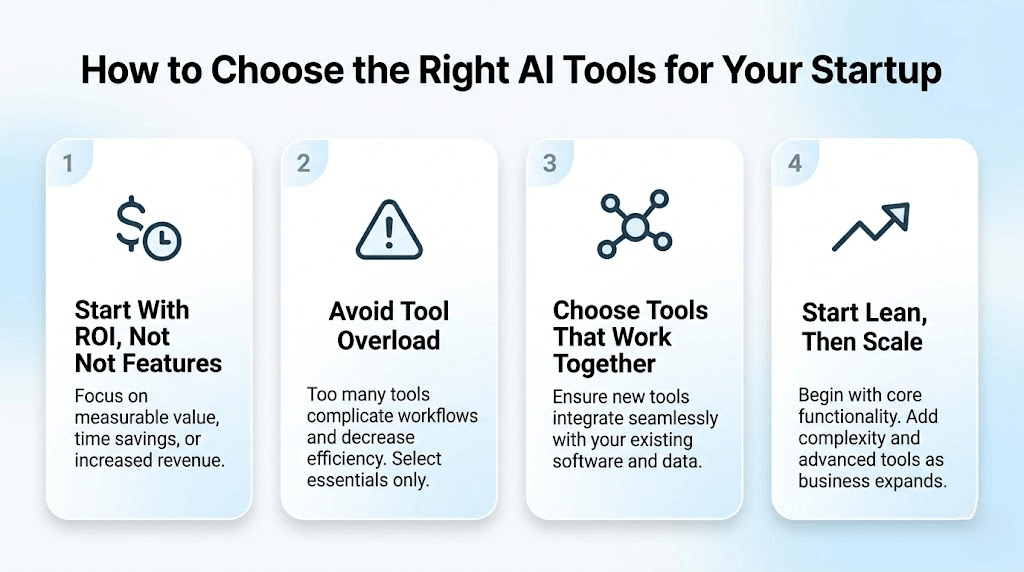
Most startups fail at this stage—not because tools are bad, but because they use too many.
Focus on simplicity.
1. Start With ROI, Not Features
Ask: Will this save time or make money in the next 30 days?
2. Avoid Tool Overload
Using 10 tools won’t make you productive—it will slow you down.
3. Choose Tools That Work Together
Your AI stack should feel like one system, not separate islands.
4. Start Lean, Then Scale
Begin with 2–3 tools and expand only when needed.
Real Startup Use Case (Proven AI Stack)
A small online startup used this simple AI system:
- ChatGPT → Content + customer replies
- Canva → Social media visuals
- Zapier → Automation workflows
- HubSpot → Customer tracking
Result:
- 60% less manual work
- Faster content production
- Higher conversion rates
Future Trends in AI for Startups (2026+)
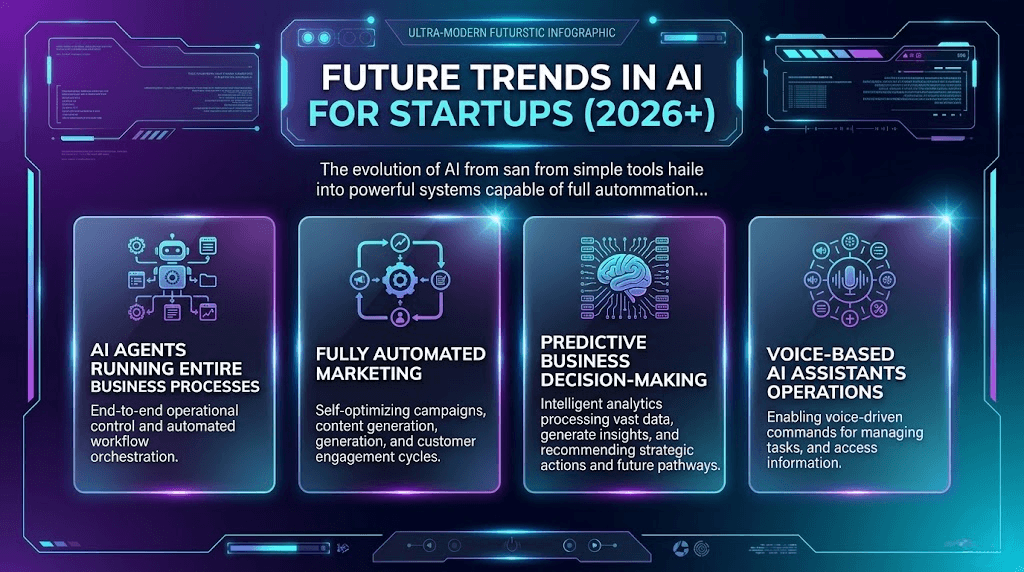
AI is moving beyond tools into full business automation.
What’s coming next:
- AI agents running entire business processes
- Fully automated marketing systems
- Predictive business decision-making
- Voice-based AI assistants for operations
Startups adopting AI early will dominate their industries.
Those who delay will struggle to compete.
Conclusion: The New Rule of Startup Growth
In 2026, startups don’t scale by working harder.
They scale by working smarter—with AI systems.
The best AI tools for startups don’t just improve productivity—they replace entire workflows.
Your next step:
Pick 2–3 tools from this guide and implement them immediately.
Not next week. Not when “everything is ready.”
Now.
Because in today’s market, execution speed decides winners.