Artificial intelligence has moved beyond simple prediction and automated responses. Today, two important AI concepts are gaining significant attention across industries. These concepts are agentic AI and generative AI, but they serve different purposes.
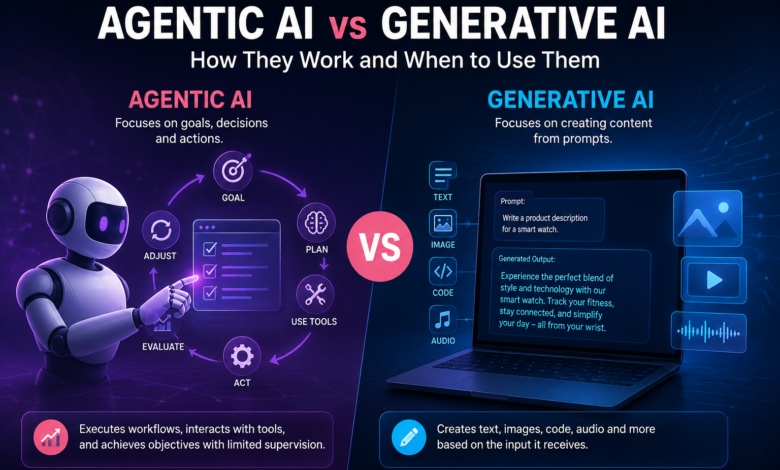
Generative AI focuses primarily on creating new content from prompts and available context. Agentic AI focuses on pursuing goals, making decisions, and completing actions with limited supervision. Understanding agentic AI vs generative AI becomes important when choosing technology for business workflows.
As AI continues evolving, knowing how these technologies actually differ can help businesses make better decisions. At Its Tech Club, we explore emerging technologies to help readers understand practical developments shaping the digital world.
Both approaches can improve productivity, but they solve different kinds of problems. Generative AI works well for creation, while agentic AI works well for execution. This guide explains what each technology means and how these systems operate.
What Is Meant by Agentic AI?
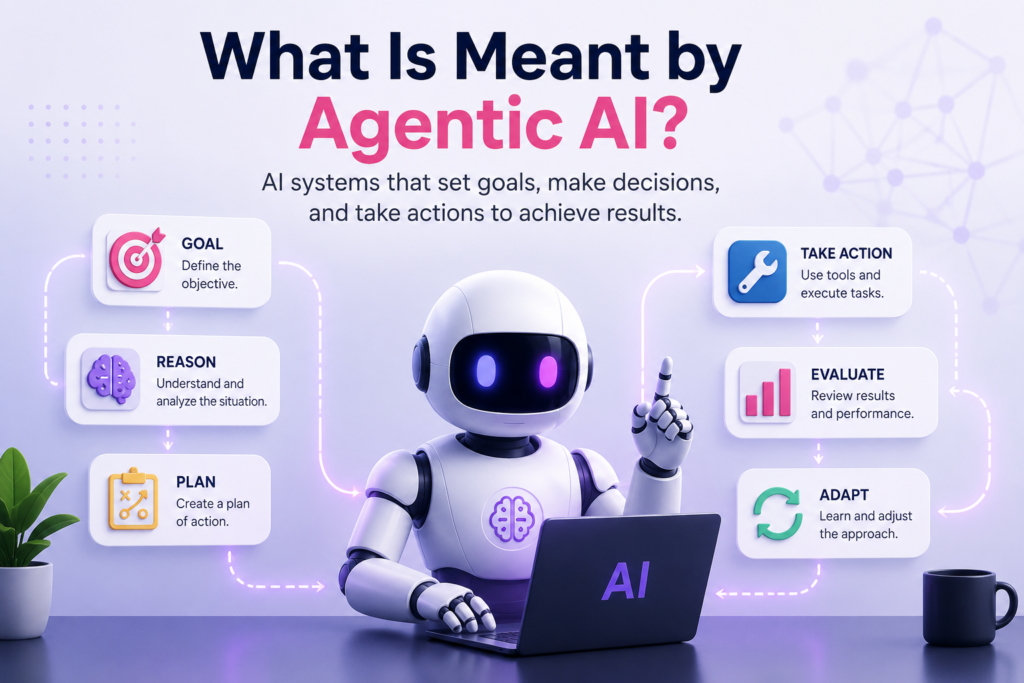
Agentic AI refers to artificial intelligence systems designed to achieve specific goals. These systems can reason through problems, plan multiple steps, and perform actions. They can also interact with tools, applications, databases, and external systems when permitted.
Unlike traditional AI applications, agentic systems can operate with greater independence. Instead of responding only to individual instructions, they can determine intermediate steps toward broader objectives.
For example, imagine telling an AI system to organize customer appointments. A basic AI might suggest available appointment times for you. An agentic system could check calendars, identify suitable times, schedule appointments, and send confirmations.
The exact capabilities depend on the system’s design, permissions, tools, and safeguards. Therefore, agentic AI does not mean completely uncontrolled autonomous intelligence.
How Does Agentic AI Work?
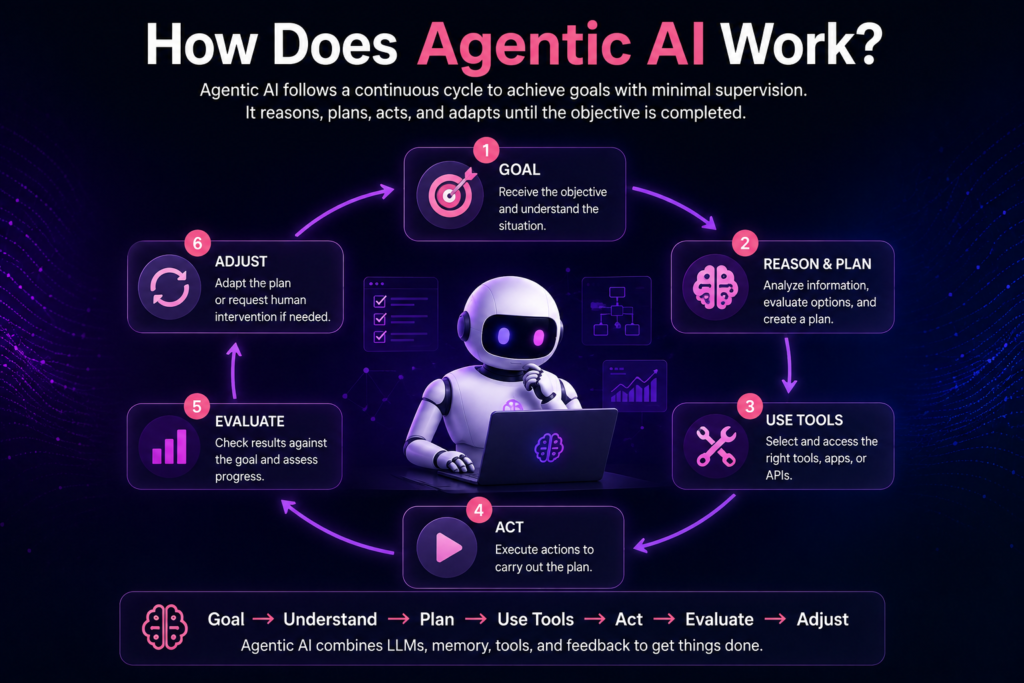
Agentic AI typically follows an ongoing cycle involving goals, reasoning, actions, and feedback. The system first receives an objective and gathers relevant information about the situation.
It then evaluates possible approaches before creating a plan for completing the objective. Afterward, it can select appropriate tools or applications for executing individual steps.
Once an action produces a result, the system can evaluate that outcome against its original objective. It may then continue, revise its approach, or request human intervention when necessary.
A simplified agentic workflow looks like this:
Goal → Understand → Plan → Use Tools → Act → Evaluate → Adjust
Modern agentic systems can combine large language models with retrieval, tools, memory, and orchestration capabilities.
What Is Meant by Generative AI?
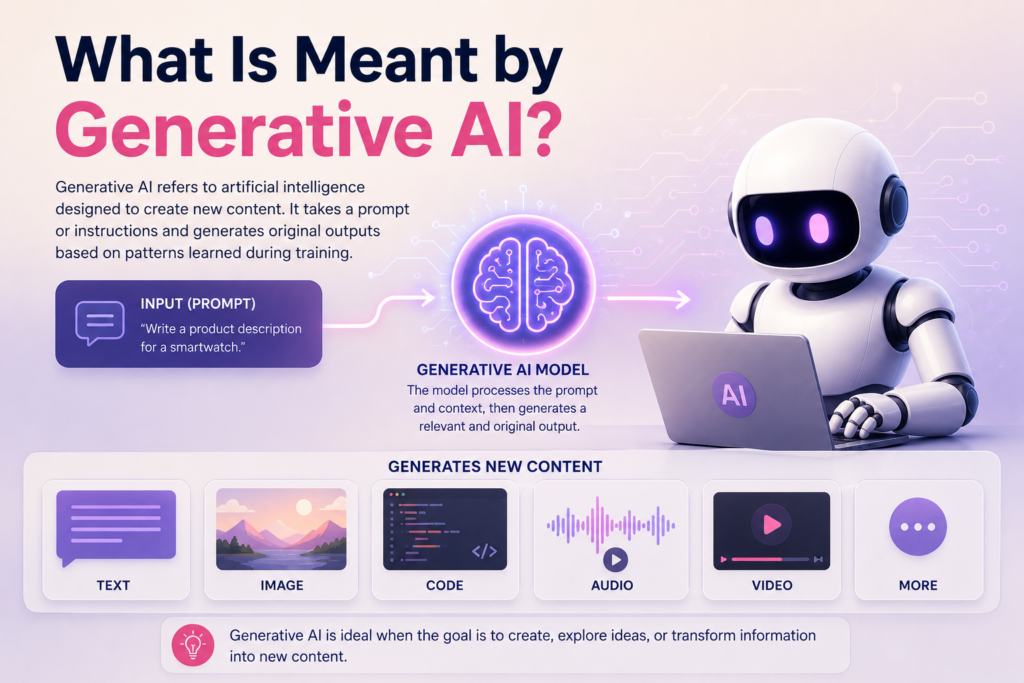
Generative AI refers to artificial intelligence designed to create new content. Depending on the model, that content can include text, images, audio, video, software code, or other outputs.
Most generative AI applications work by receiving a prompt, instruction, or contextual information from the user. The underlying model then produces an output based on patterns learned during training.
For example, you might ask generative AI to write an email for your customers. The system can produce several versions based on your instructions, tone, and supplied information.
Generative AI is therefore especially useful when the desired outcome involves creating or transforming information. Common applications include writing, summarization, brainstorming, translation, coding, image generation, and content creation.
How Does Generative AI Work?
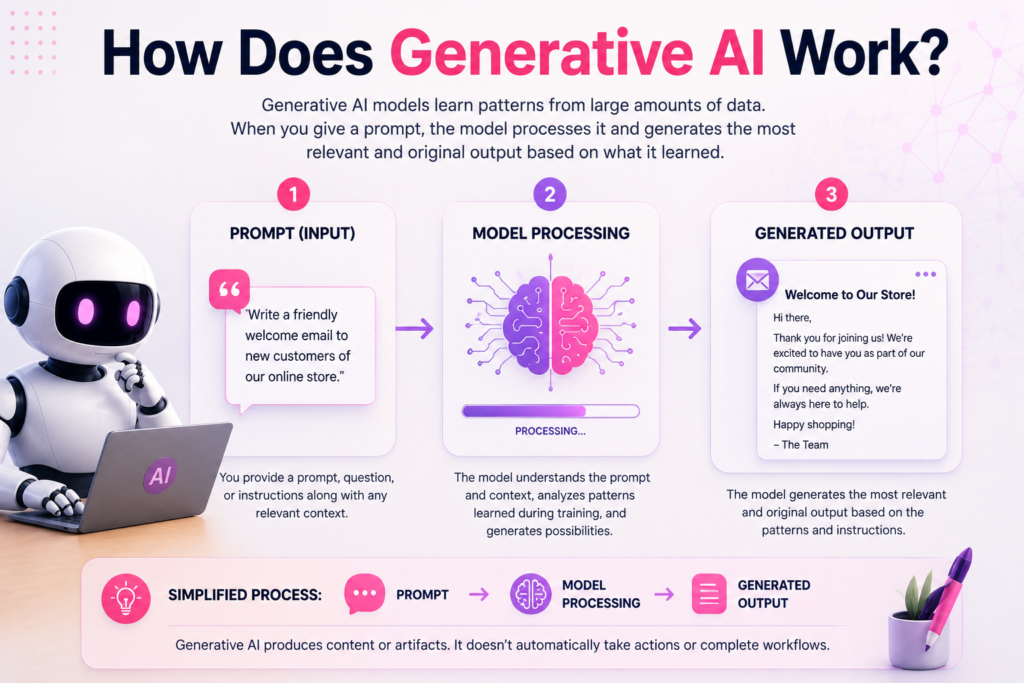
Generative AI models learn patterns and relationships from large datasets during training. Foundation models can subsequently support many different applications across language, images, audio, and other forms of content.
When someone provides a prompt, the model processes the request and available context. It then generates an output that statistically fits the learned patterns and instructions.
A simplified process looks like this:
Prompt → Model Processing → Generated Output
The important point is that generative AI primarily produces an answer or artifact. It does not necessarily manage the complete workflow required to accomplish a larger objective.
Agentic AI vs Generative AI: Key Differences
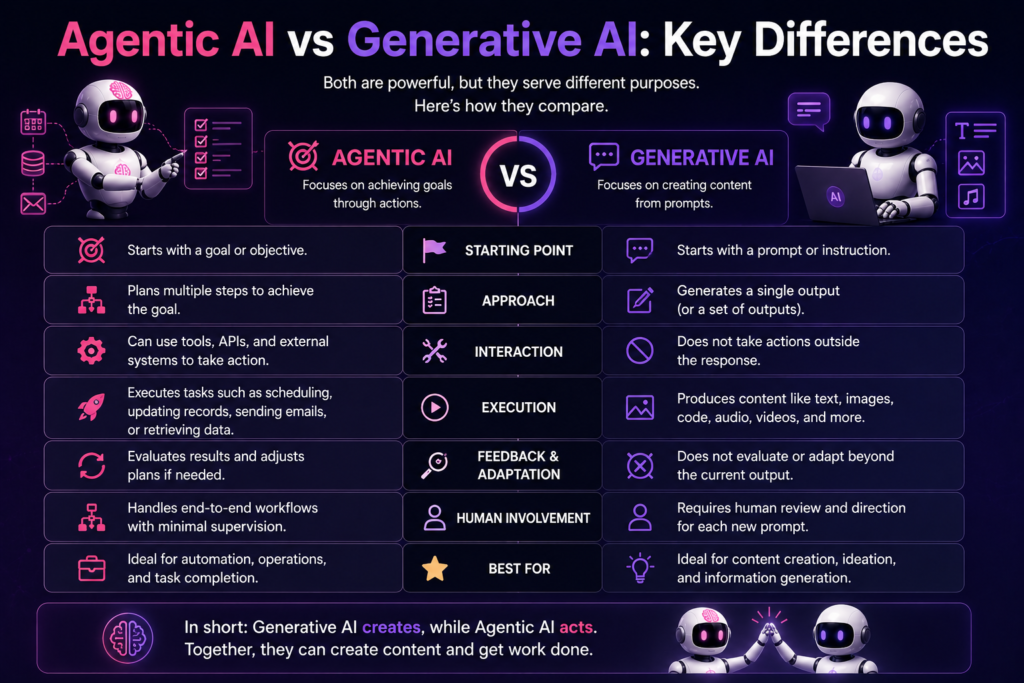
The biggest difference between these technologies involves their primary purpose. Generative AI creates content, while agentic AI focuses on accomplishing goals through actions.
Generative AI generally starts with a prompt and produces an output for someone to review or use. Agentic AI can start with a broader objective and determine several steps required for completion.
Agentic systems can also interact with approved tools and APIs. This capability allows them to update records, retrieve information, schedule activities, or perform other permitted actions.
Generative AI can certainly support these workflows, especially when content needs creating. However, the broader planning and execution process belongs to the agentic system.
Another important distinction involves autonomy. Generative applications commonly keep humans directly involved throughout the process. Agentic systems can operate with greater independence when appropriate permissions and safeguards exist.
These technologies should not necessarily be viewed as competitors. Agentic systems can use generative AI models as one component of their overall architecture.
Agentic AI vs Generative AI: A Simple Example
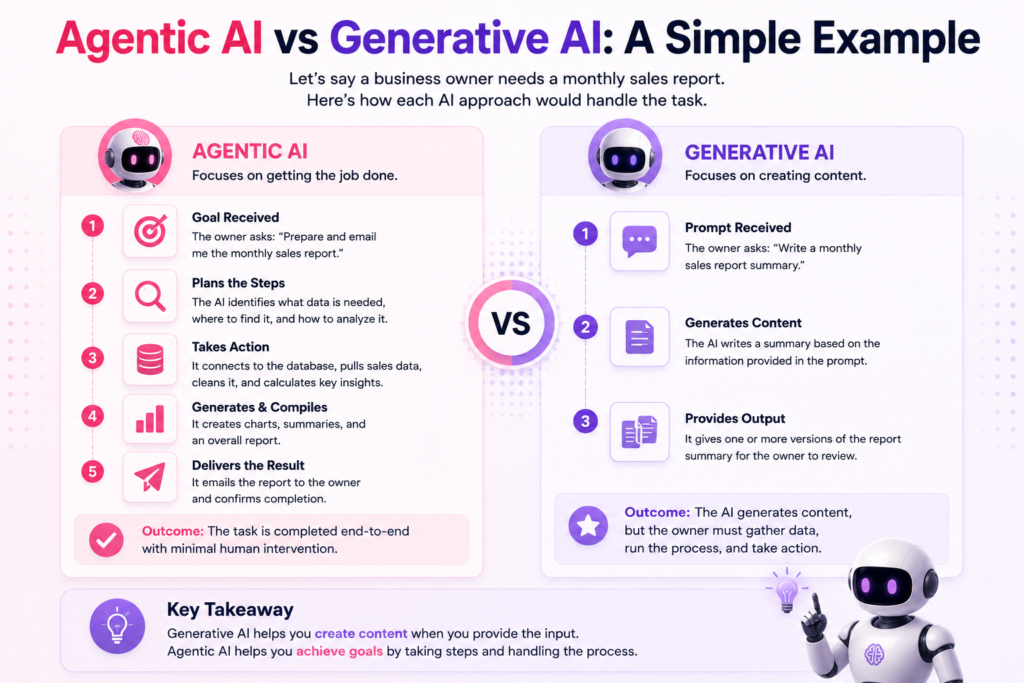
Consider a company’s customer support department as an example. A generative AI application could create a response to a customer’s question. The support employee could then review and send that response manually.
An agentic AI system could potentially handle a broader workflow instead. It could examine the customer’s request, retrieve relevant account information, determine the appropriate action, and update approved systems.
The system might then generate a response and send it after meeting predetermined conditions. If the situation falls outside those conditions, it could escalate the case to an employee.
This example highlights the central distinction clearly.
Generative AI helps create the response. Agentic AI can manage the workflow surrounding that response.
How Does Agentic AI Differ From Traditional AI?
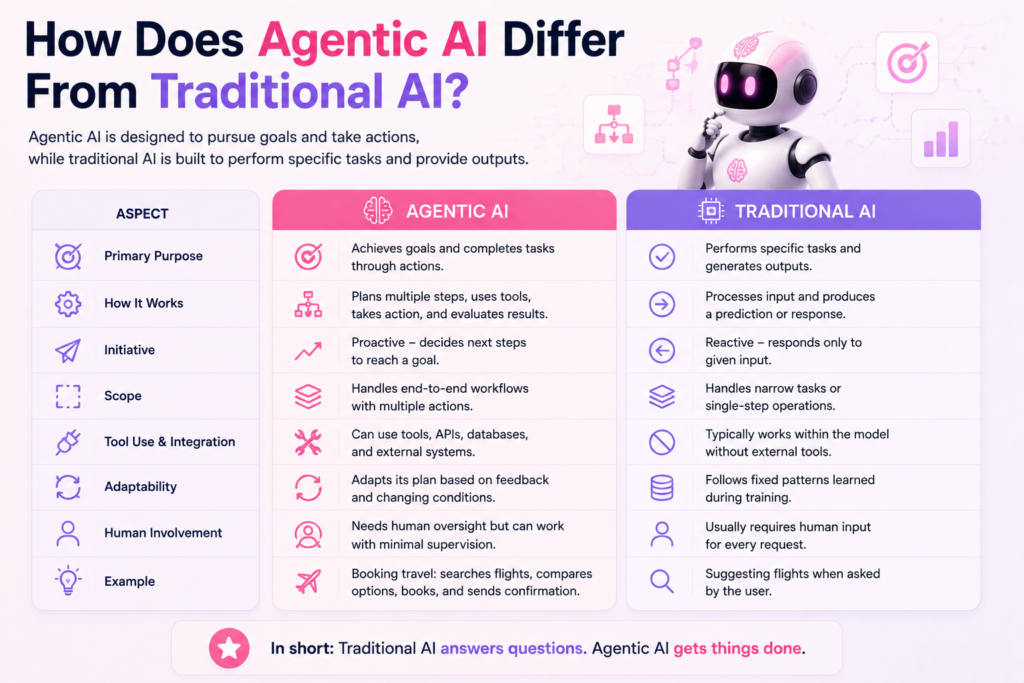
Traditional AI has historically focused on specific tasks such as classification, prediction, detection, or recommendation. Examples include spam filters, recommendation engines, and image classification systems.
These systems can be extremely effective without possessing broad autonomy. They typically receive defined inputs and produce outputs according to their particular design.
Agentic AI introduces a more goal-oriented approach to software behavior. Instead of simply predicting an outcome, an agent can decide which actions could help achieve a defined objective.
This does not mean traditional AI is outdated or ineffective. Many traditional AI systems remain better suited for predictable, narrow tasks.
The difference mainly concerns agency, autonomy, context, and action rather than simply intelligence.
How Is Agentic AI Different From Earlier Forms of AI?
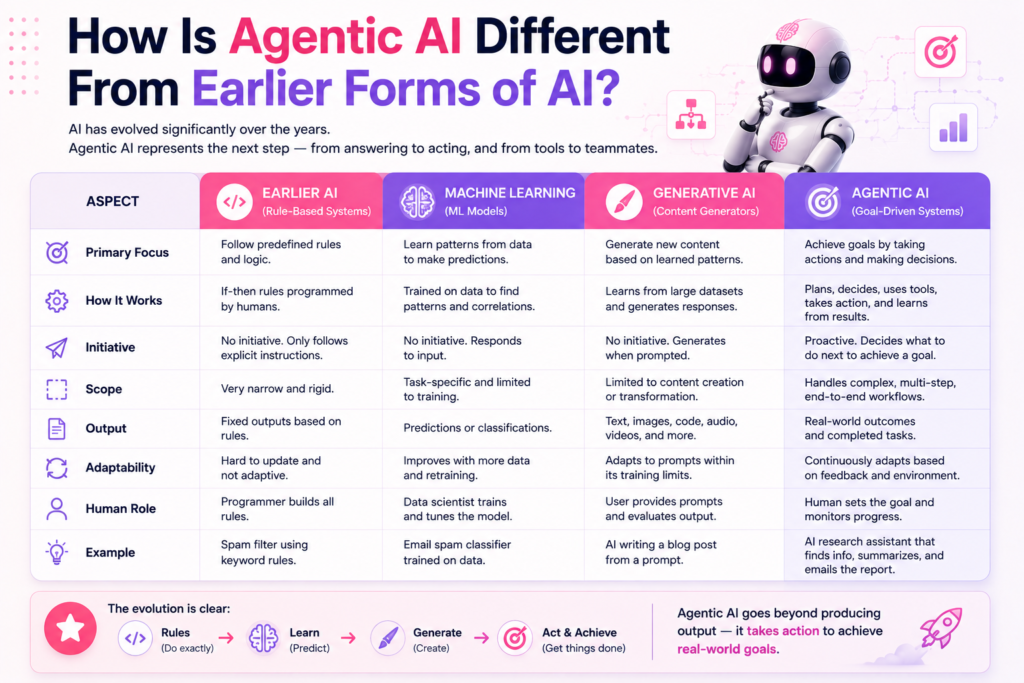
AI has developed through several important stages, although these stages overlap considerably. Earlier systems often relied on explicit rules, statistical methods, machine learning, or specialized predictive models.
Deep learning expanded AI capabilities across areas such as vision, language, speech, and complex pattern recognition. Foundation models later provided broader capabilities across numerous tasks and applications.
Generative AI expanded those capabilities by producing increasingly sophisticated content from natural-language instructions.
Agentic AI builds another layer around these capabilities by focusing on goals, planning, tools, and actions. Modern agents can combine multiple technologies rather than depending on one particular AI model.
Therefore, agentic AI should not simply be described as the next replacement for every previous AI approach. Instead, it represents an approach for building systems capable of more autonomous and goal-directed workflows.
How Is Generative AI Different From Earlier Forms of AI?
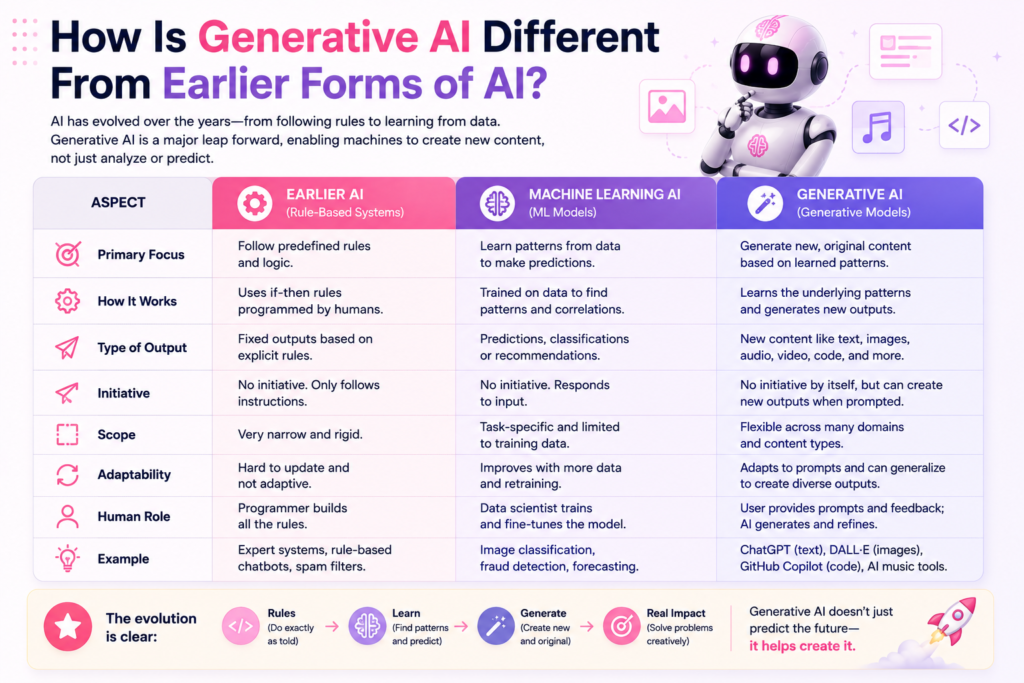
Earlier AI systems often concentrated on identifying patterns, making predictions, or classifying information. Generative AI introduced powerful capabilities for creating new content based on learned patterns.
For example, traditional AI might determine whether an email belongs to a spam category. Generative AI could instead create a professional response to that email.
Traditional AI might predict customer demand based on historical information. Generative AI could produce a report explaining those trends in natural language.
This difference explains why generative AI became especially valuable for creative and knowledge-based work. It allows users to interact with powerful models through natural-language instructions.
However, generated content can still contain inaccurate information. Human review remains important when outputs affect important business, financial, legal, or operational decisions.
When to Use Agentic AI vs Generative AI
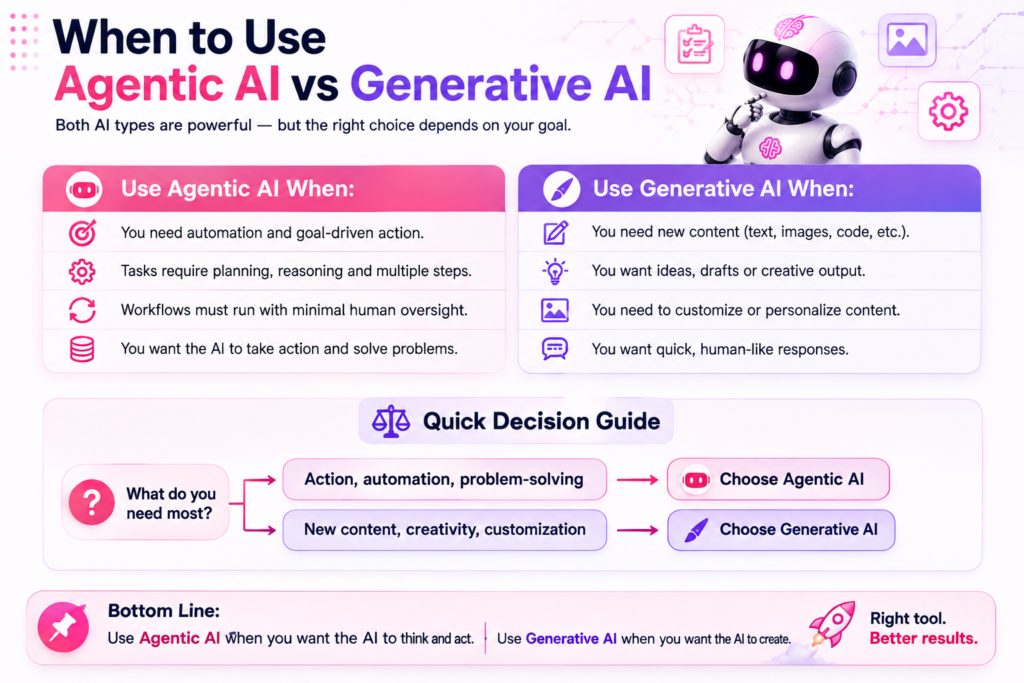
Choosing between agentic AI and generative AI should depend on the task you want technology to perform.
Generative AI is generally appropriate when your primary requirement involves creating content or transforming information. Writing articles, summarizing documents, creating images, generating code, and brainstorming ideas are common examples.
Agentic AI becomes more useful when the objective involves multiple steps and real actions. Scheduling appointments, coordinating workflows, updating systems, monitoring processes, and handling complex operational tasks can benefit from agentic approaches.
Consider these simple guidelines:
Choose generative AI when you need to create.
Choose agentic AI when you need to accomplish.
Consider both when you need creation combined with execution.
For example, a marketing workflow could use an agent to research topics, organize tasks, and monitor progress. Generative AI could then create content drafts, social posts, summaries, or campaign ideas within that workflow.
Can Agentic AI and Generative AI Work Together?
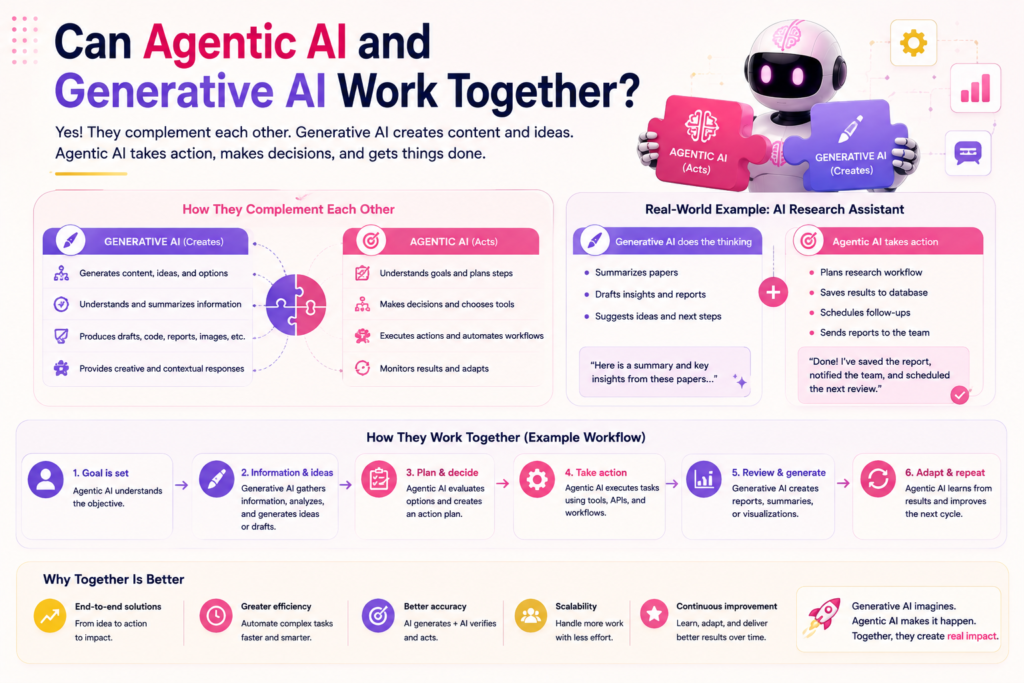
Yes, and this relationship is one of the most important concepts to understand. Agentic AI and generative AI are often complementary rather than competing technologies.
An agent can use a generative model for writing, summarization, reasoning, or other content-related tasks. The agent can then use tools and integrations to perform actions based on those outputs.
For example, an AI marketing agent could research competitors and identify content opportunities. It could then use generative AI to create a content brief and initial article draft.
Afterward, the agent could organize the draft, send it for human approval, and update a project management system. The exact actions would depend on available integrations and permissions.
This combination allows businesses to move beyond simple content generation toward more complete AI-assisted workflows.
Benefits and Limitations of Both Technologies
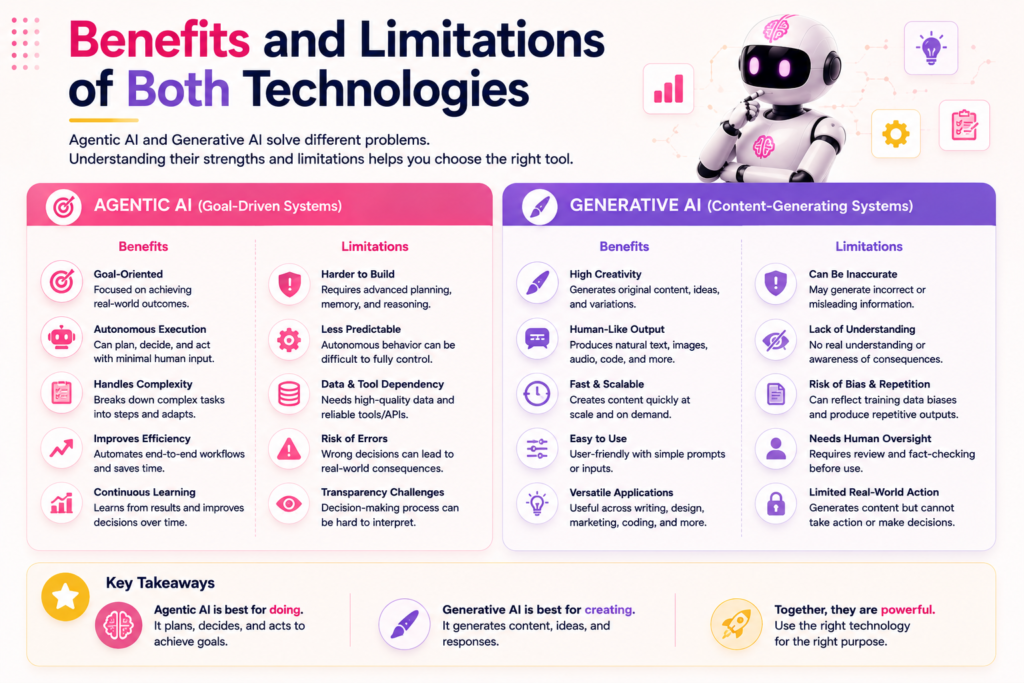
Generative AI can significantly improve productivity by helping people create content faster. It can support brainstorming, writing, coding, research, summarization, and many creative tasks.
However, generative systems can produce incorrect or misleading information. Their outputs therefore require appropriate verification, especially for sensitive or high-impact decisions.
Agentic AI can automate complex workflows and reduce repetitive manual work. It can also coordinate multiple actions that would otherwise require human involvement.
However, greater autonomy introduces additional risks and responsibilities. Poorly defined permissions, inaccurate decisions, weak safeguards, or excessive tool access can create operational and security problems.
For this reason, organizations should define clear objectives, permissions, monitoring processes, and human escalation paths before deploying autonomous systems.
Which Technology Should You Choose?
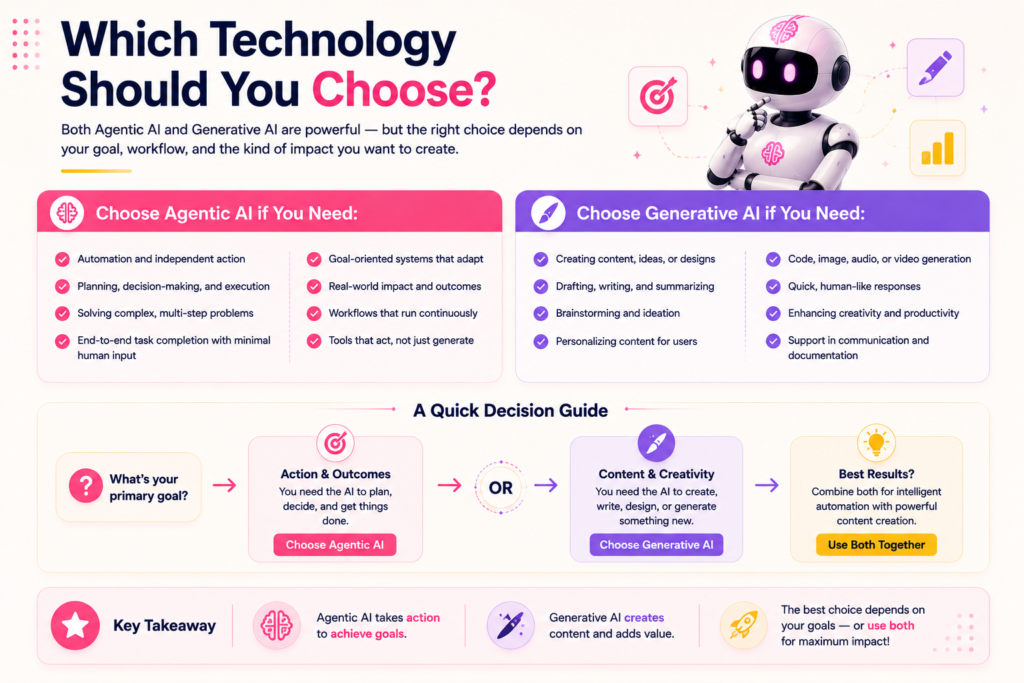
There is no universal winner in the agentic AI vs generative AI comparison. The better choice depends entirely on what you want your AI system to accomplish.
Choose generative AI when your primary requirement involves producing useful content. Choose agentic AI when your primary requirement involves completing multi-step tasks.
Businesses should also consider combining both technologies when their workflows require creation and execution. This approach can provide powerful capabilities while keeping appropriate human oversight.
As AI technology continues evolving, the distinction between generation and action may become less visible. Modern AI systems increasingly combine language models, tools, memory, retrieval, reasoning, and workflow orchestration.
Understanding these differences can help businesses evaluate AI technologies more realistically. Instead of choosing based solely on current trends, organizations can select systems according to their actual goals and operational requirements.
The Future of Agentic AI and Generative AI
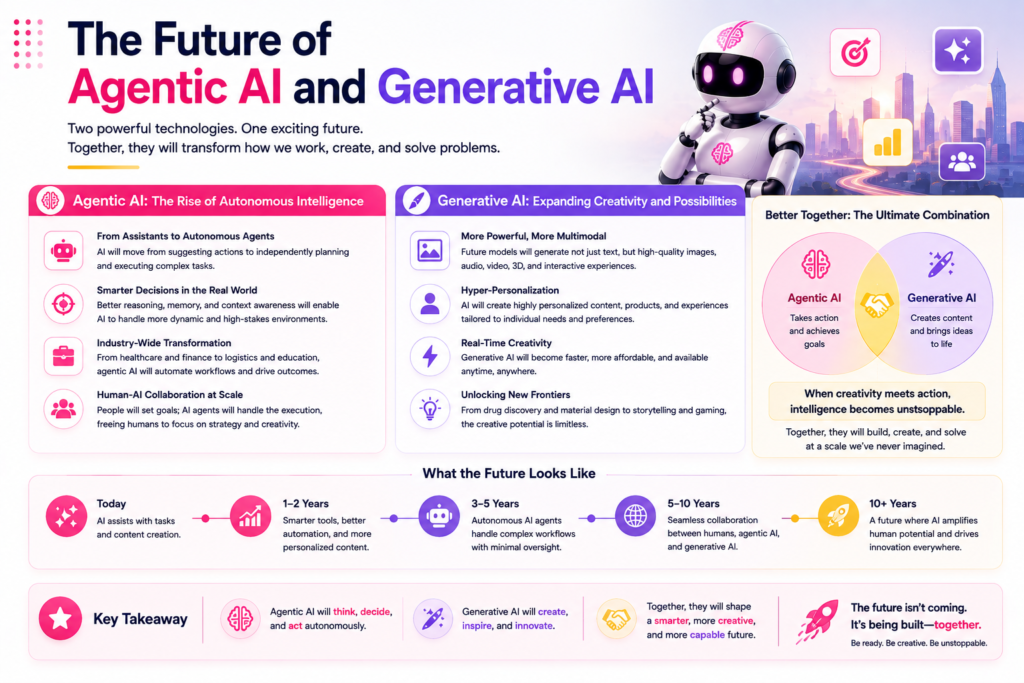
The future of AI will likely involve greater cooperation between generative and agentic capabilities. Generative models can provide powerful reasoning and creation capabilities within larger agentic systems.
Meanwhile, agentic systems can provide the planning, tool usage, and execution needed for more complex workflows. This combination could transform how people interact with business software, digital services, and automated systems.
However, greater autonomy will also require stronger security, governance, monitoring, and human oversight. The goal should not be giving AI unlimited control, but providing useful autonomy within clearly defined boundaries.
Ultimately, understanding agentic AI vs generative AI helps businesses choose technology based on real requirements. Generative AI is strongest when content creation matters most, while agentic AI becomes valuable when completing goals requires planning and action.